Pharma bets on PD-1/VEGF bispecifics: Is lung cancer the wrong target?

Decision brief
Answer first · skim in under a minute
While many drugmakers are focused on lung cancer for PD-1/VEGF bispecifics, emerging evidence shows the liver may offer higher value. This analysis covers the mechanism, key players, and strategic implications for pharma teams.
Key questions this brief answers
- What is the VEGF PD-1 bispecific mechanism?
- Which companies are leading in PD-1/VEGF bispecifics?
- Why might liver cancer be a better target than lung cancer for this class?
Contents8 sections
Pharma bets on PD-1/VEGF bispecifics: Is lung cancer the wrong target?
While many drugmakers are focused on lung cancer for PD-1/VEGF bispecifics, emerging evidence shows the liver may offer higher value. This analysis covers the mechanism, key players, and strategic implications for pharma teams.
Key takeaways
- PD-1/VEGF bispecifics are a major pharma bet, but the rush to lung cancer may be misguided given emerging evidence pointing to hepatocellular carcinoma as a potentially higher-value indication.
- Key players include Merck, BMS, Roche, AstraZeneca, and Chinese biotechs, with critical trial readouts in both lung and liver indications expected through 2026-2027.
- Investors and BD teams should monitor upcoming regulatory decisions from the FDA, particularly for liver cancer indications where the dual mechanism may offer the greatest advantage.
What is the VEGF PD-1 bispecific mechanism?
Two punches, one glove. That is the simple logic behind the PD-1/VEGF bispecific class, which fuses checkpoint blockade with anti-angiogenesis to hit tumors from two angles. The mechanism is well understood: VEGF promotes tumor vascular growth but also establishes an immunosuppressive microenvironment by impairing dendritic cell maturation, promoting regulatory T-cells, inhibiting effector T-cell infiltration, and up-regulating checkpoints such as PD-1/PD-L1. As one recent analysis notes, developing a bispecific antibody simultaneously targeting PD-1/PD-L1 and VEGF is considered one of the most effective strategies to improve overall efficacy (PMC).
Is lung cancer the wrong target?
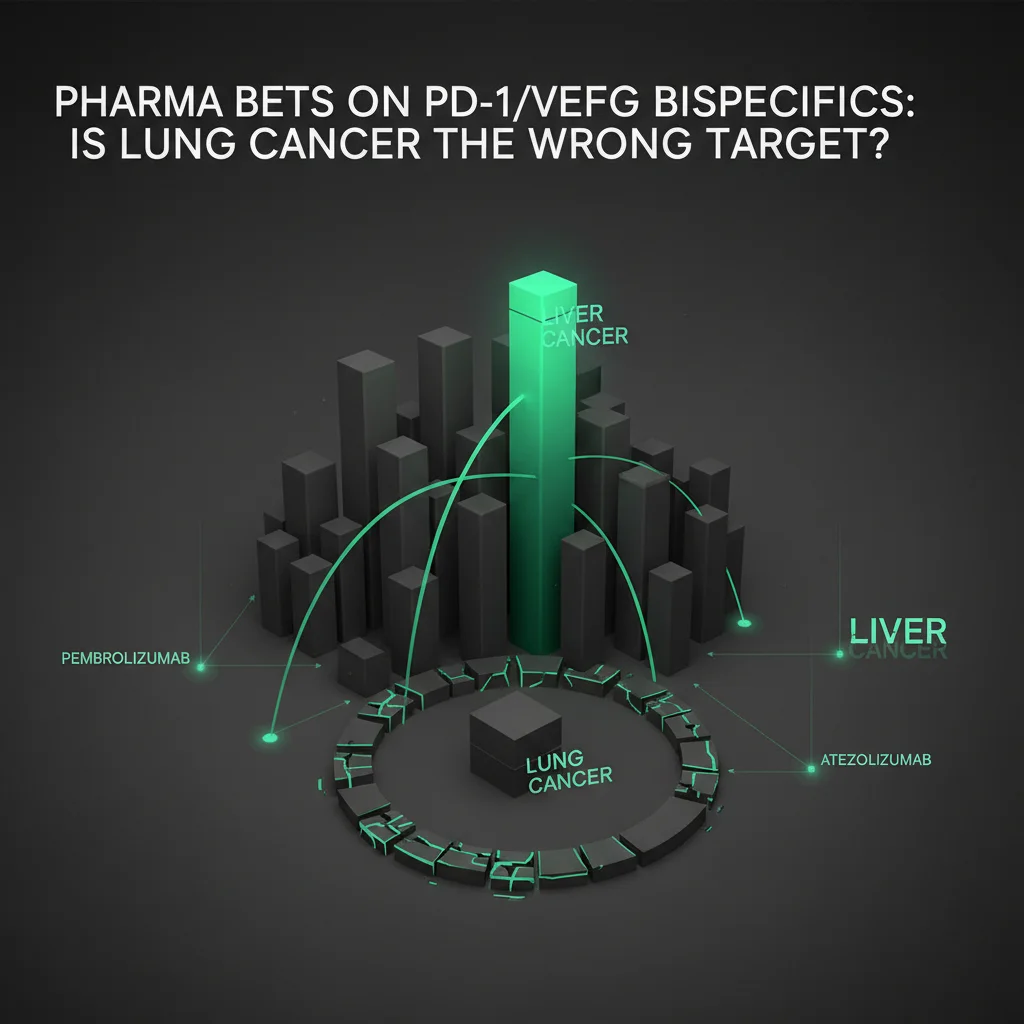
Yet the question hanging over the field is whether companies are chasing the wrong target. While many drugmakers are focused on non-small cell lung cancer (NSCLC), evidence shows the liver may be a better bet. The dual mechanism has particular theoretical appeal in hepatocellular carcinoma, where VEGF-driven angiogenesis and PD-1-mediated immune evasion are both prominent. A 2026 pathways pilot with systematic review, evidence synthesis and economic model evaluated treatments for metastatic NSCLC (PubMed), but the data emerging from liver-focused programs suggests the highest value for PD-(L)1×VEGF bispecifics may lie outside lung cancer entirely.
The regulatory landscape underscores the continued importance of PD-1 blockade while bispecifics advance. The FDA has approved subcutaneous formulations of established checkpoint inhibitors, including KEYTRUDA QLEX, a combination of pembrolizumab and berahyaluronidase alfa indicated for melanoma and NSCLC (FDA label), and OPDIVO QVANTIG, a combination of nivolumab and hyaluronidase indicated for renal cell carcinoma and melanoma (FDA label). These approvals signal that the PD-1 backbone remains a pillar of oncology, but bispecifics represent the next frontier.
For investors and BD teams, the divergence between lung and liver focus creates potential arbitrage opportunities. Assets with strong liver cancer data may be undervalued relative to the crowded lung cancer pipeline. The recent systematic review and meta-analysis on pembrolizumab in advanced gastric cancer (PubMed) and the study evaluating prior nivolumab on taxane plus ramucirumab outcomes in advanced gastric cancer (PubMed) further highlight the broadening scope of PD-1-based combinations beyond lung cancer.
This is Big pharma news today that should reshape how dealmakers and analysts evaluate the bispecific pipeline. The conventional wisdom has been to follow the lung cancer indication, but the evidence increasingly points elsewhere.
What are the implications for pharma teams?
For BD teams, this means re-evaluating licensing and partnership strategies. Assets with strong hepatocellular carcinoma data may be undervalued as the market fixates on lung cancer readouts. The data emerging from liver-focused programs will be critical for determining the class's true value proposition.
For investors, the divergence creates specific catalyst-driven opportunities. Teams should watch for FDA decisions in 2026-2027, particularly for liver cancer indications. The recent FDA approvals of subcutaneous PD-1 formulations underscore that the checkpoint blockade market remains dynamic, but bispecifics represent the next frontier for combination therapy.
Pharma teams should also monitor the evolving competitive landscape. Major pharma companies like Bristol Myers Squibb, Roche, and AstraZeneca have programs in this space. The pipeline has attracted broad interest, though some candidates have faced clinical setbacks.
Frequently Asked Questions
What is the VEGF PD-1 bispecific mechanism?
PD-1/VEGF bispecifics combine checkpoint blockade with anti-angiogenesis in a single molecule. VEGF promotes tumor vascular growth but also suppresses the immune system by impairing dendritic cell maturation, promoting regulatory T-cells, and up-regulating PD-1/PD-L1. The bispecific aims to hit both pathways simultaneously.
Which companies are leading in PD-1/VEGF bispecifics?
Key players include major pharma companies like Bristol Myers Squibb, Roche, and AstraZeneca, alongside Chinese biotechs. The field has attracted broad interest across the industry, with multiple programs in clinical development.
Why might liver cancer be a better target than lung cancer for this class?
In hepatocellular carcinoma, both VEGF-driven angiogenesis and PD-1-mediated immune evasion are prominent, making the dual mechanism particularly relevant. While lung cancer has been the initial focus for many developers, emerging evidence suggests the liver may offer higher clinical and commercial value.
Related profiles
Related coverage
Regulatory catalyst tracker
Track PDUFA dates, approval milestones, and label updates for pembrolizumab.
Unlock full calendar →Investor brief
Download a one-page summary of regulatory impact and competitive context.
Explore drug hub →Entity graph
Continue Exploring
Open the drugs, companies, and topics behind this story.
Sources & references 1 primary sources
Sources verified at publication. See our editorial policy and data sources.
This article follows our editorial standards. Report a correction via editorial contact.