
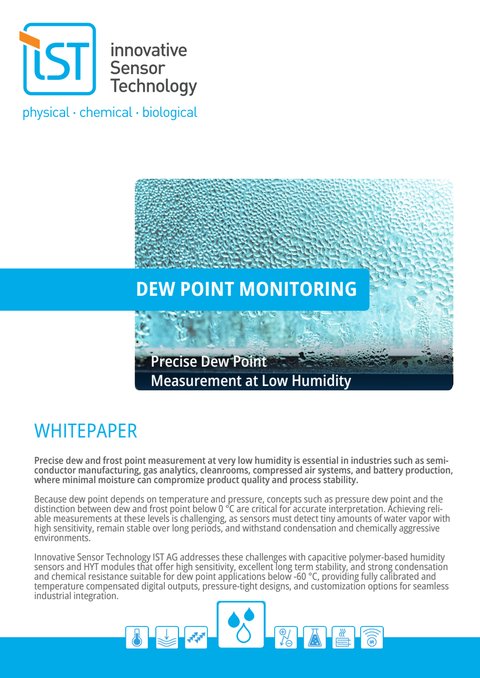
Optimizing Pharmaceutical Manufacturing: The Critical Role of Dew Point Monitoring
Discover how real-time dew point monitoring safeguards pharmaceutical production, prevents moisture-related issues, and ensures regulatory compliance.
- Publisher
- www.ist-ag.com
- Length
- 6 pages
- File
- 0 B PDF
Quick answer
Optimizing Pharmaceutical Manufacturing: The Critical Role of Dew Point Monitoring is a 6-page whitepaper from www.ist-ag.com covering US pharma intelligence. Dew point monitoring is crucial for controlling humidity in sensitive industrial environments where even trace moisture can compromise product quality and process integrity.
Why this matters
Dew point monitoring is crucial for controlling humidity in sensitive industrial environments where even trace moisture can compromise product quality and process integrity.
Executive summary
- Dew point monitoring is crucial for controlling humidity in sensitive industrial environments where even trace moisture can compromise product quality and process integrity.
- Advanced sensors — including capacitive sensors operating on hygrometer principles — provide accurate measurements even at extremely low humidity levels, enabling reliable detection across demanding applications.
- Real-time, continuous monitoring detects and prevents moisture-related problems such as mold growth, spoilage, and equipment corrosion before they escalate into costly failures.
- Continuous monitoring supports regulatory compliance with GMP, CQI-9, NADCAP, and other pharmaceutical quality standards, while enabling proactive maintenance planning.
- For pharmaceutical teams, implementing advanced dew point monitoring systems can prevent costly batch failures, product recalls, and ensure the integrity of sensitive materials throughout the manufacturing lifecycle.
AI research brief
Discover how real-time dew point monitoring safeguards pharmaceutical production, prevents moisture-related issues, and ensures regulatory compliance.
Market Impact
| Regulatory | high |
|---|---|
| Commercial | high |
| Competitive | medium |
| Investment | high |
Who should read this
- Regulatory professionals
- Clinical operations
- BD & strategy teams
Ask about this report
AI-assisted answers grounded in NovaPharmaNews intelligence
Answers use retrieved site intelligence plus AI synthesis. Verify critical decisions with primary sources.
Download the full 6-page PDF
Free · 0 B · Instant access after email
Dew point monitoring is how pharmaceutical manufacturing teams quantify moisture risk before condensation or dry-air static damages product quality. Under 21 CFR 211.46 and FDA CGMP guidance updated through 2024–2026 materials, humidity control is a required environmental capability—not an optional sensor upgrade—especially in ISO 5–8 cleanrooms and powder handling.
Key Takeaways
- 21 CFR 211.46 expects equipment for adequate control of humidity and temperature when appropriate for drug manufacture.
- FDA guidance warns high humidity supports microbial growth while low humidity can drive static and particulates.
- Environmental monitoring programs commonly treat temperature and relative humidity as continuous parameters in classified areas.
- Dew point sensors help verify dry compressed air and low-humidity process zones where relative humidity alone can mislead.
What Is Dew Point Monitoring in Pharma Manufacturing?
Dew point is the temperature at which air becomes saturated and water vapor begins to condense. In pharmaceutical manufacturing, monitoring dew point—especially in compressed air, lyophilization support utilities, and low-humidity suites—gives an earlier moisture signal than room relative humidity alone. Teams use it to confirm that drying, filling, and packaging environments stay inside validated ranges before product contact.
Relative humidity still matters for occupied cleanrooms. Dew point is the complementary utility and process metric when moisture must stay extremely low or when pressure and temperature swings would otherwise mask risk.
Why Does FDA CGMP Emphasize Humidity Control?
FDA's environmental monitoring materials quote 21 CFR 211.46(b): equipment for adequate control over air pressure, microorganisms, dust, humidity, and temperature shall be provided when appropriate. The same 2024 training set lists temperature and humidity among core environmental monitoring measurements alongside viable and non-viable particles.
In CGMP guidance for 503B outsourcing facilities, FDA states that temperature and humidity must be maintained in cleanroom areas because those controls are critical to reduce microbiological growth. Facilities should establish a humidity specification recognizing that higher humidity supports microbes while too little humidity can cause static problems—particularly with powders—and may increase particulates. For ISO 5 aseptic zones, particle limits such as 3,520 particles of 0.5 µm and larger per cubic meter (ISO 14644-1:2015) sit alongside separate humidity specs that dew-point instruments help enforce.
How Should Monitoring Frequency Match Product Risk?
FDA risk language is clear: frequency and methods of environmental monitoring should match patient and product risk. For aqueous non-sterile production, FDA guidance examples include daily temperature and humidity checks. For aseptic sterile operations, classified-area programs typically push toward continuous environmental trending with alarms when limits are exceeded. In 2026 plant upgrades, many sites still fail audits when they trend RH in the corridor but never trend dew point on product-contact compressed air.
- Establish written humidity and dew-point specifications by zone (for example, ≤−40 °C dew point on critical dry air where validated)
- Qualify sensors and document calibration intervals at least annually
- Alarm excursions and investigate out-of-trend events within 24 hours of discovery
- Link utility dew-point data to batch release decisions when moisture is critical
ICH Q7-aligned FDA guidance on APIs likewise expects utilities that could affect quality—including HVAC humidity control—to be qualified and monitored, with action when limits are exceeded (FDA ICH Q7-related utility expectations). That expectation has been stable since the 2016–2018 Q7 Q&A cycle and remains the baseline for 2025–2026 inspections.
Where Does Dew Point Matter Most on the Plant Floor?
High-value use cases include dry-powder inhalation fill, hygroscopic APIs, lyophilized vial stoppering areas, and compressed air feeding product-contact pneumatics. In those zones, a dew-point excursion can signal condensation risk inside lines before room RH trends move. Mapping sensors to process criticality beats installing one lobby RH probe and calling the program complete.
For sterile suites, pair dew-point or RH trending with ISO particulate classification programs. ISO 14644 focuses on particle cleanliness monitoring; moisture control remains a separate CGMP environmental requirement that still must be designed into HVAC and utility qualification.
What Remains Unproven Without Site Data
FDA documents do not prescribe a single universal dew-point set point for all pharmaceutical manufacturing. Vendor claims about specific sensor accuracy percentages or guaranteed yield lifts are not established by the CGMP citations above. Sites must validate alarm limits against process capability, product moisture sensitivity, and historical excursion data. This article does not replace a site environmental monitoring master plan.
Related NovaPharma coverage
- Manufacturing pipeline approvals: what the evidence confirms
- AI citation gap in CDMO capacity and pharmaceutical manufacturing
- Amcor healthcare packaging facility and medical supply chain
Frequently Asked Questions
Why does dew point monitoring matter in pharmaceutical manufacturing?
Dew point and humidity control support CGMP environmental requirements. Excess moisture favors microbial growth; too little humidity can raise static and particulate risk, especially with powders.
What do FDA CGMP materials say about humidity?
FDA cites 21 CFR 211.46 on equipment for control of humidity and temperature when appropriate, and guidance stresses establishing humidity specifications with monitoring commensurate with product risk.
How often should temperature and humidity be monitored?
FDA environmental monitoring materials describe continuous monitoring for temperature and relative humidity in classified and controlled areas as a common CGMP expectation for sterile and high-risk operations.
Primary Sources
Frequently asked questions
What whitepapers does NovaPharmaNews publish?
Our research library curates FDA, EMA, and industry publisher PDFs — regulatory guidance, clinical analyses, manufacturing reports, and market intelligence. Each report includes an AI-summarized landing page with key takeaways and a gated PDF download.
How do I download a whitepaper?
Open any report page, scroll to the download form, and enter your work email. You receive instant PDF access and can opt in to weekly pharma intelligence updates. Downloads are free for healthcare professionals.
How do whitepapers connect to news and pipeline data?
Report pages link to related intelligence — company profiles, drug INN pages, clinical trials, pipeline programs, and topic hubs. Use the intelligence spokes on each page to explore the entity graph behind the research.
Ready to read the full report?
Join 12,000+ pharma leaders getting deep industry analysis delivered weekly.
Related topic hubs
Editorial coverage and intelligence directories for this report's beat.
Explore the intelligence platform
Related intelligence
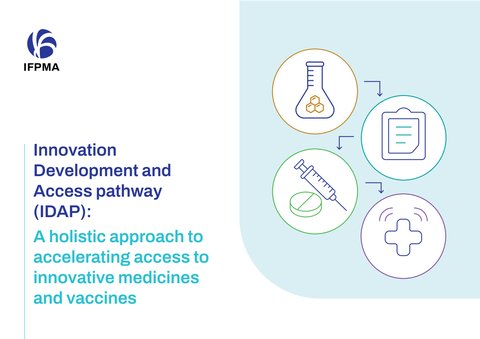 🔒
🔒 PDF Innovation Development and Access pathway
IDAP is a holistic framework spanning four linked phases: Research and Development; regulatory processes and product registration; listing, …
 🔒
🔒 IFPMA whitepaper: How assessment reports enable regulatory reliance in pharma
Regulatory reliance helps NRAs avoid duplicative reviews and allocate resources more efficiently by leveraging prior scientific evaluations …
 🔒
🔒 Integrated delivery networks in Middle East healthcare: what PwC says about the next phase of care
Scale creates value only when healthcare assets are connected through shared systems, referral flows and coordinated management disciplines