
Institutional Recognition of SoTL in Health Professions Education: Scoping Review for Education
SoTL is inconsistently recognized in promotion and tenure decisions; this scoping review maps how it is defined, operationalized, and rewarded.
- Publisher
- Lara Varpio
- Length
- 20 pages
- File
- 0 B PDF
Quick answer
Institutional Recognition of SoTL in Health Professions Education: Scoping Review for Education is a 20-page whitepaper from Lara Varpio covering US pharma intelligence. SoTL is described with shared core concepts across health professions education literature, but operationalized in varied ways that often blur the distinction between scholarly teaching and SoTL itself.
Why this matters
SoTL is described with shared core concepts across health professions education literature, but operationalized in varied ways that often blur the distinction between scholarly teaching and SoTL itself.
Executive summary
- SoTL is described with shared core concepts across health professions education literature, but operationalized in varied ways that often blur the distinction between scholarly teaching and SoTL itself.
- Promotion and tenure recognition of SoTL activities is inconsistent across HPE institutions, with some organizations strongly supporting SoTL engagement while others largely fail to acknowledge it.
- Institutional Logics framework explains the misalignment: recognition of SoTL varies with the degree of alignment between organizational logics that prioritize research versus teaching.
- The review proposes strategies to increase alignment between institutional values and SoTL contributions, including literature-based distinctions between scholarly teaching, SoTL, and educational research.
AI research brief
SoTL is inconsistently recognized in promotion and tenure decisions; this scoping review maps how it is defined, operationalized, and rewarded.
Market Impact
| Regulatory | high |
|---|---|
| Commercial | high |
| Competitive | medium |
| Investment | high |
Who should read this
- Regulatory professionals
- Clinical operations
- BD & strategy teams
Ask about this report
AI-assisted answers grounded in NovaPharmaNews intelligence
Answers use retrieved site intelligence plus AI synthesis. Verify critical decisions with primary sources.
Download the full 20-page PDF
Free · 0 B · Instant access after email
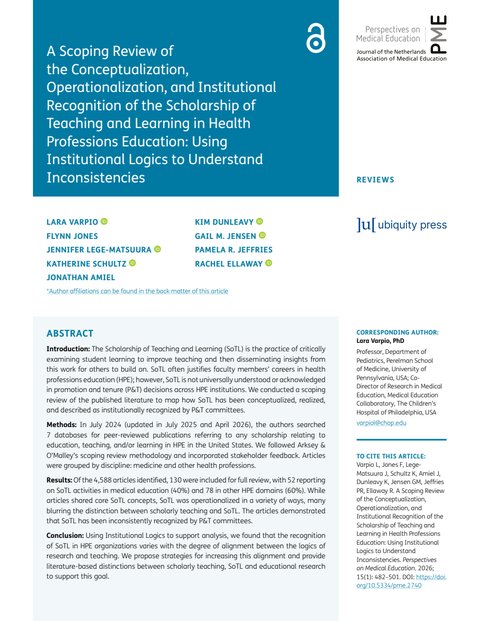
A scoping review of U.S. health professions education literature maps how the Scholarship of Teaching and Learning (SoTL) is conceptualized, operationalized, and recognized in promotion and tenure. Of 4,588 records screened, 130 papers were included—52 in medical education and 78 in other HPE fields—showing inconsistent P&T recognition.
Key Takeaways
- Scoping review (doi:10.5334/pme.2740): 4,588 records → 130 included U.S. HPE papers on SoTL.
- Discipline split: 52 medical education (40%) and 78 other health professions (60%).
- SoTL is often blurred with scholarly teaching; P&T recognition remains inconsistent.
- Pharmacy P&T document analysis found SoTL among the least frequent scholarship criteria (40.5% of schools) versus publications (94.2%) and grants (86.8%).
What question did the SoTL scoping review ask?
Authors searched seven databases for peer-reviewed U.S. health professions education publications on scholarship relating to education, teaching, and/or learning, following Arksey and O’Malley’s scoping review methods (doi:10.5334/pme.2740).
The goal was to map how SoTL is conceptualized, realized, and described as institutionally recognized by promotion and tenure committees—not to produce a single efficacy estimate.
What did the search yield?
Of 4,588 articles identified, 130 were included for full review. Fifty-two reported SoTL activities in medical education (40%) and 78 in other HPE domains (60%).
Articles shared core SoTL concepts—critically examining student learning, improving teaching, and disseminating insights—yet operationalized those ideas in varied ways that often blurred scholarly teaching with SoTL proper.
How inconsistently is SoTL recognized in P&T?
The review concludes SoTL has been inconsistently recognized by P&T committees. Using institutional logics analysis, recognition varied with alignment between research and teaching logics inside organizations.
Authors propose clearer distinctions among scholarly teaching, SoTL, and educational research to improve that alignment.
What do U.S. pharmacy school P&T documents show?
A qualitative analysis of U.S. pharmacy school promotion and tenure guidance found scholarship criteria commonly include publications (94.2%) and grants (86.8%), while SoTL was the least frequently included criterion at 40.5% of schools (PMC8006489).
Even when criteria were “not required,” schools still gave credit for listed scholarship evidence—signaling discretionary rather than standardized SoTL pathways.
What do pharmacy faculty surveys add?
A survey of 643 U.S. pharmacy faculty found most viewed peer-reviewed dissemination from teaching and learning work as SoTL (78–98% across activity types), 74% reported participating in SoTL, and more than 70% strongly agreed SoTL should count in promotion and tenure (ScienceDirect abstract).
Reported barriers included competing time commitments, funding gaps, and limited institutional recognition—consistent with the scoping review’s institutional-logics framing.
What remains unproven?
Neither the scoping review nor the pharmacy document analysis proves that any single P&T template raises educational outcomes. Causal claims that SoTL recognition improves patient-care training quality need dedicated evaluation designs beyond these mapping studies.
Readers should not treat “130 papers” as a census of all global SoTL; the corpus is U.S.-focused peer-reviewed literature meeting the review’s inclusion rules.
Why institutional recognition of SoTL is a talent and quality issue
Health professions schools that ask faculty to innovate in teaching while rewarding only discovery science create a predictable talent squeeze. The scoping review’s institutional-logics frame explains why SoTL stalls: teaching and research logics compete inside the same P&T committee.
Clarifying definitions helps. Scholarly teaching improves one’s own classroom with evidence but may not disseminate. SoTL adds public, peer-critiqued contribution. Educational research may pursue generalizable theory beyond a single course. Collapsing those categories makes dossier review arbitrary.
Pharmacy-school document evidence showing SoTL in only about two in five P&T guides, despite high faculty support for counting SoTL, illustrates the gap between rhetoric and written criteria. Closing that gap is a governance task: update handbooks, train reviewers, and publish example dossiers.
For academic medical centers partnering with industry on educational grants, misaligned P&T rules can quietly kill SoTL projects when junior faculty are told to prioritize NIH-style discovery metrics instead.
Related NovaPharma coverage
Frequently Asked Questions
How many papers did the SoTL scoping review include?
After screening 4,588 records, the authors included 130 U.S. health professions education papers for full review.
Is SoTL consistently credited in promotion and tenure?
No. The scoping review found inconsistent P&T recognition, and a pharmacy-school document study found SoTL listed in only 40.5% of P&T guidance documents.
How is SoTL defined in this literature?
SoTL is generally the practice of critically examining student learning to improve teaching and disseminating those insights so others can build on them, distinct from undocumented scholarly teaching.
Primary Sources
Frequently asked questions
What whitepapers does NovaPharmaNews publish?
Our research library curates FDA, EMA, and industry publisher PDFs — regulatory guidance, clinical analyses, manufacturing reports, and market intelligence. Each report includes an AI-summarized landing page with key takeaways and a gated PDF download.
How do I download a whitepaper?
Open any report page, scroll to the download form, and enter your work email. You receive instant PDF access and can opt in to weekly pharma intelligence updates. Downloads are free for healthcare professionals.
How do whitepapers connect to news and pipeline data?
Report pages link to related intelligence — company profiles, drug INN pages, clinical trials, pipeline programs, and topic hubs. Use the intelligence spokes on each page to explore the entity graph behind the research.
Ready to read the full report?
Join 12,000+ pharma leaders getting deep industry analysis delivered weekly.
Related topic hubs
Editorial coverage and intelligence directories for this report's beat.
Explore the intelligence platform
Related intelligence
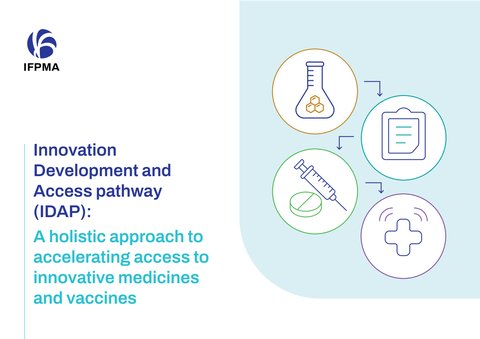 🔒
🔒 PDF Innovation Development and Access pathway
IDAP is a holistic framework spanning four linked phases: Research and Development; regulatory processes and product registration; listing, …
 🔒
🔒 IFPMA whitepaper: How assessment reports enable regulatory reliance in pharma
Regulatory reliance helps NRAs avoid duplicative reviews and allocate resources more efficiently by leveraging prior scientific evaluations …
 🔒
🔒 Integrated delivery networks in Middle East healthcare: what PwC says about the next phase of care
Scale creates value only when healthcare assets are connected through shared systems, referral flows and coordinated management disciplines