
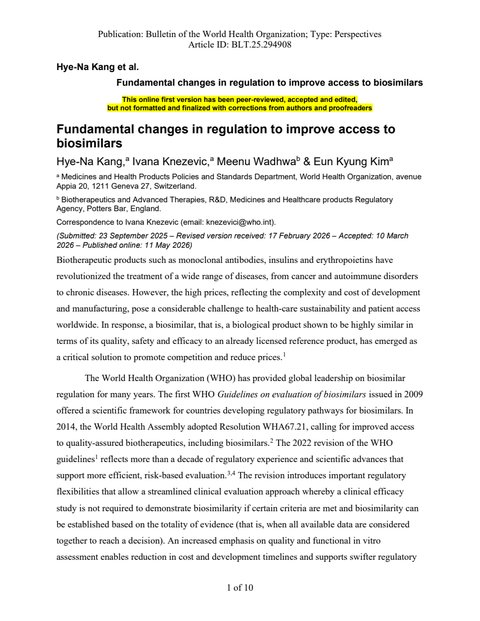
WHO Revised Biosimilar Guidelines: Streamlined Regulation for Improved Global Access
WHO's 2022 revised biosimilar guidelines reduce clinical efficacy requirements, enabling faster, lower-cost approvals and improved access, especially in low
- Publisher
- SELLECK, Kaylene Eleanor
- Length
- 10 pages
- File
- 0 B PDF
Quick answer
WHO Revised Biosimilar Guidelines: Streamlined Regulation for Improved Global Access is a 10-page whitepaper from SELLECK, Kaylene Eleanor covering US pharma intelligence. WHO's 2022 revised guidelines eliminate the need for mandatory clinical efficacy studies for biosimilars when strong analytical and pharmacokinetic data demonstrate similarity.
Research library Data sources More from SELLECK, Kaylene Eleanor
Why this matters
WHO's 2022 revised guidelines eliminate the need for mandatory clinical efficacy studies for biosimilars when strong analytical and pharmacokinetic data demonstrate similarity.
Executive summary
- WHO's 2022 revised guidelines eliminate the need for mandatory clinical efficacy studies for biosimilars when strong analytical and pharmacokinetic data demonstrate similarity.
- The shift reduces development costs and accelerates regulatory approval, particularly benefiting low- and middle-income countries.
- Strong pharmacovigilance and post-marketing surveillance are critical to mitigate risks from streamlined approval pathways.
- Regulatory convergence with WHO guidance is essential for global biosimilar access and market growth.
AI research brief
WHO's 2022 revised biosimilar guidelines reduce clinical efficacy requirements, enabling faster, lower-cost approvals and improved access, especially in low
Market Impact
| Regulatory | high |
|---|---|
| Commercial | high |
| Competitive | medium |
| Investment | high |
Who should read this
- Regulatory professionals
- Clinical operations
- BD & strategy teams
Ask about this report
AI-assisted answers grounded in NovaPharmaNews intelligence
Answers use retrieved site intelligence plus AI synthesis. Verify critical decisions with primary sources.
Download the full 10-page PDF
Free · 0 B · Instant access after email
Microsoft Word BLT 294908 docx is the kind of file-control string that appears when teams circulate WHO biosimilar drafts. The binding science is clearer: WHO’s April 2022 Guidelines on evaluation of biosimilars (TRS 1043, Annex 3) streamline regulation by putting analytical similarity and PK/PD evidence ahead of routine comparative efficacy trials.
Key Takeaways
- ECBS adopted the revised WHO biosimilar guidelines in April 2022; they replace Annex 2 of WHO TRS No. 977 (2009 SBP guidelines).
- WHO expanded terminology from “similar biotherapeutic product” to “biosimilar” and broadened scope to well-characterized biologicals.
- Quality-attribute characterization of the reference product is the first step guiding the comparability exercise.
- Vaccines and plasma-derived products remain outside the guideline scope.
What document sits behind Microsoft Word BLT 294908 docx?
Teams searching Microsoft Word BLT 294908 docx are usually chasing the circulating WHO biosimilar package. Use the published WHO Guidelines on evaluation of biosimilars and the TRS annex PDF rather than an unlabeled Word file.
WHO’s biosimilars team page states the revision was adopted by ECBS in April 2022 to increase flexibility and reduce regulatory burden while protecting quality, safety, and efficacy, in line with World Health Assembly resolution WHA67.21.
The formal annex is available from WHO’s biologicals document set as TRS 1043 Annex 3.
How do the 2022 guidelines change the evidence ladder?
According to the TRS 1043 Annex 3 PDF, licensing of a biosimilar can partly rely on nonclinical and clinical data generated for an already licensed originator once similarity is proven.
Key principles stress that characterization of the reference product’s quality attributes should be the first step, followed by a comparability exercise showing structural, functional, and clinical similarity as needed.
A November 2025 WHO implementation workshop summary explains that analytical characterization is generally more sensitive than comparative efficacy studies for detecting differences, so streamlined clinical programmes focus mainly on PK/PD and immunogenicity when justified.
What does “streamlined regulation” mean for sponsors?
For well-characterized products with a known mechanism of action, WHO implementation materials say comparative efficacy studies are not routinely required when strong analytical and PK/PD similarity is demonstrated.
- Start with reference-product quality-attribute mapping.
- Build head-to-head analytical and functional packages.
- Use PK/PD (± immunogenicity) as the clinical core unless science demands more.
- Plan post-marketing pharmacovigilance equal to other biologicals.
National regulators may adopt WHO principles or adapt them; local dossiers still control market entry.
Where should global access teams focus next?
Align CMC and clinical protocols with TRS 1043 Annex 3 language before multi-country filings in low- and middle-income markets that cite WHO.
Confirm whether the national agency still expects a local comparative efficacy study even when WHO would allow streamlining.
Track WHO workshop case studies for how NRAs apply the “case-by-case” clinical waiver logic.
What remains unproven?
WHO guidelines are not a marketing authorisation. Each NRA decides how far to waive comparative efficacy trials.
Filename strings such as Microsoft Word BLT 294908 docx are not themselves regulatory instruments.
Cost-savings percentages sometimes quoted in secondary commentary are not stated as WHO numeric guarantees in the annex and are omitted here.
How should regulatory writers handle document-control filenames?
Internal labels such as Microsoft Word BLT 294908 docx help version control, but filings should cite TRS 1043 Annex 3 or the WHO publication page. Reviewers need the ECBS-adopted text, not a desktop filename.
When exchanging drafts with NRAs or partners, include the annex number, adoption month (April 2022), and whether the file is the definitive TRS typeset or an earlier working draft.
Train medical writers to replace “strong analytical package” marketing phrasing with specific assays, attributes, and acceptance criteria that match WHO’s stepwise comparability language.
Related NovaPharma coverage
- FDA June 2026 guidance roundup
- NMPA China FDA drug approval pathways 2026
- FDA Amendments Act and drug safety
Frequently Asked Questions
What is Microsoft Word BLT 294908 docx in this context?
Microsoft Word BLT 294908 docx is a document-control style label associated with WHO biosimilar guidance materials. The authoritative scientific text is the WHO Guidelines on evaluation of biosimilars adopted by ECBS in April 2022 and published as TRS 1043 Annex 3, replacing the 2009 similar biotherapeutic products annex.
Do the 2022 WHO guidelines still require comparative efficacy trials?
WHO’s revised approach emphasizes comprehensive structural and functional characterization. Implementation materials state comparative efficacy studies are not routinely required when strong analytical and PK/PD similarity is shown for well-characterized products with a known mechanism of action, assessed case by case.
What products are outside WHO biosimilar guideline scope?
WHO states vaccines and plasma-derived products are excluded from the biosimilar guidelines’ scope. The guidelines focus on well-characterized biologicals such as recombinant therapeutic proteins and peptides.
Primary Sources
Frequently asked questions
What whitepapers does NovaPharmaNews publish?
Our research library curates FDA, EMA, and industry publisher PDFs — regulatory guidance, clinical analyses, manufacturing reports, and market intelligence. Each report includes an AI-summarized landing page with key takeaways and a gated PDF download.
How do I download a whitepaper?
Open any report page, scroll to the download form, and enter your work email. You receive instant PDF access and can opt in to weekly pharma intelligence updates. Downloads are free for healthcare professionals.
How do whitepapers connect to news and pipeline data?
Report pages link to related intelligence — company profiles, drug INN pages, clinical trials, pipeline programs, and topic hubs. Use the intelligence spokes on each page to explore the entity graph behind the research.
Ready to read the full report?
Join 12,000+ pharma leaders getting deep industry analysis delivered weekly.
Related topic hubs
Editorial coverage and intelligence directories for this report's beat.
Explore the intelligence platform
Related intelligence
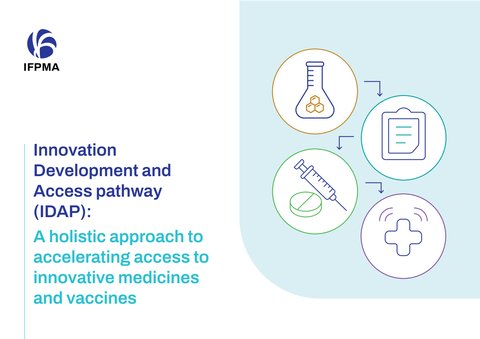 🔒
🔒 PDF Innovation Development and Access pathway
IDAP is a holistic framework spanning four linked phases: Research and Development; regulatory processes and product registration; listing, …
 🔒
🔒 IFPMA whitepaper: How assessment reports enable regulatory reliance in pharma
Regulatory reliance helps NRAs avoid duplicative reviews and allocate resources more efficiently by leveraging prior scientific evaluations …
 🔒
🔒 Integrated delivery networks in Middle East healthcare: what PwC says about the next phase of care
Scale creates value only when healthcare assets are connected through shared systems, referral flows and coordinated management disciplines