
HPN328 Merck: Harpoon deal deepens oncology

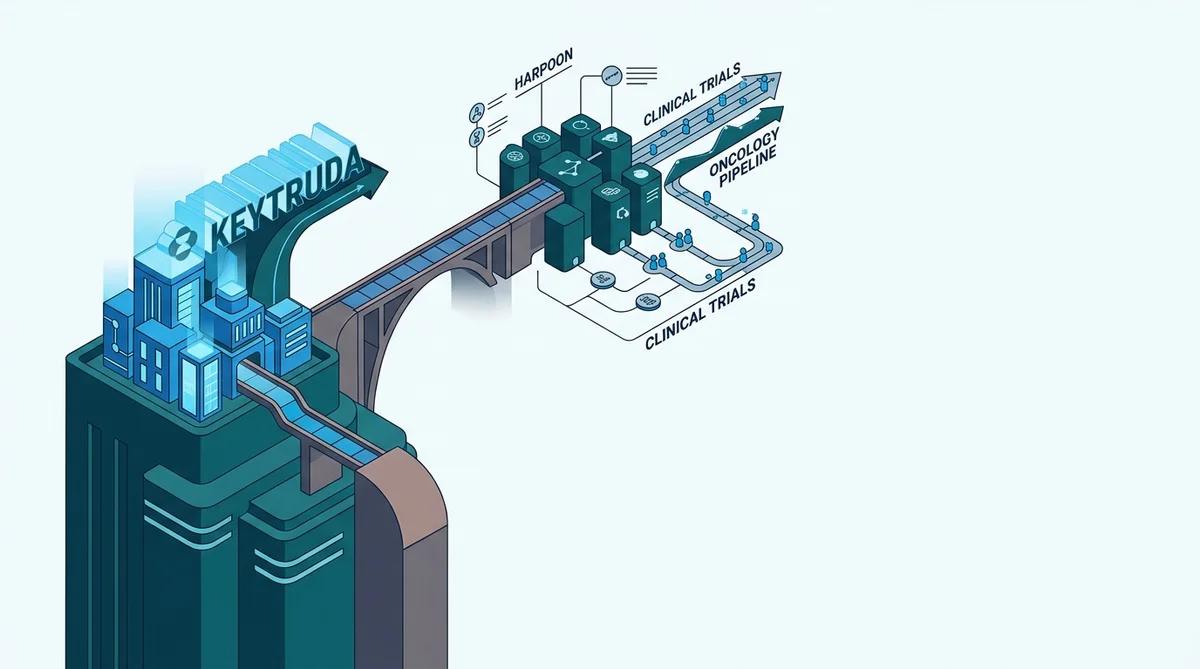
Decision brief
Answer first · skim in under a minute
Merck has completed its acquisition of Harpoon Therapeutics, adding an immuno-oncology company to its pipeline as it keeps building beyond Keytruda. For analysts and BD teams, the deal is a signal to watch for follow-on M&A and pipeline diversification.
Merck’s Harpoon buy puts HPN328 Merck (now MK-6070) at the center of a DLL3 T-cell engager bet in small cell lung cancer. The company paid $23 per share—about $680 million in equity value—to deepen oncology beyond Keytruda as that franchise ages.
Contents11 sections
Key Takeaways
- Merck acquired Harpoon for $23.00 per share cash (~$680 million equity value).
- Lead asset HPN328 / MK-6070 targets DLL3 in SCLC and neuroendocrine tumors.
- Phase 1/2 study NCT04471727 evaluates monotherapy and atezolizumab combinations.
- Closing brought an ~$650 million non-tax deductible R&D charge (~$0.26/share).
What were the Harpoon deal terms?
On January 8, 2024, Merck and Harpoon announced a definitive agreement for Merck to buy all outstanding Harpoon shares at $23.00 each in cash. Approximate total equity value was $680 million.
Source: Merck acquisition announcement and Reuters deal report.
Why does HPN328 Merck matter for the oncology pipeline?
HPN328 (MK-6070) is a TriTAC-style T-cell engager against DLL3, a Notch-pathway ligand often high in SCLC. Merck’s closing notice frames the asset as monotherapy in advanced DLL3-expressing cancers and in combination with atezolizumab in certain SCLC patients.
Trial registration: NCT04471727 on ClinicalTrials.gov. FDA orphan designation for SCLC dates to March 2022 per Merck’s completion release.
When did the deal close and how was it booked?
Merck later announced completion: Harpoon is a wholly owned subsidiary and its common stock left Nasdaq. Accounting treated the deal as an asset acquisition with an ~$650 million non-tax deductible charge to R&D.
Completion notice: Merck completes Harpoon acquisition.
Other Harpoon programs in the package
Beyond HPN328, Harpoon brought additional T-cell engager work, including HPN217 (BCMA) in relapsed/refractory multiple myeloma and earlier EpCAM-directed concepts. Those assets diversify Merck’s external immuno-oncology options as Keytruda lifecycle risk rises.
- Cash price: $23.00/share
- Equity value: ~$680 million
- R&D charge: ~$650 million
- Lead rename: HPN328 → MK-6070
How the DLL3 bet fits Keytruda lifecycle risk
Keytruda remains Merck’s PD-1 cornerstone, but patent and competitive pressure push the company toward external immuno-oncology platforms. Buying Harpoon for about $680 million equity value is a bolt-on, not a transformative merger, yet it adds a clinical-stage DLL3 engager that Merck could not build overnight.
HPN328 Merck (MK-6070) sits in Phase 1/2 with orphan designation in SCLC. That profile is earlier than many Keytruda label expansions, so valuation should weight optionality and toxicity risk more than near-term revenue. SEC and company notices emphasize accounting (asset acquisition, ~$650 million charge), which is useful for EPS models in the closing quarter.
Competitive context BD teams should monitor
DLL3 is a crowded biology. Rival T-cell engagers and ADCs can change the bar for response durability and cytokine-release management before MK-6070 reaches confirmatory trials. Merck’s closing release also notes combination work with atezolizumab in certain SCLC patients, which adds a PD-L1 combo angle without proving superiority.
Until randomized Phase 3 data appear, the Harpoon deal is best read as pipeline diversification with a named lead asset, not as a de-risked SCLC franchise.
What remains unproven
Purchase price and orphan designation do not prove Phase 3 success or a new SCLC standard of care. DLL3 T-cell engagers still need confirmatory efficacy and manageable cytokine-release / on-target toxicity. Competitive DLL3 programs can still reshape the field before MK-6070 reaches registration.
Related NovaPharma coverage
Frequently Asked Questions
What did Merck pay for Harpoon Therapeutics?
Merck agreed to acquire Harpoon for $23.00 per share in cash, an approximate total equity value of $680 million. The deal was announced January 8, 2024, and later completed; Harpoon became a wholly owned Merck subsidiary.
What is HPN328 Merck’s lead Harpoon asset?
HPN328, now MK-6070, is an investigational DLL3-targeting T-cell engager evaluated in small cell lung cancer and neuroendocrine tumors. FDA granted Orphan Drug Designation for SCLC in March 2022. It is studied in NCT04471727.
How did Merck account for the acquisition?
Merck accounted for the transaction as an asset acquisition and recorded a non-tax deductible R&D charge of about $650 million, or roughly $0.26 per share, included in non-GAAP results for the closing quarter.
Primary Sources
Regulatory catalyst tracker
Track PDUFA dates, approval milestones, and label updates for Keytruda.
Unlock full calendar →Merck & Co. pipeline snapshot
One-screen view of active programs, phases, and recent catalysts from public sources.
Investor brief
Download a one-page summary of regulatory impact and competitive context.
Explore drug hub →Entity graph
Continue Exploring
Open the drugs, companies, and topics behind this story.
This article follows our editorial standards. Report a correction via editorial contact.



Deeper reading
Industry reports & whitepapers
- Precision Prevention: UK Government's Role in Unlocking Biology-Based Cancer Prevention Research — Cancer Research UK report urges UK Government to fund precision prevention research, targeting biolo…
- Radiation Therapy: Fractionation, Image-Guidance, and Special Services (Idaho Only) — This policy outlines medically necessary radiation therapy protocols for conditions like breast canc…