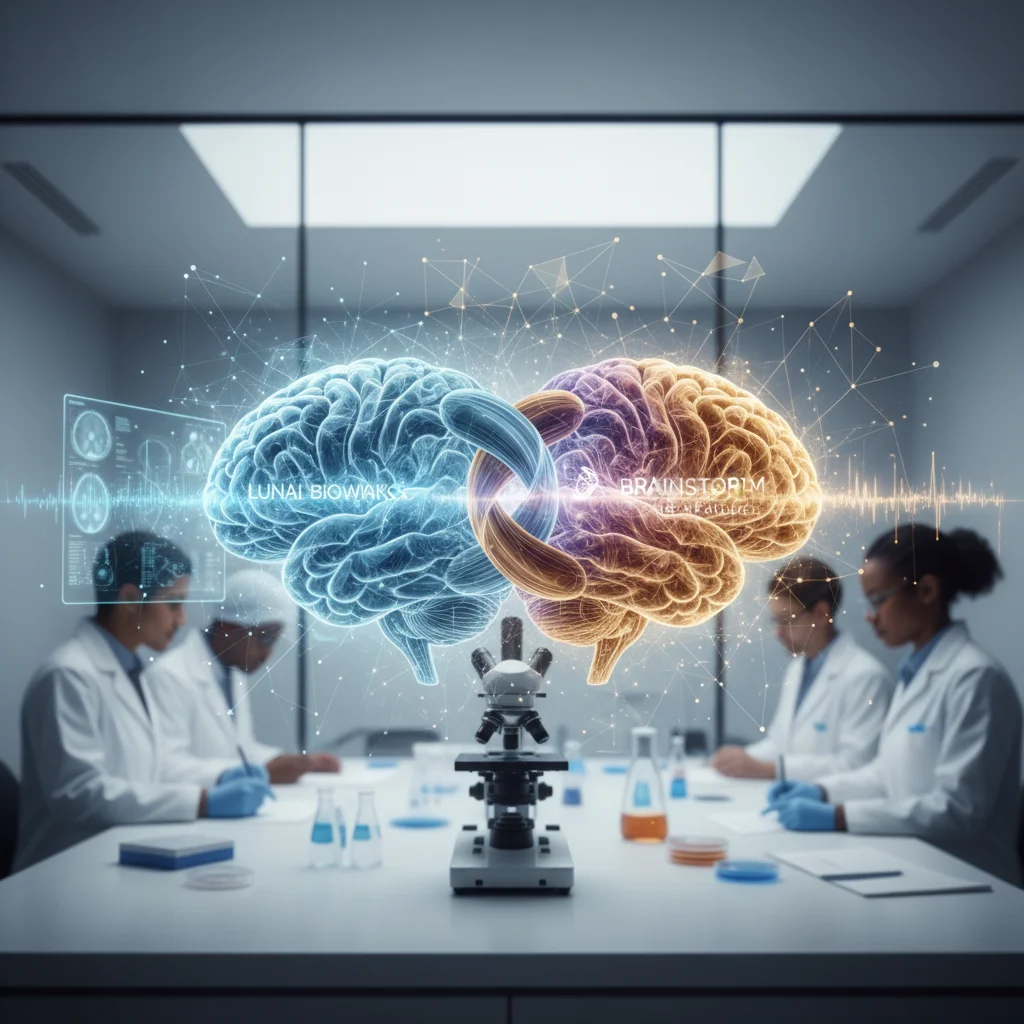
Lunai Bioworks and BrainStorm Therapeutics Launch AI Collaboration for Parkinson's and Rare Epilepsy

Decision brief
Answer first · skim in under a minute
Lunai Bioworks and BrainStorm Therapeutics have launched a new AI discovery collaboration funded by a foundation, focusing on Parkinson's disease and rare epilepsy. This initiative aims to leverage AI technology to accelerate drug discovery and development.
Lunai Bioworks and BrainStorm Therapeutics launched a foundation-funded AI discovery collaboration aimed at Parkinson's disease and rare genetic epilepsies. The May 28, 2026 PR Newswire release describes a Letter of Intent, LouLou Foundation support, and translational platforms — not a clinical efficacy readout or FDA filing.
Contents9 sections
Key Takeaways
- On May 28, 2026, Lunai Bioworks (NASDAQ: LNAI) said BioSymetrics and BrainStorm Therapeutics entered a strategic collaboration LOI for neurology target discovery.
- Initial focus areas are rare genetic epilepsies and neurodegenerative diseases, including Parkinson's disease.
- Funding support is described as a newly awarded LouLou Foundation grant; terms of the LOI beyond platform roles were not disclosed as a priced licensing deal.
- The program cites alignment with FDA interest in new approach methodologies (NAMs) that improve human translational relevance.
What platforms are being combined for Parkinson's disease?
According to the companies, BioSymetrics contributes AI-driven target discovery and in vivo zebrafish validation, while BrainStorm contributes proprietary human-derived organoid systems. For Parkinson's disease specifically, they plan to integrate BrainStorm's midbrain organoid foundation model with BioSymetrics' analysis of the Parkinson's Progression Markers Initiative (PPMI) dataset to surface progression-associated biomarkers and therapeutically actionable targets.
The stated intent is to generate partnering-ready programs for pharmaceutical licensing and downstream development. That is discovery-stage positioning, not a registrational pathway announcement.
Source: May 28, 2026 PR Newswire collaboration release.
Why does the LouLou Foundation grant matter?
The release frames the collaboration as foundation-funded rather than a large upfront biopharma option deal. For investors, that distinction matters: grant support can underwrite early experimental work without establishing clinical milestone economics. Diligence should still ask for grant size, IP ownership under the LOI, and exclusivity — none of which are quantified in the public wire as a dollar amount in the summary available here.
Lunai previously discussed Parkinson's subtype and target prioritization work in a December 9, 2025 PR Newswire update, including use of PPMI-scale proteomic analysis. That earlier announcement is context for why Parkinson's disease is an initial focus, not proof that the BrainStorm LOI has produced clinical candidates.
Related prior wire: December 9, 2025 Lunai Parkinson's subtypes release.
How should CI teams map regulatory language?
The companies say the collaboration aligns with emerging FDA guidance encouraging innovative new approach methodologies (NAMs). That is a positioning statement. It does not equal an FDA qualification of their organoid or zebrafish assays for a specific IND-enabling package.
Separately, FDA has published guidance on digital health technologies for remote data acquisition and continues adaptive-design and participation guidance updates — useful context for trial operations, but not substitutes for NAM qualification of a particular model system.
See FDA DHT remote data acquisition guidance (PDF) for the agency's DHT framework, and keep NAM claims tied to company statements until FDA documents qualify specific methods.
BD and investor screening checklist
- Ticker and subsidiary: LNAI / BioSymetrics
- Counterparty: BrainStorm Therapeutics (organoid systems)
- Indications named: Parkinson's disease; rare genetic epilepsies
- Dataset named: PPMI
- Deal form: LOI + foundation grant (not disclosed as a multi-billion option deal)
Ask for: LOI exclusivity, target ownership, grant dollar amount, and any planned IND timing. Do not invent those figures.
What remains unproven
No human efficacy data, no NCT for a joint interventional trial, and no FDA approval were announced. Claims about market size (for example, prior "$13B market" framing in earlier Lunai communications) are commercial estimates, not clinical endpoints. Until experimental validation readouts appear, treat this as platform partnership news.
Related NovaPharma coverage
- AI and brain organoids in Parkinson's and rare epilepsy
- Hillhurst Bio Phase 2a Parkinson's dosing
- FDA AI and clinical trials pilot updates
Frequently Asked Questions
What did Lunai Bioworks and BrainStorm announce?
On May 28, 2026, Lunai Bioworks (NASDAQ: LNAI) said its BioSymetrics subsidiary and BrainStorm Therapeutics launched a foundation-funded LOI collaboration for AI discovery in Parkinson's disease and rare genetic epilepsies, supported by a LouLou Foundation grant.
Is this a clinical trial or a marketed drug deal?
Neither. The announcement is a discovery collaboration and Letter of Intent combining AI/zebrafish validation with human organoid systems. No Phase 2/3 efficacy readout or FDA approval was claimed.
How does Parkinson's disease data enter the program?
The companies said they will integrate BrainStorm's Parkinson's midbrain organoid foundation model with BioSymetrics' analysis of the Parkinson's Progression Markers Initiative (PPMI) dataset to identify progression-associated biomarkers and targets.
Primary Sources
Entity graph
Continue Exploring
Open the drugs, companies, and topics behind this story.
Sources & references 1 primary sources
Sources verified at publication. See our editorial policy and data sources.
This article follows our editorial standards. Report a correction via editorial contact.