
Digital Transformation in Pharma CRM: Enhancing HCP Engagement
Pharma CRM platforms like Veeva are revolutionizing HCP engagement, leading to improved patient outcomes.
- Publisher
- Bhoomi Parekh
- Length
- 15 pages
- File
- 0 B PDF
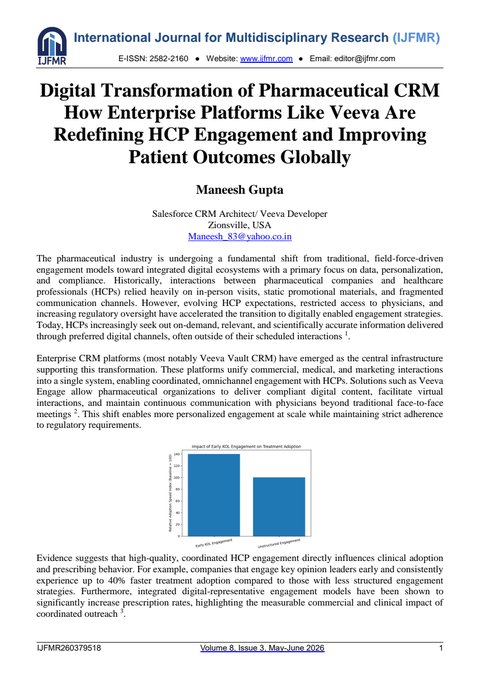
Quick answer
Digital Transformation in Pharma CRM: Enhancing HCP Engagement is a 15-page whitepaper from Bhoomi Parekh covering US pharma intelligence. Digital channels are increasingly preferred by HCPs over traditional in-person interactions.
Why this matters
Digital channels are increasingly preferred by HCPs over traditional in-person interactions.
Executive summary
- Digital channels are increasingly preferred by HCPs over traditional in-person interactions.
- Coordinated engagement can lead to faster treatment adoption and improved prescription rates.
- Regulatory compliance is essential in managing HCP interactions effectively.
- Data-driven insights from CRM systems enhance engagement strategies.
AI research brief
Pharma CRM platforms like Veeva are revolutionizing HCP engagement, leading to improved patient outcomes.
Market Impact
| Regulatory | high |
|---|---|
| Commercial | high |
| Competitive | medium |
| Investment | high |
Who should read this
- Regulatory affairs teams
Ask about this report
AI-assisted answers grounded in NovaPharmaNews intelligence
Answers use retrieved site intelligence plus AI synthesis. Verify critical decisions with primary sources.
Download the full 15-page PDF
Free · 0 B · Instant access after email
Digital Transformation in Pharma CRM: Enhancing HCP Engagement means unifying field, medical, and marketing touchpoints in one compliant system while FDA OPDP and 21 CFR Part 202 still police every promotional claim across 2024–2026 omnichannel programs.
Key Takeaways
- Enterprise life-science CRM suites centralize HCP interaction history across personal and digital channels.
- FDA OPDP expects promotional content to be truthful, balanced, and consistent with approved labeling.
- 21 CFR Part 202 sets prescription drug advertising standards that CRM content workflows must enforce.
- Approved-email modules help only if Medical-Legal-Regulatory review stays upstream of every 2024–2026 send.
What is changing in pharmaceutical CRM?
Healthcare professionals increasingly request on-demand scientific content outside fixed rep visits. That shift pushes manufacturers toward omnichannel CRM systems that log every email, remote detail, and event in one record.
Vendor platforms marketed to biopharma position approved content libraries and interaction capture as the default operating model for global brands.
The strategic point for commercial leaders is not the software brand name. It is whether the system can prove which approved asset an HCP saw, when, and under which indication claim.
Why does FDA promotional oversight still set the ceiling?
The FDA Office of Prescription Drug Promotion (OPDP) states that it protects public health by helping ensure prescription drug promotion is truthful, balanced, and accurately communicated.
OPDP reviews promotional communications, investigates complaints, and issues compliance letters when materials are false or misleading. CRM automation does not create a safe harbor from those duties.
Form FDA 2253 filings accompany first use of many promotional pieces under post-approval rules tied to 21 CFR 314.81. Digital volume raises the cost of a single off-label slip.
Which regulations should CRM content workflows encode?
OPDP regulatory information points teams to 21 CFR Part 202 for prescription drug advertising and related labeling authorities under 21 CFR Parts 201 and 314.
CRM “approved email” modules should ship only assets that completed Medical-Legal-Regulatory review and submission planning.
Field users need technical controls that block free-text claims and force selection from the approved library. Training alone fails when send volume is high.
How should commercial and medical teams share one HCP record?
Fragmented systems create conflicting narratives: marketing may push a campaign while medical affairs answers an unsolicited request on a different channel with different wording.
A single CRM object for the HCP, with channel tags and content IDs, lets compliance reconstruct the journey during an inspection or inquiry in under 5 minutes.
Define which roles may initiate promotional versus non-promotional scientific exchange, and stamp every activity with that classification at entry.
What metrics actually show better HCP engagement?
Vanity metrics such as open rates do not prove clinical adoption. Prefer measures tied to labeled education goals: completed modules on dosing, adverse-reaction counseling, or testing requirements.
Where companies cite faster treatment adoption after coordinated key-opinion-leader programs, demand the study design and year before board use.
For internal scorecards, track time-to-MLR clearance, percent of sends from approved libraries, and OPDP letter volume—not only sales call counts.
How does this connect to other NovaPharmaNews files?
Read alongside compliance and data in pharma TV marketing, FDA digital health tooling updates, and EMA AI guidance for clinical settings.
Those stories show adjacent channel and evidence rules. CRM transformation fails if promotional governance is treated as an IT project alone.
Map every CRM template to the current U.S. Prescribing Information section it supports, and retire templates within 48 hours of a label change.
Build audit exports that list asset ID, version, indication, audience type, and channel for any HCP quickly.
When agencies create local variants, require the same MLR ticket rather than silent edits in the CRM.
Separate adverse-event intake from promotional chat so safety reporting clocks are not buried in marketing threads.
For speaker programs, link events modules to spend transparency workflows so transfers of value remain reconcilable.
Remote detailing still needs fair balance panels that cannot be cropped out of the shared screen deck.
Quarterly tabletop exercises should simulate an OPDP inquiry using only CRM logs to test readiness.
Procurement should score vendors on content-governance features before price, because remediation costs dwarf license discounts.
Global affiliates need country packs; U.S. OPDP rules do not automatically clear EU or APAC claims.
Publish a one-page HCP preference policy so frequency capping is a compliance control, not only a courtesy.
Frequently Asked Questions
How do enterprise CRM platforms support digital transformation in pharma?
Platforms unify commercial, medical, and marketing interactions into one system so teams can run coordinated omnichannel HCP engagement with shared interaction history and approved content libraries.
What FDA office polices prescription drug promotion to HCPs?
FDA’s Office of Prescription Drug Promotion (OPDP) helps ensure prescription drug promotion is truthful, balanced, and accurately communicated, and reviews materials for false or misleading claims.
What regulation governs prescription drug advertising claims?
Prescription drug advertising standards are addressed in 21 CFR Part 202, and promotional submissions at first use commonly travel with Form FDA 2253 under post-approval reporting rules.
Primary Sources
Frequently asked questions
What whitepapers does NovaPharmaNews publish?
Our research library curates FDA, EMA, and industry publisher PDFs — regulatory guidance, clinical analyses, manufacturing reports, and market intelligence. Each report includes an AI-summarized landing page with key takeaways and a gated PDF download.
How do I download a whitepaper?
Open any report page, scroll to the download form, and enter your work email. You receive instant PDF access and can opt in to weekly pharma intelligence updates. Downloads are free for healthcare professionals.
How do whitepapers connect to news and pipeline data?
Report pages link to related intelligence — company profiles, drug INN pages, clinical trials, pipeline programs, and topic hubs. Use the intelligence spokes on each page to explore the entity graph behind the research.
Ready to read the full report?
Join 12,000+ pharma leaders getting deep industry analysis delivered weekly.
Related topic hubs
Editorial coverage and intelligence directories for this report's beat.
Explore the intelligence platform
Related intelligence
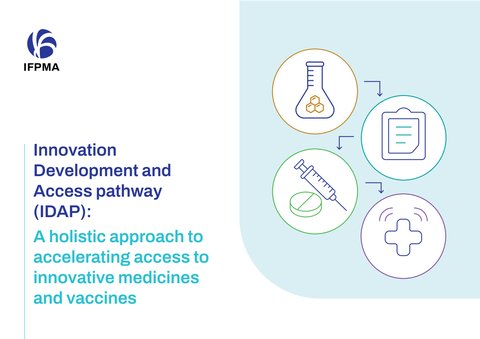 🔒
🔒 PDF Innovation Development and Access pathway
IDAP is a holistic framework spanning four linked phases: Research and Development; regulatory processes and product registration; listing, …
 🔒
🔒 IFPMA whitepaper: How assessment reports enable regulatory reliance in pharma
Regulatory reliance helps NRAs avoid duplicative reviews and allocate resources more efficiently by leveraging prior scientific evaluations …
 🔒
🔒 Integrated delivery networks in Middle East healthcare: what PwC says about the next phase of care
Scale creates value only when healthcare assets are connected through shared systems, referral flows and coordinated management disciplines