
Replimune's Third Attempt at Cancer Drug Approval: Insights from FDA Talks

Decision brief
Answer first · skim in under a minute
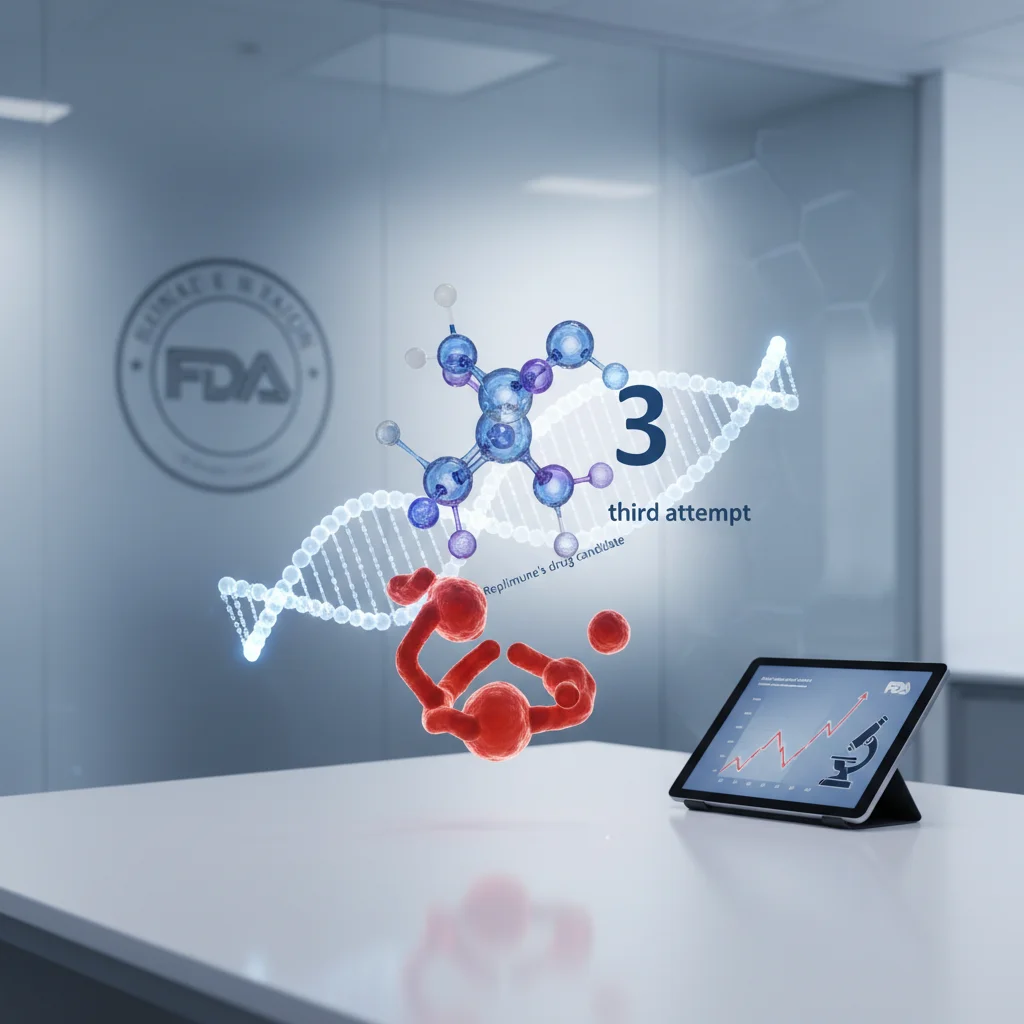
Replimune is making its third attempt to gain FDA approval for its cancer drug following productive discussions. This article explores the implications for investors and pharma teams.
Replimune is on its third attempt to win U.S. approval for an oncolytic cancer therapy. On June 26, 2026, the FDA accepted a Class 1 resubmission of the RP1-plus-nivolumab biologics license application for advanced melanoma, with an August 2, 2026 goal date after two prior complete response letters.
Contents11 sections
Key Takeaways
- FDA accepted Replimune’s Class 1 BLA resubmission for RP1 plus nivolumab on June 26, 2026, with an August 2, 2026 action goal and a late-July 2026 advisory committee.
- Prior CRLs arrived on July 21, 2025 and April 10, 2026; both centered on substantial-evidence and trial-design questions, not manufacturing or safety flags in the first letter.
- The filing rests on IGNYTE (NCT03767348); company materials cite a 34% response rate and 24.8-month median duration of response in anti–PD-1 progressed melanoma.
- Confirmatory Phase 3 IGNYTE-3 (NCT06264180) remains enrolling; Replimune has warned that without timely accelerated approval, RP1 development may not stay viable.
What is Replimune’s third cancer approval attempt?
The third swing is not a new molecule. It is a third regulatory cycle for the same cancer BLA: RP1 (vusolimogene oderparepvec) combined with nivolumab for adults with advanced melanoma after anti–PD-1 progression.
According to a June 26, 2026 GlobeNewswire release, the FDA classified the latest package as a complete Class 1 response, set an August 2, 2026 goal date, and told the company to expect an advisory committee in late July 2026.
That cadence matters for investors. Class 1 reviews are shorter than Class 2 cycles. The prior resubmission after the first CRL used a Class 2 clock that landed on April 10, 2026.
How did the first two FDA cancer CRLs unfold?
Timeline from company and SEC disclosures:
- January 2025: FDA accepted the original BLA with priority review and a July 22, 2025 PDUFA goal.
- July 21, 2025: first CRL; FDA said IGNYTE was not an adequate and well-controlled investigation and flagged confirmatory-trial design, including contribution of components.
- October 9, 2025: BLA resubmitted; accepted October 20, 2025 as a complete response with an April 10, 2026 Class 2 goal date.
- April 10, 2026: second CRL; reviewers said data still did not support substantial evidence of effectiveness.
- May 29, 2026: company said FDA agreed on a path to resubmit; June 26, 2026 Class 1 acceptance followed.
The July 22, 2025 GlobeNewswire CRL notice stated no safety issues were raised. The April 10, 2026 GlobeNewswire CRL notice said a different review team handled the resubmission and that leadership still found the evidence insufficient.
Replimune’s SEC Form 10-Q filing records the same sequence and notes the company may need restructuring if accelerated approval does not arrive from this cycle.
What cancer efficacy package is under review?
The application leans on the Phase 1/2 IGNYTE study, registered as NCT03767348 on ClinicalTrials.gov. The key cohort enrolled patients with confirmed progression on an anti–PD-1 regimen.
In its April 2026 CRL release, Replimune said patients who received RP1 plus nivolumab had a 34% response rate with a median duration of 24.8 months. Company materials also cite median progression-free survival of 30.6 months in responding patients versus 4.4 months on their prior PD-1 regimen, presented as exploratory support.
A peer-reviewed Journal of Clinical Oncology report of the anti–PD-1–failed melanoma cohort (summarized on PubMed PMID 40627813) reported a confirmed ORR of 32.9% (15.0% complete responses) and median duration of response of 33.7 months in 140 patients. Those figures are close to, but not identical with, the company press numbers and should be tracked separately.
Confirmatory work sits in IGNYTE-3 (NCT06264180), a randomized Phase 3 trial in anti–PD-1 failed melanoma versus physician’s choice. Enrollment continues while the Class 1 review runs.
Why contribution of components keeps blocking approval
FDA’s core objection is methodological. RP1 is given with nivolumab, so reviewers want clear evidence that the oncolytic virus adds benefit beyond PD-1 blockade alone.
IGNYTE’s registration-intended melanoma cohort is single-arm. That design can generate response rates that look clinically meaningful, yet still fail the “substantial evidence” bar if the agency cannot isolate each component’s effect.
The July 2025 CRL also cited patient-population heterogeneity and confirmatory-study design items. After a September 2025 Type A meeting, Replimune argued some concerns were resolved, then the April 2026 CRL again found the package insufficient. Whether the Class 1 dossier closes that gap is the open question for August 2, 2026.
What the August 2026 cancer decision means for investors
Three near-term catalysts dominate the setup:
- Late-July 2026 advisory committee briefing documents and vote language on risk-benefit.
- August 2, 2026 FDA action on the Class 1 resubmission.
- IGNYTE-3 enrollment and any protocol updates tied to control-arm feedback.
Melanoma epidemiology frames urgency without proving efficacy. Company releases note roughly 112,000 new U.S. melanoma cases estimated for 2026 and about 8,500 deaths yearly. Standard checkpoint blockade leaves a large progressed population with limited options—exactly the unmet-need argument Replimune is using.
Balance-sheet and operating risk are real. After the second CRL, management said jobs and U.S. manufacturing would be cut if accelerated approval did not arrive in time. A third rejection would likely force a deeper portfolio rethink across the RPx platform.
How this cancer review compares with peer melanoma programs
Oncolytic and post–PD-1 melanoma programs face the same evidence bar: randomized control, durable responses, and clear contribution of each agent. NovaPharma coverage of related melanoma and immunotherapy setbacks helps map that bar in practice, including Regeneron’s immunotherapy combo melanoma miss and FDA melanoma decision friction under recent leadership.
For longer-horizon cancer vaccine competitors in melanoma, see personalized mRNA cancer vaccines in melanoma. Broader disease context sits on the NovaPharma cancer disease hub.
What remains unproven ahead of AdCom
What is documented: two CRLs, a Class 1 acceptance, IGNYTE response rates in the low-to-mid 30% range, and an ongoing Phase 3 confirmatory trial.
What is not proven: whether FDA will accept single-arm IGNYTE data as substantial evidence of RP1’s contribution; whether AdCom members will endorse accelerated approval before IGNYTE-3 reads out; and whether commercial supply and cash runway survive another delay. Do not treat company PFS comparisons versus prior therapy as confirmatory endpoints until FDA says they are.
Related NovaPharma coverage
- FDA Blocks Melanoma Drug Amid Confusion Under Makary Leadership
- Personalized mRNA Cancer Vaccines: A New Era for Melanoma Treatment
- Regeneron Immunotherapy Combo Fails in Melanoma Trial
Frequently Asked Questions
What is Replimune’s third cancer FDA attempt for RP1?
After complete response letters in July 2025 and April 2026, the FDA accepted a Class 1 BLA resubmission on June 26, 2026 for RP1 plus nivolumab in advanced melanoma, with a goal date of August 2, 2026 and an advisory committee planned for late July 2026.
Why did the FDA reject Replimune’s prior RP1 applications?
In both CRLs, the agency said the IGNYTE evidence was insufficient to show substantial evidence of effectiveness, citing single-arm design limits, patient heterogeneity, and contribution-of-components concerns. No safety issues were raised in the July 2025 CRL.
What efficacy data support the RP1 cancer filing?
Replimune cites IGNYTE (NCT03767348) results in anti–PD-1 progressed melanoma of a 34% response rate and median response duration of 24.8 months for RP1 plus nivolumab. A peer-reviewed JCO report of the same cohort reported a 32.9% confirmed ORR and median duration of response of 33.7 months.
Primary Sources
- GlobeNewswire: FDA accepts RP1 Class 1 BLA resubmission (June 26, 2026)
- GlobeNewswire: Second RP1 CRL (April 10, 2026)
- GlobeNewswire: First RP1 CRL (July 22, 2025)
- ClinicalTrials.gov: IGNYTE NCT03767348
- SEC: Replimune Form 10-Q regulatory chronology
- PubMed: IGNYTE JCO melanoma results (PMID 40627813)
Entity graph
Continue Exploring
Open the drugs, companies, and topics behind this story.
Sources & references 1 primary sources
Sources verified at publication. See our editorial policy and data sources.
This article follows our editorial standards. Report a correction via editorial contact.


Deeper reading
Industry reports & whitepapers
- Precision Prevention: UK Government's Role in Unlocking Biology-Based Cancer Prevention Research — Cancer Research UK report urges UK Government to fund precision prevention research, targeting biolo…
- Radiation Therapy: Fractionation, Image-Guidance, and Special Services (Idaho Only) — This policy outlines medically necessary radiation therapy protocols for conditions like breast canc…