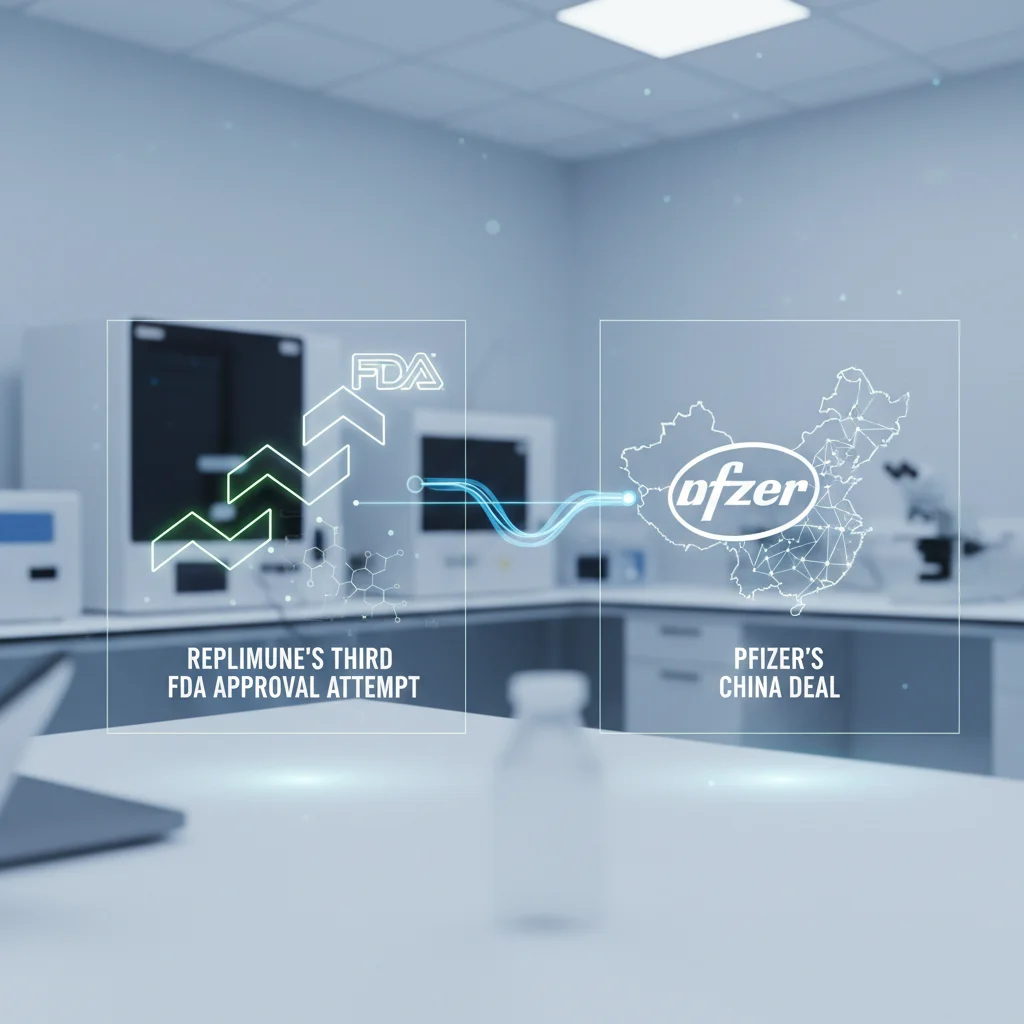
Replimune's Third FDA Approval Attempt and Pfizer's China Deal

Decision brief
Answer first · skim in under a minute
This article analyzes Replimune's third attempt for FDA approval and Pfizer's recent deal in China, highlighting implications for investors and pharma teams.
Replimune’s third regulatory cycle for RP1 in advanced melanoma collided with another Complete Response Letter in April 2026, while Pfizer’s China-origin oncology licensing shows how capital is rotating toward ex-U.S. assets.
Contents12 sections
Key Takeaways
- FDA accepted Replimune’s RP1 BLA resubmission on October 20, 2025, with a Class II PDUFA date of April 10, 2026.
- Replimune reported a second CRL for RP1 plus nivolumab on April 10, 2026, after an earlier July 2025 CRL.
- Pfizer’s 3SBio license included a $1.25 billion upfront and up to $4.8 billion in milestones for SSGJ-707 (ex-China).
- Pfizer also planned a $100 million equity investment in 3SBio upon closing.
What is the FDA status of Replimune’s RP1?
On October 20, 2025, Replimune said FDA accepted the BLA resubmission for RP1 (vusolimogene oderparepvec) with nivolumab for advanced melanoma after anti–PD-1 progression, setting a PDUFA date of April 10, 2026.
That resubmission followed a July 22, 2025 CRL in which FDA said the IGNYTE trial was not an adequate and well-controlled investigation providing substantial evidence of effectiveness.
Did the April 2026 review clear RP1?
No. On April 10, 2026, Replimune announced another CRL for the same RP1 plus nivolumab melanoma BLA. The company said a different review team handled the resubmission and again found the evidence insufficient.
For investors, “third attempt” language in secondary coverage should be read as: initial BLA cycle, July 2025 CRL, October 2025 Class II resubmission, then April 2026 CRL—not an approval.
What did Pfizer pay in its China oncology license?
Pfizer’s 3SBio release and Reuters coverage describe a global ex-China license to SSGJ-707 with a $1.25 billion upfront, up to $4.8 billion in milestones, and a planned $100 million equity stake.
- Upfront: $1.25 billion
- Milestones: up to $4.8 billion
- Equity: $100 million planned
- Asset: PD-1/VEGF bispecific SSGJ-707
Why pair these two stories for BD teams?
Replimune shows how single-arm registrational packages can stall even after breakthrough designation and a Class II resubmission. Pfizer–3SBio shows large-cap capital chasing China-origin oncology with cleaner commercial optionality outside China.
Portfolio committees should stress-test whether U.S. biotech cash runways assume an approval that FDA has twice declined to grant.
What remains unproven
Neither the July 2025 nor April 2026 CRLs are public FDA approval letters granting a label. Contribution-of-components and confirmatory-trial design issues remain open for RP1. SSGJ-707 still needs global Phase 3 success beyond China trials.
Implications for oncology competitive intelligence
Watch Melanoma franchise competitors for accelerated programs if RP1 stays in CRL limbo. Separately track PD-1/VEGF bispecifics as Pfizer manufactures SSGJ-707 drug substance in Sanford, North Carolina, per its release.
How investors should underwrite Replimune after two CRLs
Replimune equity stories that still model 2026 U.S. RP1 revenue need a hard reset. Two Complete Response Letters on the same melanoma BLA mean the bar for substantial evidence remains unmet in FDA’s view, regardless of breakthrough designation history.
Bull cases now depend on a redesigned confirmatory path, clearer contribution-of-components analyses, and cash to fund another cycle. Bear cases assume partnership dilution or program pause if Type A meetings do not reopen an accelerated pathway.
Separately, Pfizer’s willingness to pay $1.25 billion upfront for a China-origin bispecific shows large-cap oncology BD is not frozen. Capital is selective: it prefers assets with randomized plans and manufacturing stories Pfizer can run in North Carolina and Kansas.
Competitive intelligence teams should map other oncolytic virus and PD-1 refractory melanoma programs against RP1’s stalled clock. Delays create share for T-VEC successors, TIL therapies, and next-wave combinations already in Phase 3.
Practical next steps for oncology portfolio reviews
Committees should freeze RP1 peak-sales slides until Replimune publishes a post-CRL meeting outcome with dated FDA minutes or a clear new trial design. Verbal optimism without a protocol synopsis is not diligence.
For Pfizer–3SBio, track China Phase 3 start, U.S. IND bridging timelines, and whether the China commercialization option is exercised. Manufacturing localization in North Carolina is a positive signal for supply security but does not replace efficacy data.
Cross-check competitor PD-1/VEGF bispecific readouts each quarter. If rivals post randomized wins first, SSGJ-707’s $1.25 billion upfront becomes a tougher sunk-cost narrative internally at Pfizer.
Related NovaPharma coverage
- Pfizer danuglipron obesity trial watch
- Eli Lilly gene therapy and cholesterol deals
- Vabysmo EU approval analysis
Frequently Asked Questions
When did FDA accept Replimune’s RP1 BLA resubmission?
Replimune announced on October 20, 2025, that FDA accepted the RP1 plus nivolumab BLA resubmission for advanced melanoma, with a PDUFA target action date of April 10, 2026.
What happened on the April 10, 2026 PDUFA date?
Replimune reported that FDA issued another Complete Response Letter for the RP1 plus nivolumab advanced melanoma BLA on April 10, 2026.
What were the headline terms of Pfizer’s 3SBio deal?
Pfizer agreed to a $1.25 billion upfront payment and up to $4.8 billion in milestones for global rights excluding China to SSGJ-707, plus a planned $100 million equity investment.
Primary Sources
Regulatory catalyst tracker
Track PDUFA dates, approval milestones, and label updates for Replimune.
Unlock full calendar →Pfizer pipeline snapshot
One-screen view of active programs, phases, and recent catalysts from public sources.
Sources & references 1 primary sources
Sources verified at publication. See our editorial policy and data sources.
This article follows our editorial standards. Report a correction via editorial contact.