
May 2026 FDA Oncology Actions: 8 Approvals Reshape the Landscape

Decision brief
Answer first · skim in under a minute
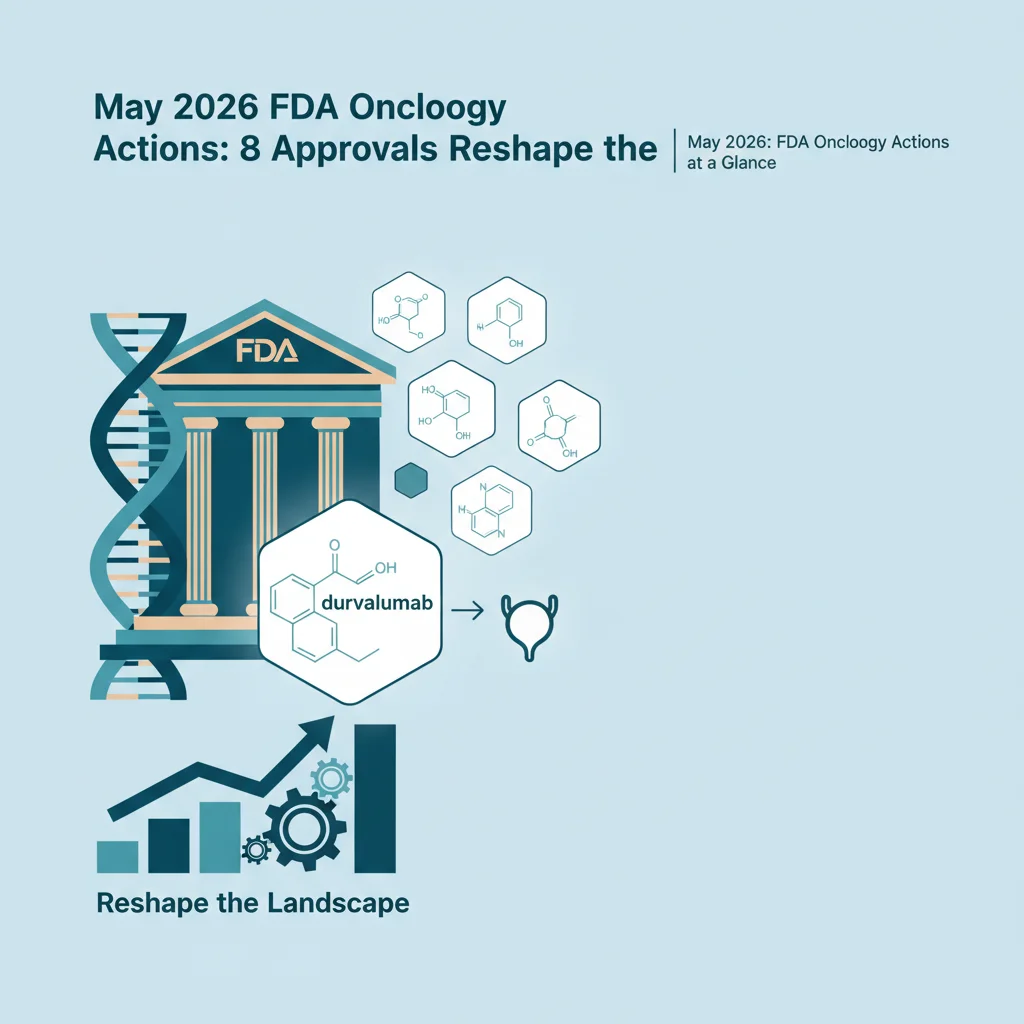
In May 2026, the FDA issued 8 oncology and hematology approvals, including durvalumab for high-risk non-muscle invasive bladder cancer. This analysis covers the approvals, their competitive impact, and what to watch next in FDA oncology guidance.
May 2026 put FDA oncology guidance into practice with a dense slate of cancer and hematology approvals. The month spanned a first PROTAC breast cancer nod, two Enhertu early-breast labels, Datroway in TNBC, and Imfinzi plus BCG for BCG-naïve high-risk NMIBC.
Contents10 sections
Key Takeaways
- On May 1, 2026, FDA approved vepdegestrant (Veppanu) for ER+/HER2−/ESR1-mutated advanced or metastatic breast cancer after at least one endocrine line.
- On May 15, 2026, FDA approved two separate early-stage HER2-positive breast cancer indications for fam-trastuzumab deruxtecan-nxki (Enhertu, Daiichi Sankyo).
- On May 22, 2026, FDA approved datopotamab deruxtecan-dlnk (Datroway) for unresectable or metastatic TNBC in patients who are not PD-1/PD-L1 inhibitor candidates (TROPION-Breast02, NCT05374512; n=644).
- On May 28, 2026, FDA approved durvalumab (Imfinzi) with BCG for BCG-naïve, high-risk NMIBC based on POTOMAC (NCT03528694; n=1,018).
What did FDA oncology guidance look like in May 2026?
The agency’s public oncology and hematology approval notifications logged a rapid May cadence across solid tumors and blood cancers.
For BD and investor teams, the pattern matches recurring FDA oncology guidance themes: biomarker-defined breast cancer, earlier-stage immunotherapy, and ADC expansion into new settings.
This analysis does not invent a single official “eight approvals” count from FDA. It highlights eight decisions that define the competitive map for 2026 pipeline planning.
Which breast cancer decisions reset the competitive map?
On May 1, 2026, FDA approved vepdegestrant (Veppanu, Arvinas), a heterobifunctional protein degrader, for adults with ER-positive, HER2-negative, ESR1-mutated advanced or metastatic breast cancer after endocrine therapy, with ESR1 status set by an FDA-authorized test.
On May 15, 2026, FDA approved two separate Enhertu (T-DXd) indications in HER2-positive early-stage breast cancer: neoadjuvant T-DXd followed by taxane, trastuzumab, and pertuzumab (THP) for Stage II or III disease, and adjuvant T-DXd for residual invasive disease after neoadjuvant trastuzumab (± pertuzumab) plus taxane.
On May 22, 2026, FDA approved Datroway (datopotamab deruxtecan-dlnk) for unresectable or metastatic TNBC in adults who are not candidates for PD-1/PD-L1 inhibitor therapy, based on TROPION-Breast02 (NCT05374512) in 644 patients.
- May 1: first PROTAC-class oncology approval (vepdegestrant / Veppanu).
- May 15: Enhertu moves deeper into early HER2-positive disease with two labels.
- May 22: TROP2 ADC Datroway gains a TNBC foothold outside PD-(L)1-eligible patients.
How does the Imfinzi plus BCG NMIBC approval change bladder cancer?
On May 28, 2026, FDA approved durvalumab (Imfinzi) with BCG for adults with BCG-naïve, high-risk NMIBC.
Efficacy came from POTOMAC (NCT03528694), a randomized open-label multicenter trial in 1,018 patients after TURBT. Sponsor reports cite a 32% lower risk of high-risk recurrence, progression, or death versus BCG alone (DFS HR 0.68; 95% CI 0.50–0.93; P=0.0154) with median follow-up over five years (60.7 months).
The same month also brought adjuvant atezolizumab / Tecentriq Hybreza for muscle-invasive bladder cancer after cystectomy in patients with ctDNA molecular residual disease (May 15, 2026 FDA notice). Together, the two bladder nods push checkpoint use earlier and into biomarker-selected adjuvant care.
What rare and hematologic nods closed the month?
On May 8, 2026, FDA approved zenocutuzumab-zbco (Bizengri) for advanced, unresectable or metastatic NRG1-fusion cholangiocarcinoma after prior systemic therapy, several months ahead of the goal date per the agency notice.
On May 13, 2026, FDA approved oral decitabine and cedazuridine with venetoclax for newly diagnosed acute myeloid leukemia in patients unfit for intensive induction, per the agency’s oncology notification list.
On May 27, 2026, FDA approved pivekimab sunirine-pvzy (Decnupaz, AbbVie), a CD123-directed antibody–alkylator conjugate, for adults with blastic plasmacytoid dendritic cell neoplasm (BPDCN), based on CADENZA (NCT03386513).
What BD and investor teams should watch next
Map each May label to your pipeline: ESR1-mutated breast cancer degrader competition, early HER2 ADC sequencing versus THP, TROP2 TNBC share outside PD-(L)1 regimens, and BCG-era NMIBC combinations.
Track postmarketing and confirmatory commitments on accelerated or biomarker-gated labels. Also watch companion diagnostics tied to ESR1, HER2 IHC/ISH, and ctDNA MRD assays named in the May 15 notices.
Use the FDA oncology notifications page as the canonical calendar rather than secondary roundups when timing a diligence memo.
What remains unproven?
May approvals do not by themselves prove class-wide survival gains for every PD-L1 or ADC regimen. Cross-trial comparisons of DFS hazard ratios are not head-to-head evidence.
Sponsor-reported POTOMAC figures should be read alongside the FDA label once posted on Drugs@FDA. Long-term overall survival for several May nods is still maturing.
Counts of “eight” versus “eleven” May oncology actions differ by which hematology and voucher-linked decisions a source includes; cite the specific FDA notice for each claim.
Related NovaPharma coverage
- Durvalumab (Imfinzi) drug profile
- Bladder cancer disease hub
- Cardiff Oncology pipeline update and FDA meeting catalysts
Frequently Asked Questions
How many FDA oncology approvals did May 2026 deliver?
FDA oncology approval notifications list multiple May 2026 decisions across breast cancer, bladder cancer, hematologic cancers, and rare tumors. NovaPharma’s glance focuses on eight high-impact nods that BD and investor teams track against FDA oncology guidance themes.
What did FDA approve for durvalumab on May 28, 2026?
On May 28, 2026, FDA approved durvalumab (Imfinzi) with Bacillus Calmette-Guerin (BCG) for adults with BCG-naïve, high-risk non-muscle invasive bladder cancer (NMIBC). Efficacy came from the POTOMAC study (NCT03528694), which enrolled 1,018 patients.
Which May 2026 breast cancer approvals matter most?
On May 1, 2026, FDA approved vepdegestrant (Veppanu) for ER-positive, HER2-negative, ESR1-mutated advanced or metastatic breast cancer after endocrine therapy. On May 15, FDA approved two early-stage HER2-positive breast cancer indications for fam-trastuzumab deruxtecan-nxki (Enhertu). On May 22, FDA approved datopotamab deruxtecan-dlnk (Datroway) for unresectable or metastatic TNBC in patients who are not candidates for PD-1/PD-L1 inhibitor therapy.
Primary Sources
- FDA oncology/hematology approval notifications
- FDA: durvalumab plus BCG for high-risk NMIBC (May 28, 2026)
- FDA: vepdegestrant for ESR1-mutated breast cancer (May 1, 2026)
- FDA: Enhertu early-stage HER2-positive breast cancer (May 15, 2026)
- FDA: Datroway for metastatic TNBC (May 22, 2026)
- FDA: pivekimab sunirine-pvzy for BPDCN (May 27, 2026)
Regulatory catalyst tracker
Track PDUFA dates, approval milestones, and label updates for durvalumab.
Unlock full calendar →Investor brief
Download a one-page summary of regulatory impact and competitive context.
Explore drug hub →Entity graph
Continue Exploring
Open the drugs, companies, and topics behind this story.
- Drug durvalumab Explore
- Therapy area oncology Explore
- Therapy area breast cancer Explore
- Therapy area bladder cancer Explore
- Therapy area hematologic malignancies Explore
- Therapy area rare solid tumors Explore
- Therapy area high-risk non-muscle invasive bladder cancer Explore
- Disease Breast Cancer Explore
Sources & references 1 primary sources
Sources verified at publication. See our editorial policy and data sources.
This article follows our editorial standards. Report a correction via editorial contact.


Deeper reading
Industry reports & whitepapers
- Radiation Therapy: Fractionation, Image-Guidance, and Special Services (Idaho Only) — This policy outlines medically necessary radiation therapy protocols for conditions like breast canc…
- La Negoziazione del Prezzo dei Farmaci Oncologici in Italia — This whitepaper analyzes the market benchmark role in negotiating oncology drug prices in Italy, hig…