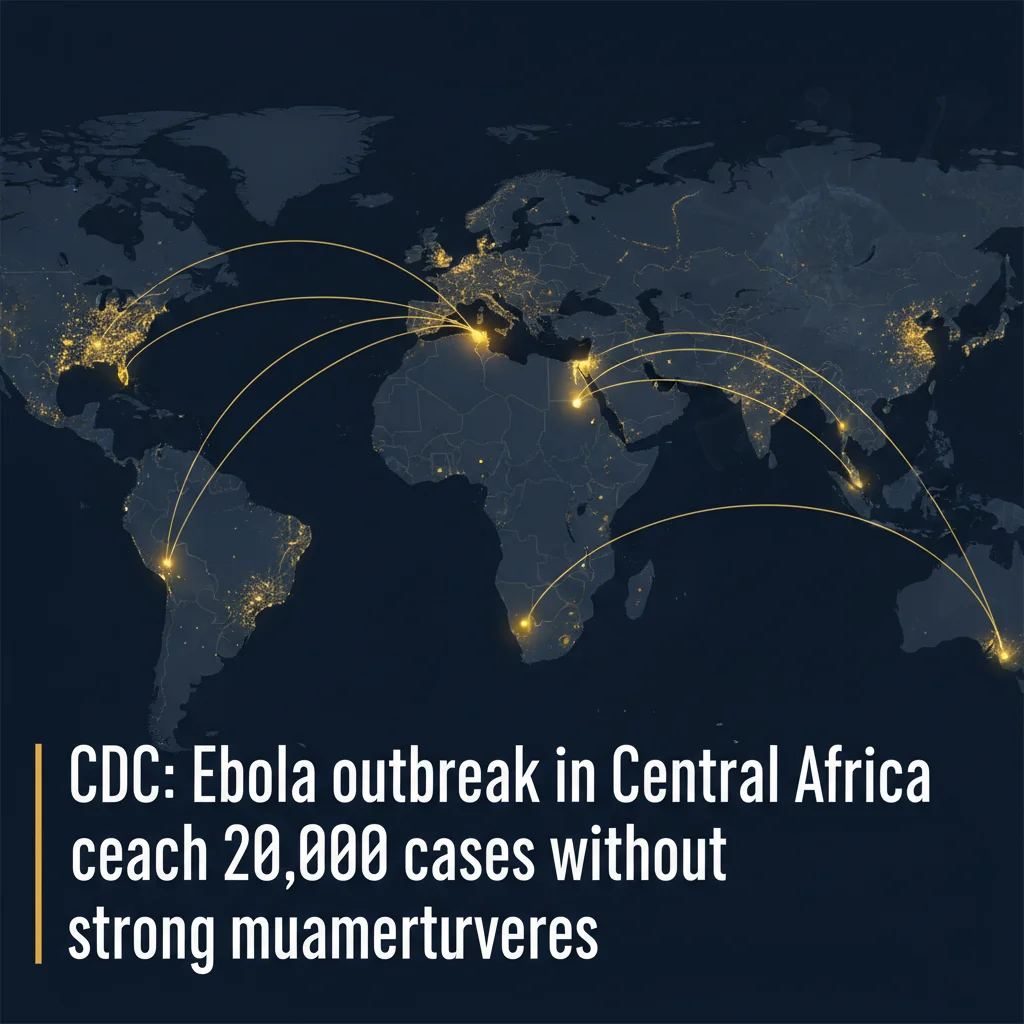
CDC: Ebola outbreak in Central Africa could reach 20,000 cases without strong countermeasures

Decision brief
Answer first · skim in under a minute
A new CDC analysis warns the Ebola outbreak in Central Africa could reach 20,000 cases without strong countermeasures. This article examines the modeling, current case counts, and implications for pharma teams.
Ebola outbreak 2026 modeling from CDC warns that Bundibugyo virus disease in Central Africa could exceed 20,000 cumulative cases within three months if isolation stays weak—while confirmed counts as of early June were still in the hundreds, not tens of thousands.
Contents9 sections
Key Takeaways
- As of June 2, 2026: 378 confirmed BVD cases and 63 confirmed deaths (DRC + Uganda) per CDC MMWR Notes.
- CDC scenario model: with 20% isolation (50-death calibration), ≥20,000 cases in 65% of simulations over ~3 months.
- With 70% isolation in the same calibration, 94% of simulations stayed <10,000 cases; ≥20,000 cases in 1%.
- No approved vaccine or medication for Bundibugyo virus is currently available per the MMWR modeling report.
What does CDC say the Ebola outbreak 2026 case count is today?
Ministries of health in DRC and Uganda declared Bundibugyo virus disease outbreaks on May 15, 2026. CDC’s MMWR Notes from the Field reported 378 confirmed cases (363 DRC, 15 Uganda) and 63 confirmed deaths as of June 2, 2026.
CDC’s situation summary states no U.S. cases from this outbreak and that overall risk to the American public remains low, while noting the outbreak later expanded across additional DRC provinces with rising confirmed totals that change rapidly.
Where does the 20,000-case Ebola outbreak 2026 warning come from?
CDC published modeled scenario projections for Bundibugyo virus disease trajectories over three months, varying assumed deaths as of May 24, 2026 (50, 100, or 200) and isolation coverage (including 20%, 50%, 70%).
Under the 50-death calibration with only 20% of infected persons successfully isolated beginning May 24, projections showed ≥20,000 cumulative cases in 65% of simulations. A June 5 CDC media update similarly highlighted that low isolation scenarios often exceed 20,000 cases, while higher isolation sharply cuts that probability.
Why does Bundibugyo change the medical countermeasure map?
Unlike Zaire ebolavirus outbreaks where licensed vaccines and therapeutics exist for some settings, CDC’s modeling MMWR states no approved vaccine or medication is currently available for Bundibugyo virus disease.
- R&D implication: platform vaccines and antivirals need Bundibugyo-specific evidence paths
- Operational implication: isolation within two days of symptom onset is the near-term lever in the model
- U.S. posture: emergency response initiated May 17, 2026 per CDC situation materials; WHO PHEIC determination also May 17, 2026
What should pharma and biodefense teams watch next?
Track confirmed vs suspected case revisions on CDC’s situation page, isolation coverage indicators, and any WHO or FDA emergency-use discussions for candidates. Do not treat modeled 20,000-case tails as current prevalence when briefing investors.
Historical BVD outbreaks were smaller (for example 2007 Uganda and 2012 DRC episodes cited in MMWR Notes), so 2026 scale depends on intervention intensity more than on analogy alone.
What remains uncertain in the models?
Simulations depend on death-count calibrations, isolation assumptions, and the absence of other interventions in some scenarios. Under-ascertainment means true infections may exceed confirmed totals even when modeled futures diverge. Avoid competitor wire roundups; cite CDC MMWR and situation pages for numbers.
Related NovaPharma coverage
- Ebola outbreak implications for women and girls
- Amish measles vaccination and pharma strategy
- Listeria soft cheese recalls 2026 analysis
Frequently Asked Questions
Is the Ebola outbreak 2026 already at 20,000 cases?
No. The 20,000 figure is a modeled projection under poor isolation assumptions in CDC MMWR scenario work, not a confirmed case count. As of June 2, 2026, MMWR Notes reported 378 confirmed Bundibugyo virus disease cases and 63 confirmed deaths in DRC and Uganda.
What isolation level shrinks Ebola outbreak 2026 projections?
In the CDC model calibrated to 50 deaths as of May 24, 2026, assuming only 20% isolation yielded ≥20,000 cumulative cases in 65% of simulations, while 70% isolation projected <10,000 cases in 94% of simulations and ≥20,000 cases in only 1%.
Are licensed Bundibugyo vaccines available for Ebola outbreak 2026?
CDC’s modeled-projections MMWR states Bundibugyo virus disease is caused by a species for which no approved vaccine or medication is currently available, which is why isolation, contact tracing, and experimental MCM pathways matter for manufacturers.
Primary Sources
Sources & references 1 primary sources
Sources verified at publication. See our editorial policy and data sources.
This article follows our editorial standards. Report a correction via editorial contact.