
Healthcare investment in Central and Eastern Europe: what pharma teams should know
CEE health spending is rising, but investment, access and outcomes still lag EU4, with longer waits for innovative medicines.
- Publisher
- Boyan Likomanov, HTA
- Length
- 31 pages
- File
- 0 B PDF
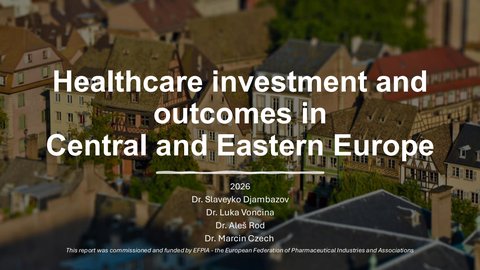
Quick answer
Healthcare investment in Central and Eastern Europe: what pharma teams should know is a 31-page whitepaper from Boyan Likomanov, HTA covering EU pharma intelligence. CEE governments invested an average of 5.47% of GDP in healthcare in 2023, compared with 8.17% in the EU4 (Germany, France, Italy, Spain). The gap has narrowed only marginally since 2017, from 3 to 2.78 percentage points.
Research library Data sources More from Boyan Likomanov, HTA
Why this matters
CEE governments invested an average of 5.47% of GDP in healthcare in 2023, compared with 8.17% in the EU4 (Germany, France, Italy, Spain). The gap has narrowed only marginally since 2017, from 3 to 2.78 percentage points.
Executive summary
- CEE governments invested an average of 5.47% of GDP in healthcare in 2023, compared with 8.17% in the EU4 (Germany, France, Italy, Spain). The gap has narrowed only marginally since 2017, from 3 to 2.78 percentage points.
- Public health and pharmaceutical spending per capita in CEE remains approximately half that of the EU4 (€1,618 vs €3,221). Out-of-pocket spending averages 22% of total health investment in CEE versus 15% in the EU4.
- CEE records ~41% higher disability-adjusted life years (DALYs) and ~137% higher treatable mortality than the EU4. Life expectancy lags by 5 years (78.2 vs 83.2 years in 2024), with convergence occurring more slowly than in Western Europe.
- Between 2020 and 2023, patients in CEE gained reimbursed access to only 31% of new EMA-authorized medicines, compared with 76% in the EU4. Average time from EMA authorization to reimbursement was 705 days in CEE—260 days longer than the EU4 average.
- Demographic decline will intensify fiscal pressures: the CEE working-age population (15-64) is projected to fall by 20% by 2050, reducing annual income-tax revenue by an estimated €14.6 billion while age-related health spending rises steeply after age 55.
AI research brief
CEE health spending is rising, but investment, access and outcomes still lag EU4, with longer waits for innovative medicines.
Market Impact
| Regulatory | high |
|---|---|
| Commercial | high |
| Competitive | medium |
| Investment | high |
Who should read this
- EU market access specialists
Ask about this report
AI-assisted answers grounded in NovaPharmaNews intelligence
Answers use retrieved site intelligence plus AI synthesis. Verify critical decisions with primary sources.
Download the full 31-page PDF
Free · 0 B · Instant access after email
Central and Eastern Europe invests substantially less in healthcare than Western Europe, resulting in slower access to innovative medicines, higher disease burden, and persistent health outcome gaps that will be further strained by demographic decline.
Key Takeaways
- CEE governments invested an average of 5.47% of GDP in healthcare in 2023, compared with 8.17% in the EU4 (Germany, France, Italy, Spain). The gap has narrowed only marginally since 2017, from 3 to 2.78 percentage points.
- Public health and pharmaceutical spending per capita in CEE remains approximately half that of the EU4 (€1,618 vs €3,221). Out-of-pocket spending averages 22% of total health investment in CEE versus 15% in the EU4.
- CEE records ~41% higher disability-adjusted life years (DALYs) and ~137% higher treatable mortality than the EU4. Life expectancy lags by 5 years (78.2 vs 83.2 years in 2024), with convergence occurring more slowly than in Western Europe.
- Between 2020 and 2023, patients in CEE gained reimbursed access to only 31% of new EMA-authorized medicines, compared with 76% in the EU4. Average time from EMA authorization to reimbursement was 705 days in CEE—260 days longer than the EU4 average.
- Demographic decline will intensify fiscal pressures: the CEE working-age population (15-64) is projected to fall by 20% by 2050, reducing annual income-tax revenue by an estimated €14.6 billion while age-related health spending rises steeply after age 55.
What This Report Covers
This 31-page analysis, commissioned by EFPIA (the European Federation of Pharmaceutical Industries and Associations), reviews healthcare investment trends, health outcomes, access to innovation, and demographic pressures across Central and Eastern Europe. It provides regional averages alongside country-specific data for 12 CEE markets, with direct comparisons to Germany, France, Italy, and Spain.
Why This Matters for Pharma Teams
For pharmaceutical and market access professionals, the report demonstrates that reimbursement speed, adoption of innovative medicines, and public budget capacity vary significantly across CEE. These findings support more granular country-by-country planning, realistic launch sequencing, and evidence strategies tailored to local funding constraints. Countries such as Slovenia, Poland, Croatia, and Bulgaria are on track to reach EU4 investment levels by 2040 if current growth is sustained, while others require accelerated policy commitment to avoid further divergence.
Frequently Asked Questions
How has the healthcare investment gap between CEE and the EU4 changed since 2017?
The gap has narrowed only slightly. In 2017, the difference was 3 percentage points of GDP; by 2023, it had narrowed to 2.78 percentage points. CEE averaged 5.47% of GDP on healthcare in 2023 versus 8.17% in the EU4. While CEE is growing faster (9.2% CAGR vs 4.9% in EU4), the absolute gap remains wide and progress is gradual.
Which CEE countries are closest to EU4 healthcare investment levels?
Slovenia and Czechia are the CEE leaders, both investing approximately 7% of GDP on healthcare. At current growth rates, Slovenia, Poland, Croatia, and Bulgaria are projected to reach the EU4 average by 2040. In contrast, Hungary, Romania, and Latvia require accelerated investment to avoid falling further behind the regional trajectory.
What is the impact of lower healthcare investment on health outcomes in CEE?
Lower investment correlates directly with worse outcomes. CEE experiences approximately 41% higher DALY burden per 100,000 people and 137% higher treatable mortality than the EU4. Life expectancy in CEE averages 78 years compared with 83 years in the EU4, and has improved more slowly since 1960 (14% vs 20% increase).
How does access to innovative medicines differ between CEE and the EU4?
Access is significantly delayed and more limited in CEE. Between 2020 and 2023, patients in CEE gained reimbursed access to only 31% of new EMA-authorized medicines compared with 76% in the EU4. The average time from EMA authorization to reimbursement was 705 days in CEE versus 445 days in the EU4—a difference of 260 days.
What demographic challenges will CEE health systems face by 2050?
The CEE working-age population (15-64) is projected to decline by 20% by 2050, equivalent to 12.9 million fewer people. This will reduce annual income-tax revenue by an estimated €14.6 billion if current patterns persist. Simultaneously, per-capita healthcare spending rises sharply after age 55, placing simultaneous pressure on both revenues and expenditures.
Related coverage
Frequently asked questions
What whitepapers does NovaPharmaNews publish?
Our research library curates FDA, EMA, and industry publisher PDFs — regulatory guidance, clinical analyses, manufacturing reports, and market intelligence. Each report includes an AI-summarized landing page with key takeaways and a gated PDF download.
How do I download a whitepaper?
Open any report page, scroll to the download form, and enter your work email. You receive instant PDF access and can opt in to weekly pharma intelligence updates. Downloads are free for healthcare professionals.
How do whitepapers connect to news and pipeline data?
Report pages link to related intelligence — company profiles, drug INN pages, clinical trials, pipeline programs, and topic hubs. Use the intelligence spokes on each page to explore the entity graph behind the research.
Ready to read the full report?
Join 12,000+ pharma leaders getting deep industry analysis delivered weekly.
Related topic hubs
Editorial coverage and intelligence directories for this report's beat.
Explore the intelligence platform
Related intelligence
 🔒
🔒 EFPIA on Harmonising Pharmaceutical Product Carbon Footprints with PAS 2090
Pharmaceutical product carbon footprint (PCF) and life cycle assessment (LCA) reporting currently lacks harmonised, sector-specific standard…
 🔒
🔒 EFPIA analysis: biopharmaceutical strategies in 10 countries and what Europe can learn
Biotech and biopharma are now embedded in national security and competitiveness frameworks; policy support spans research, startups, manufac…
 🔒
🔒 EFPIA report: economic impact of industry clinical trials across Europe
Industry clinical trials created €10.1 billion in direct GVA and €21.7 billion in total GVA across the EEA in 2025, accounting for indirect …