
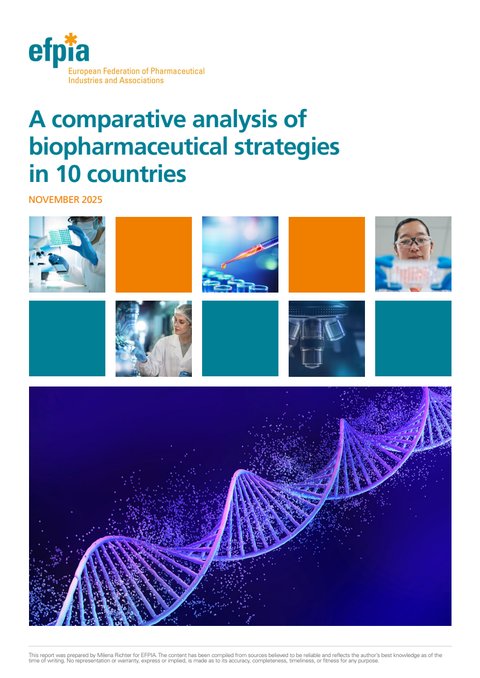
EFPIA analysis: biopharmaceutical strategies in 10 countries and what Europe can learn
Europe faces growing biopharma competition as countries align R&D, regulation, and manufacturing to attract investment and resilience.
- Publisher
- www.efpia.eu
- Length
- 51 pages
- File
- 0 B PDF
Quick answer
EFPIA analysis: biopharmaceutical strategies in 10 countries and what Europe can learn is a 51-page whitepaper from www.efpia.eu covering EU pharma intelligence. Biotech and biopharma are now embedded in national security and competitiveness frameworks; policy support spans research, startups, manufacturing, and post-launch conditions.
Why this matters
Biotech and biopharma are now embedded in national security and competitiveness frameworks; policy support spans research, startups, manufacturing, and post-launch conditions.
Executive summary
- Biotech and biopharma are now embedded in national security and competitiveness frameworks; policy support spans research, startups, manufacturing, and post-launch conditions.
- Europe's share of global pharmaceutical R&D declined from 37% in 2010 to 32% in 2020, with projections indicating further decline to 21% by 2040 without intervention.
- The Asia–Pacific region now accounts for roughly one-third to approaching one-half of the global innovative-drug pipeline, with China contributing approximately 23%.
- Policy predictability, regulatory efficiency, clinical trial infrastructure, venture capital availability, and translational ecosystems are critical competitive levers.
- Europe's scientific excellence, values-driven governance, and collaborative research infrastructure are underexploited strengths that must be paired with political urgency and cross-border coordination.
AI research brief
Europe faces growing biopharma competition as countries align R&D, regulation, and manufacturing to attract investment and resilience.
Market Impact
| Regulatory | high |
|---|---|
| Commercial | high |
| Competitive | medium |
| Investment | high |
Who should read this
- EU market access specialists
Ask about this report
AI-assisted answers grounded in NovaPharmaNews intelligence
Answers use retrieved site intelligence plus AI synthesis. Verify critical decisions with primary sources.
Download the full 51-page PDF
Free · 0 B · Instant access after email
Biopharmaceutical innovation is now treated as a strategic sector tied to national competitiveness and security. This EFPIA comparative analysis of biopharmaceutical strategies across 10 countries reveals that governments are deploying coordinated public investment, regulation, and industrial policy across the entire value chain—and Europe risks permanent loss of innovation leadership without urgent, coherent action.
Key Takeaways
- Biotech and biopharma are now embedded in national security and competitiveness frameworks; policy support spans research, startups, manufacturing, and post-launch conditions.
- Europe's share of global pharmaceutical R&D declined from 37% in 2010 to 32% in 2020, with projections indicating further decline to 21% by 2040 without intervention.
- The Asia–Pacific region now accounts for roughly one-third to approaching one-half of the global innovative-drug pipeline, with China contributing approximately 23%.
- Policy predictability, regulatory efficiency, clinical trial infrastructure, venture capital availability, and translational ecosystems are critical competitive levers.
- Europe's scientific excellence, values-driven governance, and collaborative research infrastructure are underexploited strengths that must be paired with political urgency and cross-border coordination.
What This Analysis Covers
The EFPIA whitepaper provides a descriptive comparison of national biopharmaceutical strategies across 10 upper-income countries. It maps how governments combine public investment, regulation, public-private partnerships, financing mechanisms, and industrial policy to support innovation, resilience, and manufacturing capacity. The report does not rank countries but identifies patterns and sector-specific strengths relevant to European policymakers.
Why This Matters for Pharma Teams
For R&D, business development, regulatory, and market access functions, this analysis signals that policy design has become a competitive lever. Investment and expansion decisions must now account for clinical trial environment quality, venture capital availability, translational research ecosystems, manufacturing support intensity, and regulatory predictability—factors that vary significantly across jurisdictions and shape long-term return on investment.
Frequently Asked Questions
What are the six key pillars of biopharmaceutical support assessed in this report?
The analysis evaluates countries across R&D intensity, public-private collaboration, clinical trials uptake, regulatory framework efficiency and agility, venture capital and financing dynamics, and translational ecosystem strength and startup generation capacity.
What role does national security play in biopharmaceutical policy?
National security has become increasingly central to biopharmaceutical policy design, particularly in China and the US. Governments are deliberately integrating biotech, AI, and quantum technology into national security frameworks, which is contributing to capital flows, public investment prioritization, and supply-chain localization strategies. Post-COVID-19, countries are also structuring resilience policies around pandemic preparedness and geopolitical fragmentation risk mitigation.
How does Europe's current position compare to the US and China?
Europe's share of global pharmaceutical R&D has declined to 32% as of 2020, down from 37% in 2010. Without intervention, projections indicate further decline to 21% by 2040. Meanwhile, the US and China dominate innovation leadership, with China alone now contributing approximately 23% of the global innovative-drug pipeline. The Asia–Pacific region accounts for roughly one-third to approaching one-half of total pipelines.
What are the primary barriers to European competitiveness identified in the report?
Key barriers include regulatory fragmentation and incomplete implementation of EU legislation (such as the Clinical Trials Regulation), technology transfer bottlenecks, financing gaps, fragmented national pricing and reimbursement systems, underinvestment in clinical trial infrastructure, and policy inconsistencies between industrial support and cost-driven pricing that undermine investor confidence and global launch incentives.
Related coverage
Frequently asked questions
What whitepapers does NovaPharmaNews publish?
Our research library curates FDA, EMA, and industry publisher PDFs — regulatory guidance, clinical analyses, manufacturing reports, and market intelligence. Each report includes an AI-summarized landing page with key takeaways and a gated PDF download.
How do I download a whitepaper?
Open any report page, scroll to the download form, and enter your work email. You receive instant PDF access and can opt in to weekly pharma intelligence updates. Downloads are free for healthcare professionals.
How do whitepapers connect to news and pipeline data?
Report pages link to related intelligence — company profiles, drug INN pages, clinical trials, pipeline programs, and topic hubs. Use the intelligence spokes on each page to explore the entity graph behind the research.
Ready to read the full report?
Join 12,000+ pharma leaders getting deep industry analysis delivered weekly.
Related topic hubs
Editorial coverage and intelligence directories for this report's beat.
Explore the intelligence platform
Related intelligence
 🔒
🔒 EFPIA on Harmonising Pharmaceutical Product Carbon Footprints with PAS 2090
Pharmaceutical product carbon footprint (PCF) and life cycle assessment (LCA) reporting currently lacks harmonised, sector-specific standard…
 🔒
🔒 EFPIA report: economic impact of industry clinical trials across Europe
Industry clinical trials created €10.1 billion in direct GVA and €21.7 billion in total GVA across the EEA in 2025, accounting for indirect …
 🔒
🔒 Efpia on AI Across the Medicines Lifecycle: Governance, GxP and Regulatory Policy Insights
AI governance across the medicines lifecycle requires attention to five critical stages: planning and design, data collection and processing…