
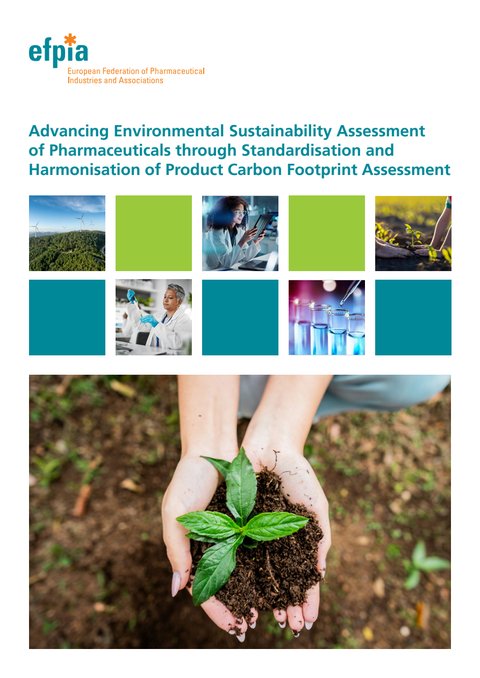
EFPIA on Harmonising Pharmaceutical Product Carbon Footprints with PAS 2090
EFPIA says harmonised product carbon footprint standards are needed to improve transparency, trust, and consistency in pharmaceutical sustainability reporting.
- Publisher
- www.efpia.eu
- Length
- 9 pages
- File
- 0 B PDF
Quick answer
EFPIA on Harmonising Pharmaceutical Product Carbon Footprints with PAS 2090 is a 9-page whitepaper from www.efpia.eu covering EU pharma intelligence. Pharmaceutical product carbon footprint (PCF) and life cycle assessment (LCA) reporting currently lacks harmonised, sector-specific standards, resulting in inconsistent methodologies and potentially misleading environmental claims across companies.
Why this matters
Pharmaceutical product carbon footprint (PCF) and life cycle assessment (LCA) reporting currently lacks harmonised, sector-specific standards, resulting in inconsistent methodologies and potentially misleading environmental claims across companies.
Executive summary
- Pharmaceutical product carbon footprint (PCF) and life cycle assessment (LCA) reporting currently lacks harmonised, sector-specific standards, resulting in inconsistent methodologies and potentially misleading environmental claims across companies.
- Fragmented approaches create measurable risks: reduced credibility of environmental claims, procurement distortions based on methodology rather than actual sustainability performance, regulatory duplication, and inconsistent Scope 3 emissions reporting downstream.
- PAS 2090:2025, developed by BSI with co-sponsorship from NHS England and the Office for Life Sciences, represents the first publicly available Product Category Rules specification designed for international pharmaceutical product environmental assessment.
- Even with standardised methodologies, direct product-to-product comparisons remain limited by data quality variability, supply chain opacity, and contextual use factors that cannot be isolated in standalone product metrics.
- EFPIA advocates for policymakers and regulators to adopt PAS 2090 internationally rather than developing fragmented national or regional frameworks.
AI research brief
EFPIA says harmonised product carbon footprint standards are needed to improve transparency, trust, and consistency in pharmaceutical sustainability reporting.
Market Impact
| Regulatory | high |
|---|---|
| Commercial | high |
| Competitive | medium |
| Investment | high |
Who should read this
- EU market access specialists
Ask about this report
AI-assisted answers grounded in NovaPharmaNews intelligence
Answers use retrieved site intelligence plus AI synthesis. Verify critical decisions with primary sources.
Download the full 9-page PDF
Free · 0 B · Instant access after email
The European Federation of Pharmaceutical Industries and Associations (EFPIA) calls for international adoption of PAS 2090:2025 as a unified standard for pharmaceutical product carbon footprint and life cycle assessment reporting, citing significant methodological inconsistencies that undermine environmental credibility and create regulatory inefficiencies across markets.
Key Takeaways
- Pharmaceutical product carbon footprint (PCF) and life cycle assessment (LCA) reporting currently lacks harmonised, sector-specific standards, resulting in inconsistent methodologies and potentially misleading environmental claims across companies.
- Fragmented approaches create measurable risks: reduced credibility of environmental claims, procurement distortions based on methodology rather than actual sustainability performance, regulatory duplication, and inconsistent Scope 3 emissions reporting downstream.
- PAS 2090:2025, developed by BSI with co-sponsorship from NHS England and the Office for Life Sciences, represents the first publicly available Product Category Rules specification designed for international pharmaceutical product environmental assessment.
- Even with standardised methodologies, direct product-to-product comparisons remain limited by data quality variability, supply chain opacity, and contextual use factors that cannot be isolated in standalone product metrics.
- EFPIA advocates for policymakers and regulators to adopt PAS 2090 internationally rather than developing fragmented national or regional frameworks.
Why Standardisation Matters for Pharmaceutical Environmental Reporting
While greenhouse gas emissions measurement at the corporate level is well-established through ISO 14040-44 and GHG Protocol standards, product-level environmental reporting in pharmaceuticals remains methodologically inconsistent. The absence of sector-specific guidance creates substantial discretion in methodological choices—data inclusion thresholds, system boundaries, and supply chain assumptions—making it probable that identical products yield different carbon footprints depending on the assessment approach employed.
This fragmentation carries operational and strategic consequences. Regulatory bodies receive inconsistent data when evaluating environmental performance claims. Healthcare procurement teams cannot reliably compare products on environmental grounds. Companies face duplicated assessment efforts across jurisdictions. Downstream organisations struggle to incorporate pharmaceutical Scope 3 emissions into their own carbon accounting with confidence.
What PAS 2090 Establishes
PAS 2090:2025 provides minimum requirements for data quality, methodological consistency, and reporting transparency specific to pharmaceutical products. Developed collaboratively by industry stakeholders, academia, healthcare authorities, and the British Standards Institution, the standard was designed for international applicability rather than regional compliance alone.
The standard clarifies methodological choices within existing ISO frameworks, establishing harmonised approaches to system boundaries, data sources, and reporting formats. This reduces the discretionary space that currently permits wide variation in results for the same product across different companies or assessment teams.
Frequently Asked Questions
Why does the pharmaceutical sector need its own carbon footprint standard?
Generic ISO standards for product carbon footprinting do not account for pharmaceutical-specific complexities: multi-component formulations, cold-chain requirements, complex global supply networks, and highly variable manufacturing processes. Without sector-specific Product Category Rules, companies apply different methodological interpretations, producing incomparable results for identical products. This undermines stakeholder trust and prevents meaningful environmental performance differentiation.
Can companies simply compare their PCFs once PAS 2090 is adopted?
EFPIA acknowledges that standardised methodology does not eliminate all comparison limitations. Variability in data quality, data availability for upstream and downstream processes, and the opacity of complex supply chains mean that direct product-to-product PCF comparisons remain constrained. Environmental and clinical impacts are intertwined with how, when, and where products are used across the care continuum—factors that cannot be captured in standalone product metrics.
What should pharmaceutical teams do now?
Regulatory, sustainability, manufacturing, and market access teams should begin documenting their current PCF and LCA methodologies, data sources, and system boundaries. Evaluate readiness to align with PAS 2090 minimum requirements for data quality and reporting transparency. Engage with procurement and commercial stakeholders to clarify how PCF data will inform decision-making and establish realistic expectations about product comparability. This preparation positions companies to respond efficiently as regulators increasingly adopt harmonised standards.
Who developed PAS 2090 and why should it be trusted?
PAS 2090 was developed independently by the British Standards Institution with co-sponsorship from NHS England and the UK Office for Life Sciences. Development involved cross-stakeholder collaboration including pharmaceutical industry representatives, suppliers, academia, healthcare authorities, and non-governmental organisations. This multi-stakeholder model and institutional independence provide credibility that isolated corporate or regional standards lack.
Related coverage
Frequently asked questions
What whitepapers does NovaPharmaNews publish?
Our research library curates FDA, EMA, and industry publisher PDFs — regulatory guidance, clinical analyses, manufacturing reports, and market intelligence. Each report includes an AI-summarized landing page with key takeaways and a gated PDF download.
How do I download a whitepaper?
Open any report page, scroll to the download form, and enter your work email. You receive instant PDF access and can opt in to weekly pharma intelligence updates. Downloads are free for healthcare professionals.
How do whitepapers connect to news and pipeline data?
Report pages link to related intelligence — company profiles, drug INN pages, clinical trials, pipeline programs, and topic hubs. Use the intelligence spokes on each page to explore the entity graph behind the research.
Ready to read the full report?
Join 12,000+ pharma leaders getting deep industry analysis delivered weekly.
Related topic hubs
Editorial coverage and intelligence directories for this report's beat.
Explore the intelligence platform
Related intelligence
 🔒
🔒 EFPIA analysis: biopharmaceutical strategies in 10 countries and what Europe can learn
Biotech and biopharma are now embedded in national security and competitiveness frameworks; policy support spans research, startups, manufac…
 🔒
🔒 EFPIA report: economic impact of industry clinical trials across Europe
Industry clinical trials created €10.1 billion in direct GVA and €21.7 billion in total GVA across the EEA in 2025, accounting for indirect …
 🔒
🔒 Efpia on AI Across the Medicines Lifecycle: Governance, GxP and Regulatory Policy Insights
AI governance across the medicines lifecycle requires attention to five critical stages: planning and design, data collection and processing…