
FDA's Permanent Ban on Compounded GLP-1s: What It Means for Pharma

Decision brief
Answer first · skim in under a minute
The FDA has announced a permanent ban on compounded GLP-1 medications, a significant move that could reshape the pharmaceutical landscape. This article breaks down the implications for business development teams, investors, and analysts.
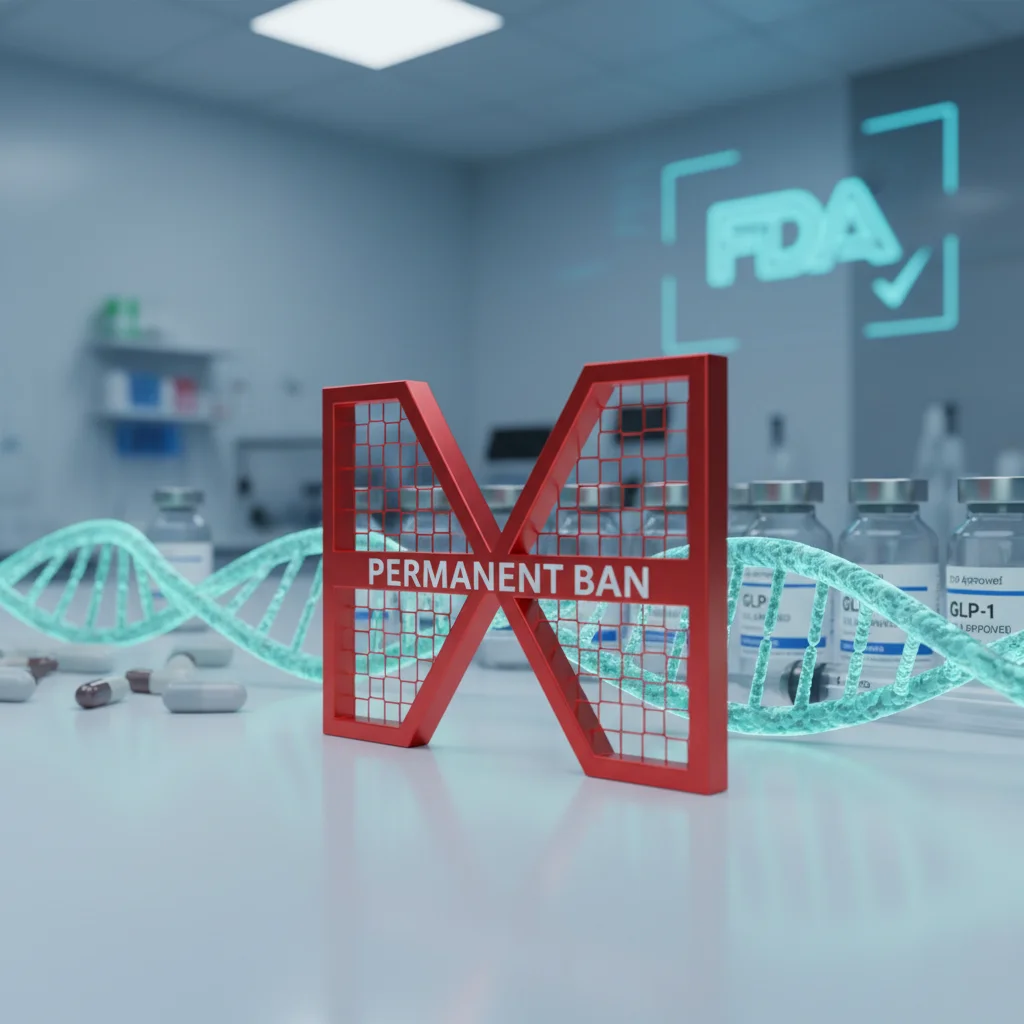
FDA’s permanent ban on compounded GLP-1s is best understood as the end of shortage-era enforcement discretion for essentially identical copies of approved GLP-1 drugs, followed by 2026 actions against mass-marketed unapproved products.
Contents10 sections
Key Takeaways
- FDA declared the semaglutide injection shortage resolved on February 21, 2025, with 503A/503B wind-down dates of April 22 and May 22, 2025.
- Tirzepatide shortage resolution earlier ended 503A discretion and set a March 19, 2025 503B wind-down.
- February 6, 2026 FDA statement targets mass-marketed non-approved GLP-1 APIs and misleading advertising.
- Narrow patient-specific 503A compounding may remain only when not essentially a copy and clinical need is documented.
What ended the shortage-era compounding window?
FDA’s compounder policy update states that on February 21, 2025 the agency determined the semaglutide injection shortage was resolved. Temporary enforcement discretion for essentially copy compounding then wound down to April 22, 2025 (503A) and May 22, 2025 (503B).
The underlying declaratory order is published as FDA media file 185526. Tirzepatide had already left shortage earlier, with earlier discretion end dates.
Why do headlines say “permanent ban”?
Once an approved drug is commercially available and off the shortage list, sections 503A and 503B again restrict compounding of essentially identical copies. That statutory baseline feels like a “permanent ban” on mass copycat GLP-1 products even though limited, differentiated, patient-specific compounding can still exist under narrow conditions.
Outsourcing facilities generally cannot compound from bulk GLP-1 APIs unless the substance is on the 503B Bulks List or the finished approved drug is on the shortage list—neither of which currently supports routine semaglutide or tirzepatide copies.
What did FDA announce in February 2026?
On February 6, 2026, FDA said it intends to take action against non-FDA-approved GLP-1 drugs mass-marketed as alternatives to approved products, citing quality, safety, and efficacy verification gaps. See the FDA press announcement.
The agency also flagged misleading advertising claims that compounded products are generics, contain the “same” active ingredient in a clinical-proof sense, or are proven to deliver labeled results.
What does this mean for pharma commercial teams?
Branded GLP-1 franchises regain structural share as copy compounding exits. Patient support, supply-chain reliability, and payer coverage become the competitive battleground again.
Compounding-heavy telehealth models face higher enforcement risk. Warning letters in 2025 already targeted misleading semaglutide and tirzepatide promotions.
How should compliance teams respond?
Audit marketing for any claim that a compounded GLP-1 equals Ozempic, Wegovy, Mounjaro, or Zepbound. Confirm 503A prescriptions document a clinical difference when compounding is attempted at all.
Monitor the separate April 30, 2026 proposal to exclude semaglutide, tirzepatide, and liraglutide from the 503B Bulks List, which would further close bulk compounding pathways for outsourcing facilities.
What remains uncertain?
“Permanent” describes the return to baseline copy restrictions after shortage resolution, not a new single statute titled “GLP-1 ban.” Litigation over shortage determinations previously delayed some timelines but did not restore open-ended mass compounding as of FDA’s 2026 enforcement posture.
Localized pharmacy stockouts can still occur without putting products back on the national shortage list.
Related NovaPharma coverage
- US FDA Proposes New Regulations on Weight-Loss Drug Compounding
- Sunlight GLP-1 2026: FDA Decision on Compounded Semaglutide
- Semaglutide drug profile
Frequently Asked Questions
When did FDA resolve the semaglutide shortage?
FDA determined on February 21, 2025 that the semaglutide injection product shortage was resolved, then set compounder enforcement-discretion end dates of April 22, 2025 (503A) and May 22, 2025 (503B).
Can any compounded GLP-1 still be lawful?
Possibly only in narrow patient-specific 503A situations that are not essentially copies of commercially available products and that meet other statutory conditions. Routine mass copies are not permitted after shortage resolution.
What did FDA announce on February 6, 2026?
FDA announced intent to restrict GLP-1 APIs used in non-approved compounded drugs that are mass-marketed as alternatives to FDA-approved products and to police misleading advertising claims.
Primary Sources
Sources & references 1 primary sources
Sources verified at publication. See our editorial policy and data sources.
This article follows our editorial standards. Report a correction via editorial contact.


Deeper reading
Industry reports & whitepapers
- Lilly's Weight-Loss Pill Approved, Sparking Competition with Novo Nordisk — Eli Lilly's daily weight-loss pill received FDA approval, setting the stage for a competitive battle…
- Ensuring Compatibility for GLP-1-based Drugs — The rise of GLP-1 agonists like Semaglutide demands innovative ready-to-use cartridges to enhance de…