STAT+: What stripping civil service protections for thousands of federal workers will mean for HHS

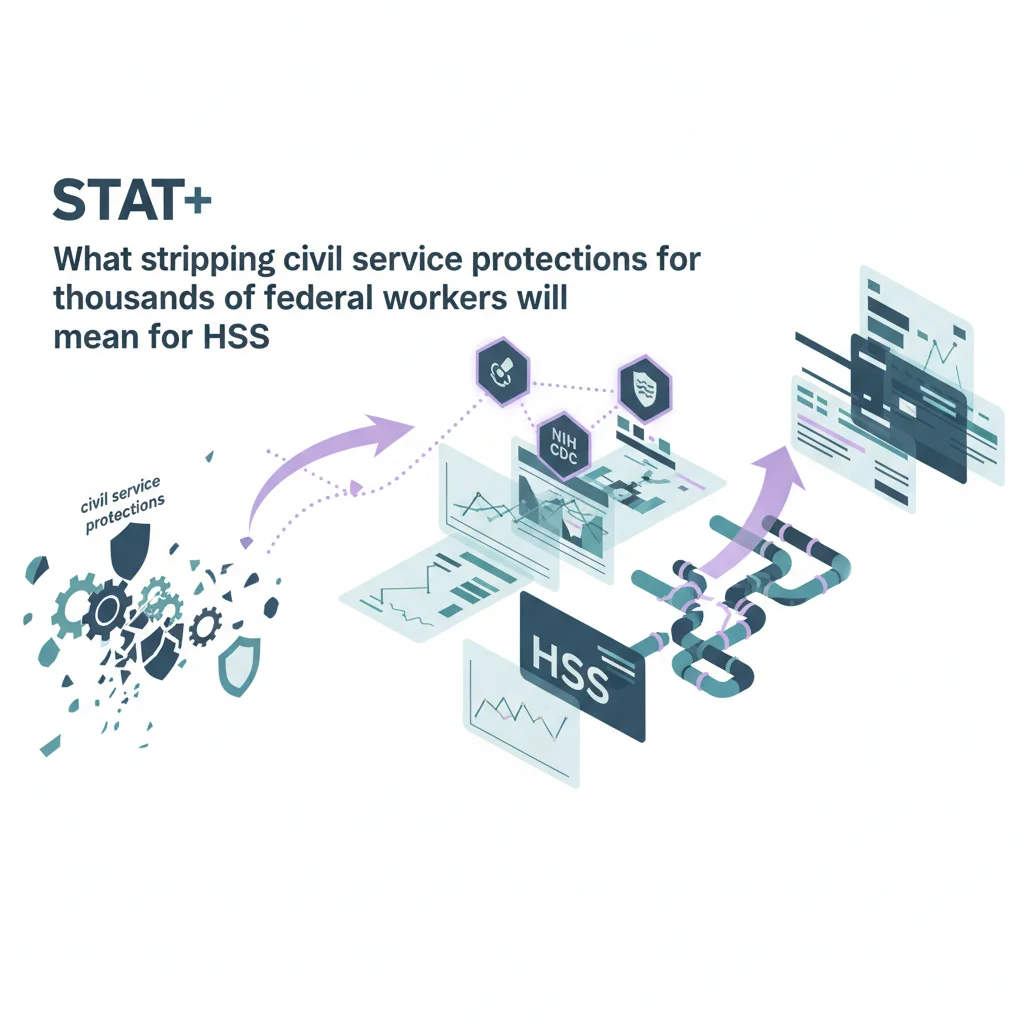
Decision brief
Answer first · skim in under a minute
President Trump's executive order reclassifying thousands of federal workers under Schedule F removes civil service protections for senior HHS staff, including at FDA, NIH, and CDC. This analysis explains the policy change, its implications for pharmaceutical regulatory processes, and what BD teams should monitor next.
STAT What stripping civil service protections means for HHS is no longer a hypothetical. Schedule Policy/Career rules and OPM's February 2026 final regulations create at-will accountability for policy-influencing career roles that can include FDA, NIH, and CDC positions.
Contents10 sections
Key Takeaways
- E.O. 14171 restored and renamed Schedule F as Schedule Policy/Career for policy-influencing career jobs.
- OPM issued final regulations on February 6, 2026 amending 5 CFR part 213 to add the schedule.
- Covered employees remain career hires but lose chapter 75-style adverse-action protections.
- Pharma teams should watch agency position lists for FDA/NIH/CDC roles moved into the schedule.
What is Schedule Policy/Career?
The personnel vehicle once called Schedule F was reinstated by Executive Order 14171 and redesignated Schedule Policy/Career. It covers career positions of a confidential, policy-determining, policy-making, or policy-advocating character.
OPM's February 6, 2026 final rule, published in the Federal Register (FR Doc 2026-02375), amends excepted-service regulations to implement that schedule while stressing that patronage remains prohibited.
How do the accountability rules change?
An April 23, 2025 OPM proposed rule on govinfo (FR Doc 2025-06904) explained the design: policy-influencing positions stay career and nonpartisan in hiring, yet become at-will and excepted from adverse-action procedures or MSPB appeals.
- Intent: faster removal for poor performance, misconduct, or failure to implement administration policy.
- Constraint: employees are not required to personally or politically support the President.
- Duty: they must faithfully implement administration policies consistent with their constitutional oath.
What did later presidential documents do?
A June 10, 2026 presidential document on implementing Schedule Policy/Career in the excepted service placed listed positions into the schedule and stated that numbering or organizational realignments do not remove a listed role from Schedule Policy/Career. See the June 10, 2026 FR PDF (2026-11594).
What should pharma regulatory teams monitor at HHS?
Drug sponsors care about review continuity, advisory-committee staffing, and inspection capacity. If FDA, NIH, or CDC policy-influencing billets move into Schedule Policy/Career, leadership turnover risk rises even when scientific standards remain legally unchanged. Track published position appendices and agency implementation memos rather than unverified headcount rumors.
What remains unsettled?
Litigation outcomes, the exact count of HHS employees ultimately listed, and whether review timelines change are not settled by the regulation text alone. Secondary media estimates of “about 8,000” workers are not treated here as primary facts.
How should sponsors interpret HHS workforce risk?
For companies with active NDAs, BLAs, or IND amendments, the practical question is continuity of review staff and advisory-committee logistics. Schedule Policy/Career changes the removal mechanics for policy-influencing billets; it does not rewrite 21 CFR efficacy standards. Still, sudden leadership churn can slow meetings, reassign applications, and reset institutional memory on complex files.
Compliance and government-affairs teams should map which FDA centers and HHS operating divisions appear in published Schedule Policy/Career appendices. They should also document primary contacts on each priority file so transitions do not strand mid-cycle information requests. Public Federal Register PDFs remain the authoritative list of placed positions when agencies publish them.
Investors tracking PDUFA calendars should treat personnel risk as a soft timeline factor, not as evidence that a specific drug will receive a complete response letter. Pair OPM rule reading with the agency calendar and meeting minutes already in the public domain.
Finally, keep a dated folder of the govinfo PDFs cited in this article. Personnel rules iterate quickly, and older Schedule F commentary from 2020 or 2024 no longer matches the Schedule Policy/Career nomenclature or the February 2026 OPM regulatory text that agencies are implementing now.
That archival habit also helps when counsel asks which version of the rule governed a given personnel action date.
Related NovaPharma coverage
- FDA guidance on sharing potential NDA patent information
- FDA MRD guidance in multiple myeloma
- Neurocrine Biosciences pipeline update
Frequently Asked Questions
What replaced Schedule F in federal personnel rules?
Executive Order 14171 reinstated the prior Schedule F concept as Schedule Policy/Career for career positions of a confidential, policy-determining, policy-making, or policy-advocating character. OPM finalized implementing regulations in February 2026.
Do Schedule Policy/Career employees remain career staff?
Yes. Official materials emphasize they remain career positions filled on a nonpartisan basis, but they serve at-will and are excepted from standard adverse-action procedures and Merit Systems Protection Board appeals that apply to competitive-service employees.
Why does this matter for FDA, NIH, and CDC work?
Policy-influencing roles across HHS can be placed into Schedule Policy/Career. Faster removal authority for nonperformance or failure to implement administration policy could affect continuity of regulatory review, grant, and public-health operations.
Primary Sources
Sources & references 1 primary sources
Sources verified at publication. See our editorial policy and data sources.
This article follows our editorial standards. Report a correction via editorial contact.