From Promise to Proof: The Shakeup in Today’s Biosimilar Market


Decision brief
Answer first · skim in under a minute
This article delves into the evolving landscape of the biosimilar market, highlighting key developments and their implications for stakeholders. Understand the investment opportunities and competitive dynamics shaping the future.
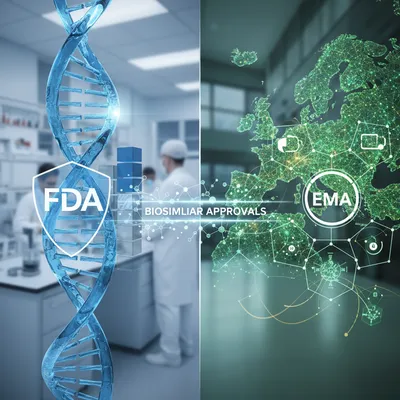
The 2026 biosimilar market shakeup is regulatory. EMA says comparative efficacy trials are generally not expected for well-characterized products. FDA is cutting pharmacokinetic study burden. Proof now rests more on analytics and PK than on large efficacy trials.
Contents11 sections
Key Takeaways
- EMA reflection paper: comparative efficacy studies are generally not expected if analytics hold.
- Comparative PK studies remain essential under EMA’s tailored approach.
- FDA: draft guidance may cut PK study costs by up to about 50% (about $20 million).
- FDA cited 82 approved U.S. biosimilars in that streamlining announcement.
What is shaking up today’s biosimilar market?
The shakeup is not one product launch. EMA and FDA are easing clinical evidence rules for well-characterized biologics. That lowers development cost. It also shortens filing timelines for challengers chasing loss-of-exclusivity cliffs.
EMA’s scientific framing sits in the Reflection paper on a tailored clinical approach in biosimilar development.
What does EMA’s tailored clinical approach allow?
The reflection paper says comparative efficacy studies are no longer expected for biosimilars that labs can fully characterize with modern analytics. Sponsors still must show physicochemical and functional similarity. Comparative clinical PK studies remain essential. Those studies can also support safety and immunogenicity claims.
EMA expects the tailored approach to cover most biosimilar candidates. Quality and PK bars stay in place. The weight of evidence moves toward analytics and PK. Large efficacy trials are no longer the default proof package.
For BD teams, that means dossier strategy should stress analytical similarity methods, critical quality attributes, and a clean PK bridge. A Phase 3 comparative efficacy study is no longer the automatic centerpiece for every monoclonal antibody program in Europe.
How is FDA cutting biosimilar development friction?
- New draft Q&A guidance revises biosimilar development questions under the BPCI Act.
- FDA estimate: up to about 50% pharmacokinetic study cost savings, or roughly $20 million, when streamlined PK testing is scientifically justified.
- FDA cited 82 approved U.S. biosimilars spanning oncology, rheumatology, diabetes, IBD, and osteoporosis in that announcement.
Primary source: FDA press announcement on biosimilar streamlining.
The draft Q&A replaces older Revision 3 text. It is guidance, not a final rule. Sponsors still need scientific justification when they propose less PK work. FDA’s message is efficiency where analytics already bound clinical risk.
Commercial implications for originators and challengers
Lower clinical burden helps firms that can ship strong analytical packages and multi-region dossiers fast. Originators should expect denser post-exclusivity competition. Earlier multi-entrant price erosion is more likely in Europe and the United States.
Pharmacy-level substitution still varies by EU member state. EMA may treat authorized biosimilars as scientifically interchangeable. National law still decides auto-substitution at the counter.
Global filers must still serve markets that keep confirmatory efficacy expectations. WHO’s evaluation text remains a useful cross-check: WHO guidelines on evaluation of biosimilars.
What “proof” means for investors in 2026
Proof is no longer the same as a large comparative efficacy trial for every molecule class. Investors should diligence analytical similarity packages. They should also review PK/PD bridges, immunogenicity plans, and tender strategy.
Portfolio companies that still budget full Phase 3 comparative efficacy studies for highly characterized monoclonal antibodies may overspend relative to EMA’s stated expectations. Cash burned on redundant CES is capital that cannot fund manufacturing scale or multi-market filings.
Teams should write BD memos with clear assumptions on approval status, label scope, and supply. National HTA bodies may not treat every form as equivalent for budgets. Clear sourcing beats peak-share models built only on CHMP headlines.
What remains unproven
Headline global market-size forecasts are not primary regulatory facts. This article omits them. Actual 2026–2028 share shifts will turn on interchangeability policy, hospital tendering, and whether major Asian regulators align with EMA/FDA streamlining.
Draft reflection papers and draft FDA Q&As can still change after consultation. Treat them as directional policy signals until final texts lock in.
Where international divergence still blocks full streamlining gains
Even if EMA and FDA reduce confirmatory efficacy expectations, global programs often follow the strictest major market. Sponsors targeting Japan, China, or Brazil may still run comparative efficacy studies that Europe no longer expects. That mutes near-term cost savings.
Until those agencies align, the “promise to proof” story is regional. EU and U.S. filings can move faster on analytics-plus-PK packages. Multi-region launches remain gated by the slowest confirmatory requirement.
Related NovaPharma coverage
- Biosimilar approvals: U.S. vs Europe insights
- FDA draft guidance on biosimilar PK study costs
- Biosimilars and specialty drug spending reductions
- FDA interchangeable biosimilars to Simponi / Simponi Aria
Frequently Asked Questions
What EMA policy shift is reshaping biosimilar development?
EMA’s reflection paper on a tailored clinical approach states comparative efficacy studies are no longer expected for thoroughly characterized biosimilars that show physicochemical and functional similarity, with comparative PK studies still essential.
What did FDA announce about biosimilar development costs?
In an FDA press announcement on streamlining biosimilars, the agency said new draft Q&A guidance could save developers up to about 50% of pharmacokinetic study costs, or roughly $20 million, when scientifically justified.
How many U.S. biosimilars had FDA approved in that announcement?
The FDA announcement stated the agency had approved 82 biosimilars providing additional treatment options across conditions such as cancer, rheumatoid arthritis, diabetes, Crohn’s disease, and osteoporosis.
Primary Sources
Sources & references 1 primary sources
Sources verified at publication. See our editorial policy and data sources.
This article follows our editorial standards. Report a correction via editorial contact.