
FDA Voucher Program Pause Urged: Rare Disease Policy Analysis

Decision brief
Answer first · skim in under a minute
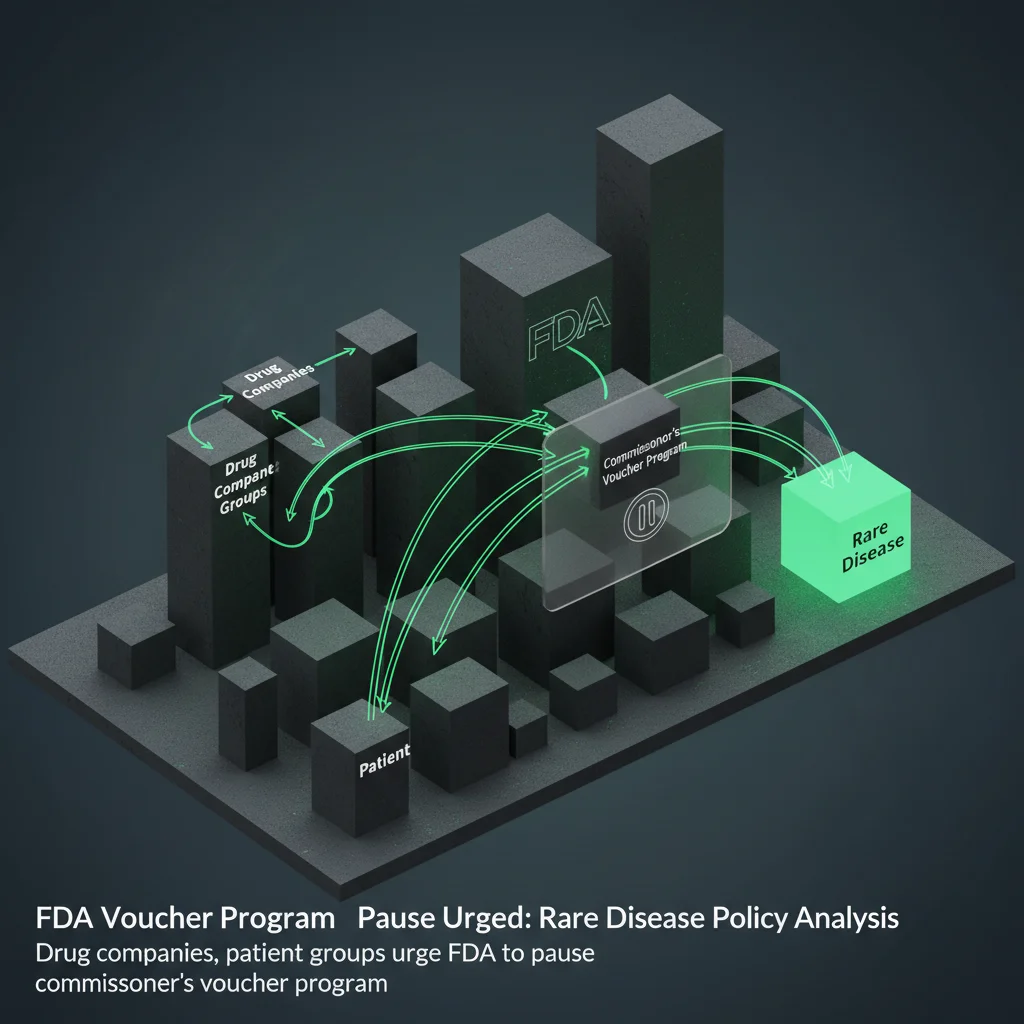
Drug companies and patient groups are urging the FDA to pause its commissioner's voucher program, citing concerns over political meddling in rare disease drug reviews. This analysis tracks the policy shift and its implications for pharma business development and investment teams.
Fda policy tracker online attention in 2026 centers on two voucher tracks: the Commissioner's National Priority Voucher (CNPV) pilot and the rare pediatric disease priority review voucher. Sponsors should separate political controversy from the primary FDA and statutory text.
Contents10 sections
Key Takeaways
- CNPV aims for 1–2 month reviews on a limited set of national-priority applications.
- FDA says CNPV keeps the same statutory approval standards as ordinary applications.
- Reuters documented CNPV review delays when safety or efficacy questions arose.
- Rare pediatric PRVs are authorized through September 30, 2029 under current FDA guidance.
What does FDA say the CNPV pilot does?
FDA's Commissioner's National Priority Voucher pilot page describes a pathway to reduce review times for selected drug and biological applications aligned with U.S. national health priorities. Benefits include enhanced communications and rolling review.
A June 2025 FDA press announcement said vouchers could shorten review from about 10–12 months to 1–2 months after final submission, while maintaining safety, efficacy, and quality standards.
Where have CNPV timelines slipped?
Reuters reported on January 15, 2026 that FDA delayed two drugs in the voucher program after reviewers raised safety and efficacy concerns, including a patient death on one medicine. The same reporting said some CNPV reviews were taking around four months rather than one to two.
See the Reuters report on CNPV delays. Separately, Disc Medicine later disclosed an FDA decline to approve bitopertin under the national priority pathway, underscoring that vouchers do not guarantee approval.
How does the rare pediatric PRV track differ?
The rare pediatric disease PRV under FD&C Act section 529 is a statutory incentive, not the commissioner's pilot. FDA's 2026 update states that after the Consolidated Appropriations Act, 2026, the program sunsets after September 30, 2029.
- Congress extended authority in H.R. 1262-related legislation to September 30, 2029.
- FDA may not award PRVs under that program after the sunset date.
- Designation requests still go through OOPD processes described on FDA.gov.
Primary pages: FDA rare pediatric PRV overview and Congress.gov text of H.R. 1262.
What should rare-disease BD teams do?
Model CNPV as optional acceleration with residual scientific risk, not as a political override of review standards. Model rare pediatric PRVs against the 2029 sunset and transfer/sale economics. Do not assume an informal “pause” of either program without an FDA notice saying so.
What remains unproven?
Claims that industry and patient groups jointly forced a formal CNPV pause at a June 4, 2026 town hall are not corroborated in the FDA primary pages cited here. Until FDA posts a pause order, treat pause talk as advocacy, not agency action.
How should teams use an Fda policy tracker online approach?
Build a simple tracker with three columns: statutory PRV programs, commissioner pilots, and live application clocks. Update it from FDA.gov pages and Federal Register notices first, then add wire reporting for operational color. That order prevents advocacy headlines from overwriting primary program text.
For CNPV candidates, document whether CMC and draft labeling were submitted at least 60 days before the final application, as FDA has stated for the pilot. Ambiguous pivotal results or incomplete modules can extend the review window even after a voucher is granted. Rare-disease teams should also log pediatric PRV designation dates against the September 30, 2029 award cutoff.
BD diligence memos should state explicitly whether a deal thesis depends on CNPV timing, transferable PRV resale value, or neither. Mixing those incentives creates valuation errors when one pathway slips and the other does not.
When communicating with boards, replace the vague phrase "FDA voucher pause" with the precise instrument under discussion: CNPV pilot operations, rare pediatric PRV sunset law, or a specific application delay. Precision keeps diligence notes aligned with the primary sources regulators actually publish.
Related NovaPharma coverage
- Rare disease hub
- Federal court litigation and rare disease implications
- European navenibart deal BioCryst analysis
Frequently Asked Questions
What is the Commissioner's National Priority Voucher program?
CNPV is an FDA pilot announced in June 2025 that can shorten review of selected drug or biologic applications to roughly 1–2 months after final submission, using a collaborative tumor board-style review while keeping standard approval standards.
Have CNPV reviews always hit the 1–2 month target?
No. Reuters reported in January 2026 that FDA delayed two CNPV reviews after scientists flagged safety and efficacy concerns, and that some reviews were taking around four months.
What is the rare pediatric disease PRV sunset date?
After enactment of the Consolidated Appropriations Act, 2026, FDA states the rare pediatric disease PRV program sunsets after September 30, 2029, and FDA may not award PRVs under that program after that date.
Primary Sources
Sources & references 1 primary sources
Sources verified at publication. See our editorial policy and data sources.
This article follows our editorial standards. Report a correction via editorial contact.


Deeper reading
Industry reports & whitepapers
- FDA CBER Patient Listening Meeting on Gene Therapy Safety: Patient and Care Partner Perspectives — Patient and care partner perspectives inform FDA’s thinking on approved gene therapy safety and long…