AI Clinical Research Data Harmonization Gap

Decision brief
Answer first · skim in under a minute
AI clinical research tools fail without comparable trial data. FDA AI guidance, ICH M11, and CDISC study-data rules make harmonization a submission risk.
AI clinical research tools fail when trial data are not comparable across sites and studies. Regulators are tightening the standards path—FDA AI credibility guidance, CDISC study-data requirements, and ICH M11 structured protocols—so data harmonization is now a submission and portfolio risk, not only an IT cleanup project.
Contents10 sections
Key Takeaways
- FDA published January 2025 draft guidance on AI used to support regulatory decisions, centered on risk-based model credibility for a stated context of use.
- CDER reports experience with more than 500 submissions containing AI components from 2016 to 2023, plus more than 800 public comments on its AI discussion paper.
- ICH M11 CeSHarP (Step 5 via EMA) standardizes protocol structure and electronic exchange so protocol content can be reused without re-keying free text.
- FDA still expects study data to conform to the Data Standards Catalog (CDISC SDTM/ADaM and related models); AI does not waive those transport and terminology rules.
Why is data harmonization still the bottleneck for AI in trials?
Clinical programs generate eCRF, lab, imaging, wearable, and real-world extracts that rarely share the same variable names, units, or visit windows. Models trained on one sponsor’s warehouse often break when asked to pool Phase 2 and Phase 3 tables or to compare EU and U.S. sites.
Harmonization means mapping those sources onto shared semantics—typically CDISC domains and controlled terminology—before analytics or AI scoring. Without that step, “AI acceleration” claims collapse into manual data-management backlog. Public regulator materials emphasize standards adherence; they do not publish a universal percent time saved from any named vendor tool.
What does FDA’s AI guidance actually require?
In January 2025, FDA issued draft guidance titled Considerations for the Use of Artificial Intelligence to Support Regulatory Decision-Making for Drug and Biological Products. The document frames a risk-based credibility assessment for AI models that produce information intended to support safety, effectiveness, or quality decisions.
CDER’s Artificial Intelligence for Drug Development page states the draft was informed by a Duke Margolis workshop, more than 800 external comments on the May 2023 AI discussion paper, experience with more than 500 AI-containing submissions from 2016 to 2023, and public workshops in 2024 and 2025.
In January 2026, CDER and CBER, working with EMA, published 10 guiding principles of good AI practice, including human-centric design, risk-based approach, adherence to standards, clear context of use, data governance, and life-cycle management.
How do CDISC and FDA study-data rules constrain AI pipelines?
Even when sponsors use AI for cleaning, coding, or signal detection, electronic submissions still travel through eCTD Modules 4 and 5 under FDA’s standardized study-data framework. FDA’s study-data materials require conformance to the FDA Data Standards Catalog, which points to CDISC models such as SDTM and ADaM.
Technical rejection criteria (for example eCTD validations covering trial summary, DM, and ADSL datasets) can block a filing if required standardized datasets are missing. That means AI-generated intermediate tables still need a governed mapping layer into catalog-listed structures before they count as reviewable evidence.
- Standards catalog compliance remains a gate for Modules 4/5 study data
- SDTM/ADaM (and related models) define the exchange shape reviewers expect
- AI outputs that cannot be traced to those standards create credibility and rejection risk
What does ICH M11 change for protocol-level harmonization?
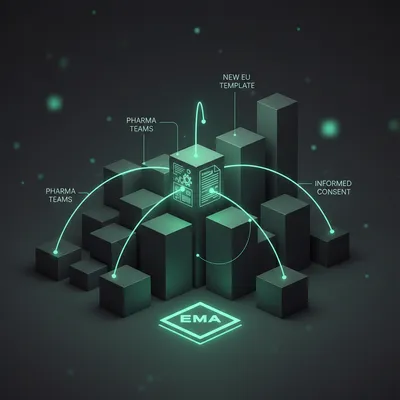
ICH M11 introduces the Clinical Electronic Structured Harmonised Protocol (CeSHarP): a template plus technical specification for consistent protocol organization and interoperable electronic exchange across ICH regions.
The EMA ICH M11 scientific guideline page explains that the template standardizes required and optional protocol components, while the technical specification defines conformance, cardinality, and attributes for machine-readable exchange. ICH adopted the final M11 guideline on 19 November 2025; EMA Step 5 documents carry December 2025 dates.
For EU and global programs, M11 is the upstream fix: if endpoints, populations, and visit schedules are structured at protocol authoring, downstream SDTM mapping and cross-trial AI reuse become cheaper and more auditable.
How should EU pharma and CRO teams respond in 2026?
Treat harmonization as a regulatory workstream with named owners, not a side project for data engineers.
- Map every AI use case to a context of use and a credibility plan consistent with FDA’s draft guidance and the FDA–EMA guiding principles.
- Budget protocol authoring against ICH M11 template/TS fields before first patient in.
- Require vendors to export CDISC-aligned datasets with traceable transforms, not only dashboards.
- Align EU CTIS/clinical operations with the same controlled terminology used for U.S. Module 5 packages when the program is multi-regional.
Related NovaPharma coverage on EMA AI research priorities and MHRA AI tooling shows the same theme: regulators want documented data lineage, not black-box speed claims.
What remains unproven?
Public FDA and EMA pages do not certify that any commercial “AI harmonization” product cuts cycle time by a fixed percentage across therapeutic areas. They also do not replace human accountability for protocol design, medical coding, or benefit–risk conclusions. Sponsors should delete vendor ROI figures that lack a primary filing, peer-reviewed methods paper, or regulator case study with transparent denominators.
Related NovaPharma coverage
- EMA researchers map AI research priorities across the medicines lifecycle
- MHRA targets medicine safety with new AI sandbox
- BioCryst’s New ORLADEYO Data Adds Real-World HAE Evidence
Frequently Asked Questions
What is clinical data harmonization in trials?
It is the alignment of definitions, formats, and controlled terminology so data from sites, labs, devices, and prior studies can be compared and submitted in a regulator-accepted structure such as CDISC SDTM/ADaM.
How does FDA expect sponsors to handle AI that supports regulatory decisions?
FDA’s January 2025 draft guidance describes a risk-based credibility assessment for AI models used to produce information intended to support drug safety, effectiveness, or quality decisions for a defined context of use.
What is ICH M11 CeSHarP?
ICH M11 defines a Clinical Electronic Structured Harmonised Protocol template and technical specification so protocol content can be exchanged in a consistent, machine-readable format across ICH regions.
Primary Sources
Sources & references 1 primary sources
Sources verified at publication. See our editorial policy and data sources.
This article follows our editorial standards. Report a correction via editorial contact.