
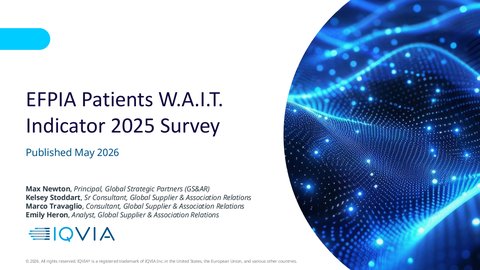
EFPIA Patients W.A.I.T. Indicator 2025: Europe access trends, reimbursement and time-to-availability
Availability remains near prior levels, while time to patient access has lengthened in the EFPIA Patients W.A.I.T. Indicator 2025 Survey.
- Publisher
- www.efpia.eu
- Length
- 72 pages
- File
- 0 B PDF
Quick answer
EFPIA Patients W.A.I.T. Indicator 2025: Europe access trends, reimbursement and time-to-availability is a 72-page whitepaper from www.efpia.eu covering EU pharma intelligence. Full availability on public reimbursement lists stands at 28%, down from 29% in the 2024 study, indicating a declining trend in unrestricted patient access across the EU27.
Why this matters
Full availability on public reimbursement lists stands at 28%, down from 29% in the 2024 study, indicating a declining trend in unrestricted patient access across the EU27.
Executive summary
- Full availability on public reimbursement lists stands at 28%, down from 29% in the 2024 study, indicating a declining trend in unrestricted patient access across the EU27.
- Limited availability—medicines available under restrictions—remains significant at 17%, reflecting the shift toward conditional access pathways rather than universal reimbursement.
- Average time to availability increased to 597 days from 578 days in the prior study, suggesting lengthening delays between central approval and public list inclusion.
- Access disparity exceeds 80% between highest and lowest performing European countries across multiple studies, underscoring persistent fragmentation in the European market.
- Public reimbursement lists capture only one component of the access landscape; alternative channels, managed entry agreements, and non-reimbursed early access programmes remain unmeasured.
AI research brief
Availability remains near prior levels, while time to patient access has lengthened in the EFPIA Patients W.A.I.T. Indicator 2025 Survey.
Market Impact
| Regulatory | high |
|---|---|
| Commercial | high |
| Competitive | medium |
| Investment | high |
Who should read this
- EU market access specialists
Ask about this report
AI-assisted answers grounded in NovaPharmaNews intelligence
Answers use retrieved site intelligence plus AI synthesis. Verify critical decisions with primary sources.
Download the full 72-page PDF
Free · 0 B · Instant access after email
The EFPIA Patients W.A.I.T. Indicator 2025 reveals that full availability of innovative medicines on European public reimbursement lists has declined to 28%, while time to patient access has increased to 597 days—19 days longer than the prior year. Access disparity across Europe remains pronounced, with more than 80% variation between the highest and lowest performing countries.
Key Takeaways
- Full availability on public reimbursement lists stands at 28%, down from 29% in the 2024 study, indicating a declining trend in unrestricted patient access across the EU27.
- Limited availability—medicines available under restrictions—remains significant at 17%, reflecting the shift toward conditional access pathways rather than universal reimbursement.
- Average time to availability increased to 597 days from 578 days in the prior study, suggesting lengthening delays between central approval and public list inclusion.
- Access disparity exceeds 80% between highest and lowest performing European countries across multiple studies, underscoring persistent fragmentation in the European market.
- Public reimbursement lists capture only one component of the access landscape; alternative channels, managed entry agreements, and non-reimbursed early access programmes remain unmeasured.
What Does This Study Cover?
The EFPIA Patients W.A.I.T. Indicator—a long-running survey since 2004—tracks availability of 168 innovative medicines with central marketing authorisation across 36 countries. The 2025 edition measures whether products appear on public reimbursement lists, classifies access as full or limited, and quantifies time from European Commission approval to availability. Data are current as of 5 January 2026 and include medicines approved between 2021 and 2024. Information is collected directly from local pharmaceutical industry associations to ensure accuracy and transparency.
Why This Matters for Pharma Teams
For market access, regulatory, and commercial teams, the W.A.I.T. Indicator provides comparative visibility into how quickly innovative medicines reach patients across Europe and the frequency of access restrictions. These insights support launch sequencing decisions, reimbursement strategy development, affiliate planning, and country prioritization. However, teams should note that public reimbursement list data do not capture every access pathway—including managed entry agreements, private channels, or early access programmes—and country-specific nuances should be verified with local associations or EFPIA directly.
How Has the Access Landscape Changed?
Between 2019 and 2025, the European access environment has shifted substantially. In 2019, 46% of innovative medicines were not available to patients, and full availability was the dominant access route at 42%. By 2025, unavailability has remained near 49%, but the composition of available medicines has changed: full availability has declined to 28%, while limited availability—medicines available under restrictions—has grown to 17%. This trend reflects the rise of alternative access channels and conditional reimbursement models alongside traditional public listing.
Frequently Asked Questions
What counts as "full availability" versus "limited availability"?
Full availability means the innovative medicine is included on the public reimbursement list without restrictions. Limited availability indicates the product is on the list but subject to conditions—such as managed entry agreements, line-of-therapy restrictions, formulary limitations, or availability to a defined patient subpopulation. The W.A.I.T. Indicator does not measure uptake or actual usage; it records whether reimbursement access is formally granted and under what terms.
Why has time to availability increased?
The average time from central approval to public reimbursement list inclusion rose from 578 days in 2024 to 597 days in 2025. The W.A.I.T. Indicator measures this transition but does not attribute causation to specific factors. Delays may reflect variations in national health technology assessment timelines, pricing negotiations, or administrative processes, but the report emphasizes that country-specific context should be discussed directly with local associations.
What does the 80% access disparity between countries mean?
Across multiple studies, the difference in full availability rates between the highest and lowest performing European countries exceeds 80 percentage points. This indicates substantial fragmentation: some countries achieve rapid and broad reimbursement, while others experience prolonged delays or more frequent restrictions. This disparity underscores the importance of country-specific market access planning.
Does the W.A.I.T. Indicator show all ways patients can access medicines?
No. The W.A.I.T. Indicator focuses on public reimbursement lists and does not capture private purchase pathways, non-reimbursed early access programmes, managed entry agreements, or sales data. The report acknowledges these gaps and notes that a complete picture of patient access requires supplementary data from other sources and direct dialogue with local healthcare systems.
How is the data collected and validated?
Local pharmaceutical industry associations in each of the 36 surveyed countries provide availability data directly to IQVIA and EFPIA. Definitions of availability and restrictions are documented in the report's appendix to ensure transparency. Where public reimbursement lists are not kept current, companies are contacted directly to confirm the status of their molecules under the study's defined criteria.
Related coverage
Frequently asked questions
What whitepapers does NovaPharmaNews publish?
Our research library curates FDA, EMA, and industry publisher PDFs — regulatory guidance, clinical analyses, manufacturing reports, and market intelligence. Each report includes an AI-summarized landing page with key takeaways and a gated PDF download.
How do I download a whitepaper?
Open any report page, scroll to the download form, and enter your work email. You receive instant PDF access and can opt in to weekly pharma intelligence updates. Downloads are free for healthcare professionals.
How do whitepapers connect to news and pipeline data?
Report pages link to related intelligence — company profiles, drug INN pages, clinical trials, pipeline programs, and topic hubs. Use the intelligence spokes on each page to explore the entity graph behind the research.
Ready to read the full report?
Join 12,000+ pharma leaders getting deep industry analysis delivered weekly.
Related topic hubs
Editorial coverage and intelligence directories for this report's beat.
Explore the intelligence platform
Related intelligence
 🔒
🔒 EMA 2025 Annual Report Annexes: Committees, Opinions, and Governance
The document comprises 24 annexes documenting EMA committee memberships, 2025 scientific opinions, and regulatory decisions across human and…
 🔒
🔒 Healthcare investment in Central and Eastern Europe: what pharma teams should know
CEE governments invested an average of 5.47% of GDP in healthcare in 2023, compared with 8.17% in the EU4 (Germany, France, Italy, Spain). T…
 🔒
🔒 EFPIA on Harmonising Pharmaceutical Product Carbon Footprints with PAS 2090
Pharmaceutical product carbon footprint (PCF) and life cycle assessment (LCA) reporting currently lacks harmonised, sector-specific standard…