ANVISA Approves MagicTouch SCB: What You Need to Know
ANVISA has officially approved MagicTouch SCB, a groundbreaking treatment for chronic pain, offering new hope for patients seeking relief.
Quick Answer
ANVISA has officially approved MagicTouch SCB, a groundbreaking treatment for chronic pain, offering new hope for patients seeking relief.
Key Questions
- What is a sirolimus-coated balloon and how does it differ from a drug-eluting stent?
- Why is the MagicTouch SCB approval significant for Brazil's cardiology market?
- What clinical evidence supports the MagicTouch sirolimus-coated balloon?
- How does the MagicTouch SCB deliver sirolimus to the vessel wall?
- What are the next steps for Concept Medical in Brazil?
Concept Medical's MagicTouch sirolimus-coated balloon (SCB) received commercial approval from Brazil's Agência Nacional de Vigilância Sanitária (ANVISA) for treating coronary artery disease. This regulatory milestone, announced September 12, 2025, marks the first ANVISA-approved sirolimus-coated balloon in Brazil. The device introduces a metal-free treatment alternative for percutaneous coronary intervention (PCI) procedures.
Contents10 sections
Key Takeaways
- First ANVISA-approved sirolimus balloon: Concept Medical's MagicTouch SCB became the first and only sirolimus-coated balloon approved by ANVISA for coronary artery disease treatment in Brazil, offering a metal-free alternative to drug-eluting stents. [Concept Medical]
- Extensive clinical evidence: The device is supported by over 45 clinical trials involving more than 24,000 patients globally, with ongoing pivotal studies including MAGICAL SV (NCT06271590) and MAGICAL ISR (NCT05908331). [ClinicalTrials.gov]
- Growing PCI market: National PCI hospitalizations in Brazil increased 190.94% from 2008 to 2023 per DATASUS data, with the Southeast region showing the highest procedural volumes. [SciELO/CSP]
- Nanolute drug delivery: The device uses proprietary polymer-free nanocarrier technology to encapsulate sirolimus in a phospholipid carrier, enabling 100% balloon surface coverage and sustained drug release over 8-12 weeks. [Concept Medical]
- Metal-free therapeutic option: Unlike drug-eluting stents that remain permanently implanted, the MagicTouch SCB delivers sirolimus locally and is removed, potentially reducing late thrombotic risk.
What Is the MagicTouch Sirolimus-Coated Balloon?
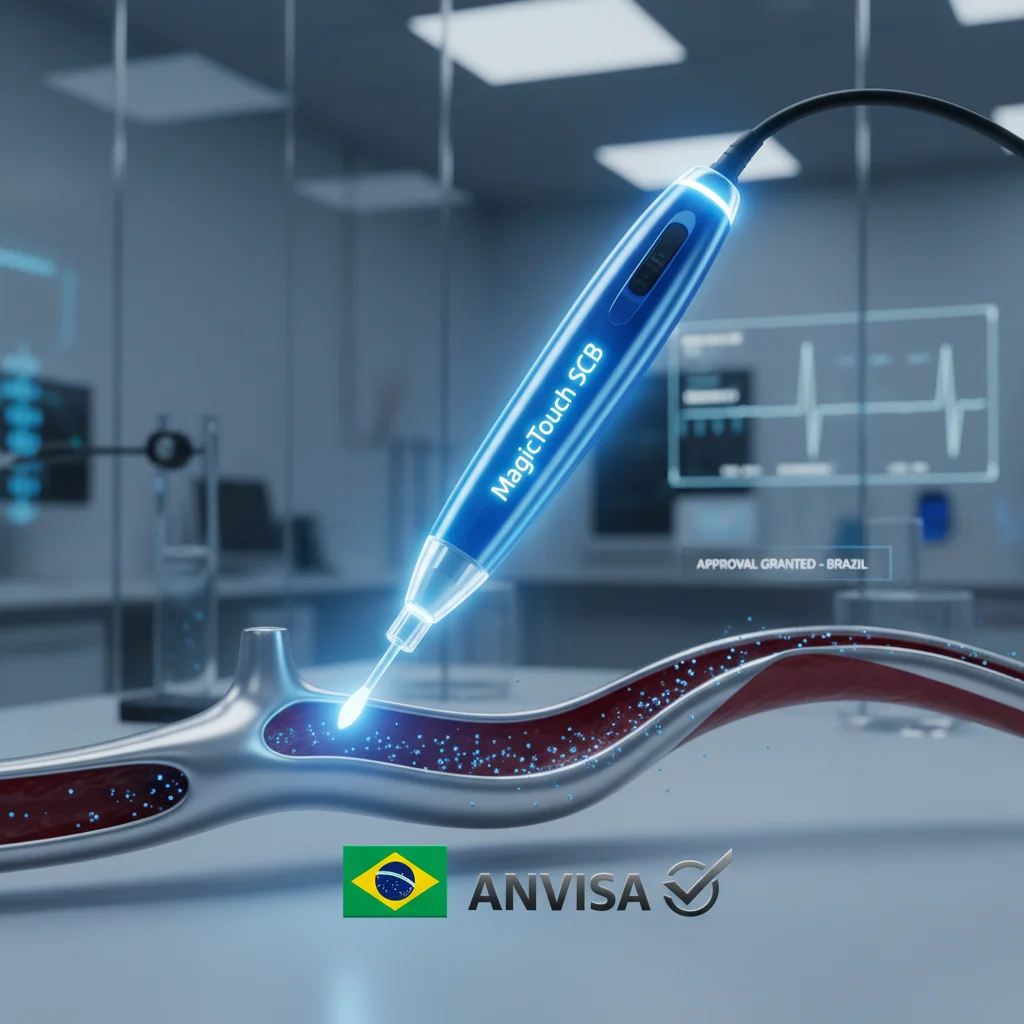
The MagicTouch sirolimus-coated balloon is a drug-coated balloon (DCB) device designed for percutaneous coronary intervention. It delivers sirolimus—an immunosuppressant and anti-proliferative agent—directly to the coronary artery wall during angioplasty.
Sirolimus inhibits neointimal hyperplasia, the abnormal growth of smooth muscle cells that causes restenosis (recurrent narrowing of the coronary artery). The device's proprietary NANOLUTE technology uses polymer-free nanocarriers to encapsulate sirolimus in a phospholipid carrier. This enhances lipophilicity and ensures homogeneous drug distribution across the entire balloon surface.
Unlike traditional drug-eluting stents (DES), which remain permanently in the vessel, the MagicTouch SCB is a metal-free device. The balloon delivers the drug and is then removed. This design theoretically reduces long-term thrombotic risk and inflammation associated with permanent metallic implants.
What Clinical Evidence Supports This Device?
ANVISA's approval decision was based on established clinical evidence from international markets. According to Concept Medical's press release, the MagicTouch SCB is supported by over 45 clinical trials involving more than 24,000 patients globally.
Two pivotal trials are currently recruiting participants:
| Trial | NCT Number | Population | Primary Endpoint | Enrollment |
|---|---|---|---|---|
| MAGICAL SV | NCT06271590 | Small vessels (≤2.75 mm) | Target Lesion Failure at 12 months | 1,605 |
| MAGICAL ISR | NCT05908331 | In-stent restenosis | Target Lesion Failure at 12 months | 492 |
The MAGICAL SV trial is a multicenter, randomized, single-blind, non-inferiority study comparing MagicTouch SCB to drug-eluting stents. The MAGICAL ISR trial is a superiority study comparing MagicTouch SCB to plain old balloon angioplasty for in-stent restenosis lesions.
A 2024 pooled analysis published in the Journal of Invasive Cardiology found comparable rates of target lesion revascularization, myocardial infarction, and major adverse cardiovascular events between sirolimus-coated balloons and thin-strut drug-eluting stents at 2 years.
How Does ANVISA's Approval Fit Into Regulatory Context?
ANVISA granted commercial approval to the MagicTouch sirolimus-coated balloon on September 12, 2025. This represents a significant regulatory milestone as the first sirolimus-coated balloon device authorized by ANVISA.
The approval positions Concept Medical as the first market entrant in this device category in Brazil. The regulatory decision reflects ANVISA's assessment that the device meets safety and efficacy standards for commercial distribution.
The 2021 ACC/AHA/SCAI Guideline for Coronary Artery Revascularization supports the use of drug-coated balloons for treating in-stent restenosis. This guideline provides a framework for integrating DCB technology into clinical practice.
What Is the Market Opportunity in Brazil?
Brazil represents a substantial clinical and commercial opportunity for interventional cardiology devices. DATASUS data shows national PCI hospitalizations increased 190.94% from 2008 to 2023.
Regional disparities exist across Brazil's healthcare system:
- Southeast region: Highest PCI procedure rates, accounting for the majority of hospitalizations
- South region: 26.22 procedures per 100,000 population (2023)
- North region: 1.49 procedures per 100,000 population—indicating underserved demand
The Southeast and South regions show the highest procedural volumes, while the North remains critically underserved. This geographic variation presents both challenges and opportunities for device manufacturers.
Compared with conventional DES, which remain permanently implanted, the MagicTouch SCB offers theoretical advantages. These include reduced late thrombosis risk, preservation of coronary anatomy for future interventions, and elimination of long-term foreign body burden.
What Should Clinicians and Investors Watch Next?
The commercial rollout of MagicTouch SCB in Brazil will generate real-world efficacy and safety data in the Brazilian patient population. This post-market surveillance will complement existing clinical trial evidence.
Concept Medical may pursue label expansions or additional clinical studies to demonstrate outcomes in specific patient subgroups. Potential targets include patients with diabetes, small vessel disease, or complex lesions.
The approval in Brazil could serve as a regulatory precedent for other Latin American markets. Neighboring countries may accelerate market entry through ANVISA-recognized pathways or regional regulatory harmonization initiatives.
Key challenges remain. Establishing comprehensive post-market surveillance data, securing favorable reimbursement decisions from Brazil's Unified Health System (SUS) and private insurers, and competing with established DES manufacturers will determine commercial success.
Frequently Asked Questions
What is a sirolimus-coated balloon and how does it differ from a drug-eluting stent?
A sirolimus-coated balloon (SCB) is a temporary interventional device that delivers the anti-proliferative drug sirolimus directly to the coronary artery wall during angioplasty and then is removed. In contrast, a drug-eluting stent (DES) is a permanent metallic scaffold that remains in the vessel indefinitely. The MagicTouch SCB's metal-free design reduces late thrombotic complications and preserves vessel anatomy for future interventions.
Why is the MagicTouch SCB approval significant for Brazil's cardiology market?
This is the first sirolimus-coated balloon device approved by ANVISA, introducing a novel metal-free treatment option to Brazil's PCI market. National PCI hospitalizations increased 190.94% from 2008 to 2023 per DATASUS data, indicating substantial demand for interventional cardiology solutions.
What clinical evidence supports the MagicTouch sirolimus-coated balloon?
The MagicTouch SCB is supported by over 45 clinical trials involving more than 24,000 patients globally per Concept Medical. Ongoing pivotal trials include MAGICAL SV (NCT06271590) for small vessels with 1,605 participants and MAGICAL ISR (NCT05908331) for in-stent restenosis with 492 participants.
How does the MagicTouch SCB deliver sirolimus to the vessel wall?
The device uses proprietary NANOLUTE technology, a polymer-free nanocarrier system that encapsulates sirolimus in a phospholipid carrier. This enhances lipophilicity, ensuring homogeneous drug distribution across 100% of the balloon surface and sustained therapeutic release over 8-12 weeks.
What are the next steps for Concept Medical in Brazil?
Concept Medical will initiate commercial distribution of MagicTouch SCB in Brazil, establish relationships with interventional cardiology centers, and generate real-world clinical data. The company may also pursue regulatory approvals in other Latin American markets through ANVISA-recognized pathways.
Primary Sources
- Concept Medical. "ANVISA Grants Commercial Approval to Concept Medical's MagicTouch Sirolimus-Coated Balloon for CAD in Brazil." Press Release, September 12, 2025.
- ClinicalTrials.gov. NCT06271590: MagicTouch Sirolimus-Coated Balloon for Treatment of Coronary Artery Lesions in Small Vessels (MAGICAL SV). U.S. National Library of Medicine.
- ClinicalTrials.gov. NCT05908331: MagicTouch Sirolimus-coated Balloon for Treatment of In-Stent Restenosis in Coronary Artery Lesions (MAGICAL ISR). U.S. National Library of Medicine.
- Concept Medical. "NANOLUTE Technology." Technical Documentation.
- Silva AS, et al. "Temporal and Spatial Trends in Myocardial Revascularization in Brazil, 2008-2023." Cadernos de Saúde Pública, 2024.
- Gao X, et al. "Sirolimus-Coated Balloon vs. Thin-Strut Drug-Eluting Stent for Coronary In-Stent Restenosis: A Pooled Analysis." Journal of Invasive Cardiology, 2024.
- Lawton JS, et al. "2021 ACC/AHA/SCAI Guideline for Coronary Artery Revascularization." Journal of the American College of Cardiology, 2022.
Related profiles
Related coverage
Continue Exploring
Jump into the entities behind this story.
This article follows our editorial standards. Report a correction via editorial contact.