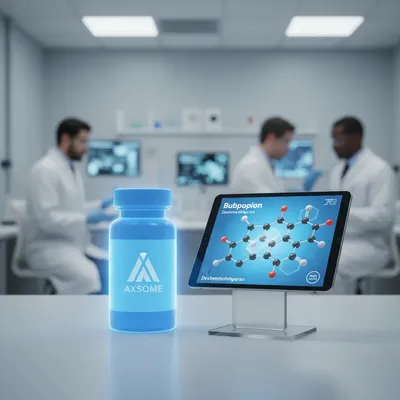
Drugs: Auvelity
FDA Approves Auvelity: A New Option for MDD
The FDA has approved Auvelity, a new oral antidepressant combining bupropion and dextromethorphan, for the treatment of major depressive disorder (MDD) in adults. Manufactured by Axsome Therapeutics, this approval marks a significant advancement in MDD treatment options.
Intelligence Snapshot
Executive Summary
Investment catalyst: The U.S. Food and Drug Administration (FDA) approval of bupropion/dextromethorphan ( Auvelity ) positions Axsome Therapeutics ($AXSM) to capture market share in the large and underserved major depressive disorder (MDD) segment, establishing a commercial-stage revenue base for the first time.
Key Insights
-
Competitive impact: Auvelity's dual NMDA antagonist and NDRI mechanism differentiates it…
Competitive impact: Auvelity's dual NMDA antagonist and NDRI mechanism differentiates it structurally from legacy SSRIs and SNRIs — including escitalopram , sertraline , venlafaxine , and duloxetine — positioning it as a mechanistically distinct alternative rather than a direct formulary substitute.
-
Market opportunity: MDD affects tens of millions of adults in the United States, with a…
Market opportunity: MDD affects tens of millions of adults in the United States, with a substantial proportion failing to achieve adequate response on first-line agents, representing a meaningful addressable population for a novel-mechanism therapy.
-
Next catalysts: Commercial launch trajectory, early prescription volume data, managed…
Next catalysts: Commercial launch trajectory, early prescription volume data, managed care coverage decisions, and any pipeline updates from Axsome's broader CNS portfolio will be the primary near-term signals for investors and BD teams.
Market Impact
| Regulatory | medium |
|---|---|
| Commercial | medium |
| Competitive | low |
| Investment | low |
The FDA approved bupropion/dextromethorphan (Auvelity) on August 19, 2022, for the treatment of major depressive disorder in adults — marking the first approval of an oral NMDA receptor antagonist-based antidepressant and a meaningful commercial milestone for Axsome Therapeutics ($AXSM). The Auvelity FDA approval adds a mechanistically differentiated option to a market long dominated by monoaminergic agents.
Loading intelligence…
Executive Scorecard
Heuristic scores · directional, not investment adviceRegulatory catalyst tracker
Track PDUFA dates, approval milestones, and label updates for Auvelity.
Unlock full calendar →Investor brief
Download a one-page summary of regulatory impact and competitive context.
Explore drug hub →Contents9 sections
Key Takeaways
- Investment catalyst: The U.S. Food and Drug Administration (FDA) approval of bupropion/dextromethorphan (Auvelity) positions Axsome Therapeutics ($AXSM) to capture market share in the large and underserved major depressive disorder (MDD) segment, establishing a commercial-stage revenue base for the first time.
- Competitive impact: Auvelity's dual NMDA antagonist and NDRI mechanism differentiates it structurally from legacy SSRIs and SNRIs — including escitalopram, sertraline, venlafaxine, and duloxetine — positioning it as a mechanistically distinct alternative rather than a direct formulary substitute.
- Market opportunity: MDD affects tens of millions of adults in the United States, with a substantial proportion failing to achieve adequate response on first-line agents, representing a meaningful addressable population for a novel-mechanism therapy.
- Next catalysts: Commercial launch trajectory, early prescription volume data, managed care coverage decisions, and any pipeline updates from Axsome's broader CNS portfolio will be the primary near-term signals for investors and BD teams.
What Is Auvelity and Why Is Its FDA Approval Significant?
For BD teams and portfolio managers, the approval is notable not only for the asset itself but for what it signals about regulatory receptivity to glutamatergic targets in psychiatry — a pathway that had previously been validated only in the injectable or intranasal setting.
Drug at a Glance
Generic name (INN)Bupropion hydrochloride / dextromethorphan hydrobromide Brand nameAuvelity Mechanism of actionNMDA receptor antagonist (dextromethorphan) + norepinephrine/dopamine reuptake inhibitor (bupropion) IndicationMajor depressive disorder (MDD) in adults SponsorAxsome Therapeutics ($AXSM) Approval statusFDA approved Approval dateAugust 19, 2022IntelligenceRegulatory Impact
FDA are the agencies to watch. Regulatory relevance reads medium for major depressive disorder (mdd), with Auvelity most exposed to upcoming decisions. Teams should track submission types, designations, and guidance shifts that could move approval timelines.
What Is the Mechanism of Action for Auvelity in MDD?
Bupropion/dextromethorphan (Auvelity) operates through a dual mechanism that distinguishes it from the SSRI and SNRI classes that have dominated MDD pharmacotherapy for decades. Dextromethorphan functions as an NMDA receptor antagonist, modulating glutamatergic neurotransmission — the same broad pathway implicated in the rapid-acting antidepressant effects observed with ketamine-class agents. Bupropion serves a dual role: as a norepinephrine and dopamine reuptake inhibitor (NDRI) and as a cytochrome P450 2D6 inhibitor, the latter function being pharmacokinetically critical because it elevates systemic dextromethorphan exposure to therapeutically relevant levels.
This co-formulation strategy is the intellectual core of the asset. Without bupropion's CYP2D6 inhibition, dextromethorphan is rapidly metabolized and does not achieve CNS concentrations sufficient for NMDA antagonism at standard doses. The fixed-dose combination is therefore not simply additive; it is mechanistically interdependent, according to the pharmacological rationale described in Auvelity's FDA-approved prescribing information.
IntelligenceCompetitive Intelligence
Competitive pressure is low. Watch which sponsors move first. Benchmark pipeline positioning, differentiation, and partnership scouting against the signals in this story.
What Did the Clinical Trials for Auvelity Show?
The FDA's approval of bupropion/dextromethorphan (Auvelity) was supported by data from the ASCENT-2 Phase 3 trial, which evaluated the combination in adult patients with MDD. The primary endpoint was change from baseline in the Montgomery-Åsberg Depression Rating Scale (MADRS) total score at Week 6. According to Axsome Therapeutics, ASCENT-2 met its primary endpoint, with Auvelity demonstrating a statistically significant improvement in MADRS scores compared with placebo. Full granular efficacy data — including mean MADRS point differences, confidence intervals, and p-values — are available in the FDA medical review for NDA 214369 and in peer-reviewed publications indexed on PubMed.
Why it matters for investors and BD teams: A Week 6 primary endpoint in MDD is clinically meaningful — many legacy agents require 8–12 weeks to demonstrate full effect in label language. If Auvelity's onset advantage is confirmed in real-world practice, it could become a differentiating commercial message that supports premium positioning and formulary negotiation leverage.
IntelligenceMarket Signals
Commercial pull is medium and investment relevance low. Expect implications for major depressive disorder (mdd) pricing, access, and launch sequencing.
What Are the Investment Implications for Axsome Therapeutics ($AXSM)?
The Auvelity FDA approval converts Axsome Therapeutics ($AXSM) from a clinical-stage to a commercial-stage company — a structural transition that materially changes the risk profile and valuation framework applicable to the stock. Key near-term variables include the pace of managed care formulary inclusion, the net realized price after rebates, and the rate of physician adoption in psychiatry and primary care — the two channels that drive the majority of antidepressant volume in the U.S.
The competitive set is large and largely genericized. Escitalopram, sertraline, fluoxetine, venlafaxine, and duloxetine are all available at low cost, which means payers will apply step-edit pressure. Axsome's commercial thesis depends on demonstrating that Auvelity's mechanistic differentiation — particularly for patients with prior SSRI/SNRI failure — justifies its positioning on formulary tiers above generic alternatives.
Competitive Landscape: MDD Oral Antidepressants
| Drug | Company | Status | Key Differentiator |
|---|---|---|---|
| Bupropion/dextromethorphan (Auvelity) | Axsome Therapeutics ($AXSM) | FDA approved (Aug 2022) | Dual NMDA antagonist + NDRI; oral; novel mechanism |
| Escitalopram (Lexapro) | Generic / Allergan | Generic available | Established SSRI; low cost; extensive real-world data |
| Sertraline (Zoloft) | Generic / Pfizer ($PFE) | Generic available | High-volume SSRI; preferred first-line by many payers |
| Duloxetine (Cymbalta) | Generic / Eli Lilly ($LLY) | Generic available | SNRI; dual norepinephrine/serotonin reuptake; pain comorbidity label |
| Esketamine (Spravato) | Janssen / J&J ($JNJ) | FDA approved (2019); REMS-restricted | NMDA antagonist; intranasal; treatment-resistant MDD / acute SI |
IntelligenceStrategic Takeaways
Investment catalyst: The U.S. Food and Drug Administration (FDA) approval of bupropion/dextromethorphan ( Auvelity ) positions Axsome Therapeutics ($AXSM) to capture market share in the large and underserved major depressive disorder (MDD) segment, establishing a commercial-stage revenue base for the first time. Competitive impact: Auvelity's dual NMDA antagonist and NDRI mechanism differentiates it structurally from legacy SSRIs and SNRIs — including escitalopram , sertraline , venlafaxine , and duloxetine — positioning it as a mechanistically distinct alternative rather than a direct formulary substitute. Market opportunity: MDD affects tens of millions of adults in the United States, with a substantial proportion failing to achieve adequate response on first-line agents, representing a meaningful addressable population for a novel-mechanism therapy.
What Is the Market Opportunity for Auvelity in MDD?
MDD represents one of the largest addressable markets in CNS pharmacotherapy. According to data cited by the National Institute of Mental Health, an estimated 21 million adults in the United States experienced at least one major depressive episode in 2021. A substantial subset of this population is characterized by inadequate response to first- or second-line agents — a clinical segment where a novel-mechanism oral therapy could command both clinical and commercial differentiation.
Auvelity's addressable opportunity is most acute in the treatment-experienced segment, where the clinical and commercial argument for stepping up to a mechanistically distinct agent is strongest. Pricing, net realized revenue, and payer access terms disclosed in subsequent earnings calls will be the primary inputs for refining peak sales modeling.
IntelligenceEvidence Quality
Claims are grounded in the cited primary and secondary sources, with editorial review applied before publication.
What to Watch Following Auvelity's Approval?
Commercial execution will be the defining near-term variable for Axsome Therapeutics ($AXSM). Prescription volume trends, formulary tier placements from major pharmacy benefit managers, and net revenue per unit will be closely tracked by sell-side analysts across subsequent quarterly earnings reports. Any label expansion filings — for example, into adjunctive MDD use or other CNS indications in Axsome's pipeline — would represent additional catalysts.
What to watch next: Axsome's quarterly earnings disclosures for Auvelity net product revenue; managed care coverage decisions from major PBMs; real-world prescription data from IQVIA or Symphony Health; and any IND or Phase 2 initiation announcements for pipeline assets that could broaden the company's CNS commercial platform.
Related profiles
Related coverage
Continue Exploring
Jump into the entities behind this story.
Ask AI About Major Depressive Disorder (MDD)
Grounded in NovaPharmaNews intelligence. Pick a prompt to start.
Follow Auvelity developments
NMPA major depressive disorder (mdd) alerts and Auvelity pipeline updates, every Monday.
- Evidence strength
- 79/100
- Last verified
- Jun 18, 2026
- AI-assisted review
- Yes
- Editorial review
- Dr. Sarah Chen
High source quality · grounded in cited primary and secondary sources.
This article follows our editorial standards. Report a correction via editorial contact.