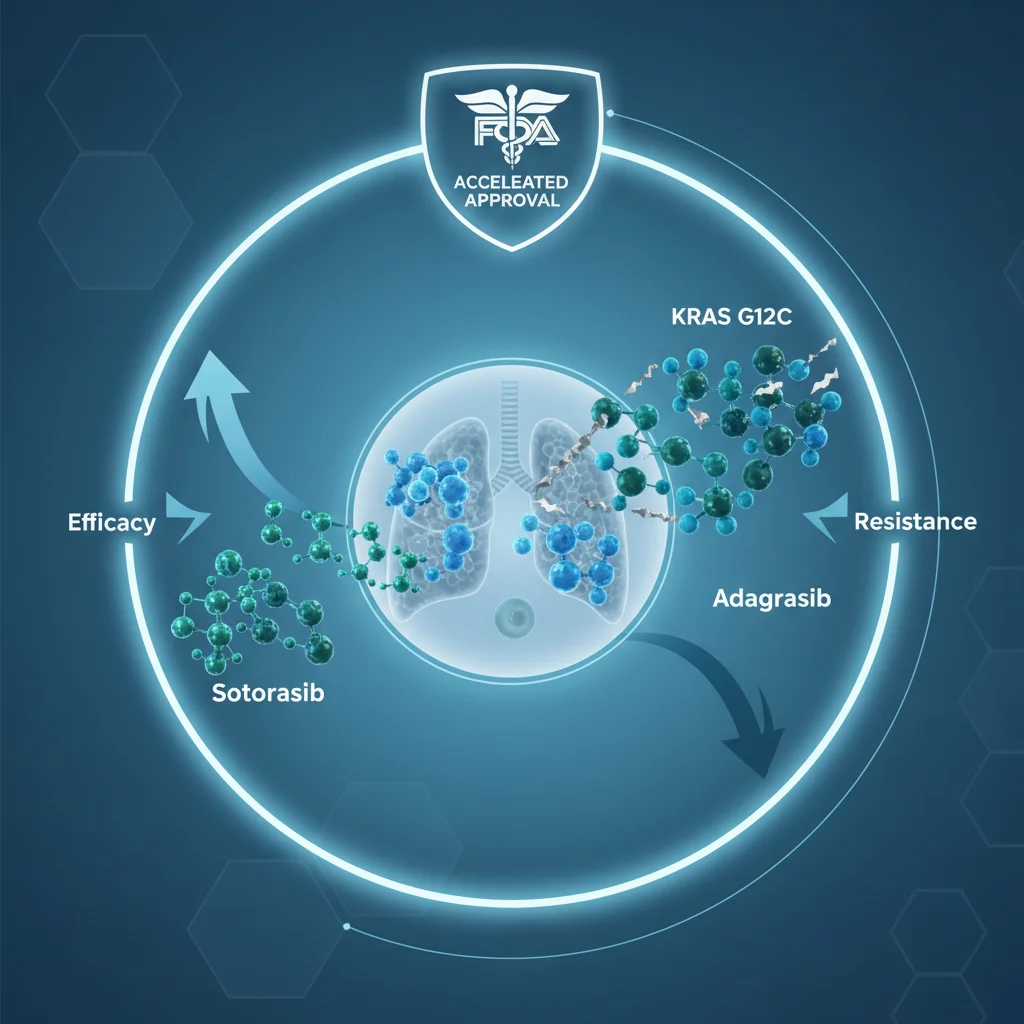
KRAS G12C Inhibitors NSCLC: Market Analysis of Sotorasib & Adagrasib
This article delves into the market dynamics of KRAS G12C inhibitors, Sotorasib and Adagrasib, highlighting their roles in non-small cell lung cancer treatment.

Medically Reviewed
by Dr. James Morrison, Chief Medical Officer (MD, FACP, FACC)
Reviewed on: April 30, 2026
Key Takeaways
- FDA approval milestone: Sotorasib (AMG 510) and adagrasib (MRTX849) are the only FDA-approved KRAS G12C inhibitors for previously treated adults with locally advanced or metastatic KRAS G12C-mutated non-small cell lung cancer as of June 2024, representing the first targeted therapies for this molecularly defined patient population. [Source: U.S. Food and Drug Administration]
- Clinical efficacy challenge: Phase III trials demonstrate that sotorasib exhibits inferior overall survival compared to docetaxel, raising questions about monotherapy durability and highlighting the need for improved treatment strategies.
- Resistance mechanisms emerging: Emerging secondary KRAS mutations and bypass signaling pathways are driving clinical interest in combination therapy approaches to overcome resistance and improve patient outcomes.
- Market positioning: Sotorasib and adagrasib establish a competitive niche in KRAS G12C-mutated NSCLC, but face pricing pressures and reimbursement challenges amid limited survival benefit over standard chemotherapy.
The U.S. Food and Drug Administration (FDA) approval of sotorasib and adagrasib marks a watershed moment in targeted oncology, introducing the first covalent KRAS G12C inhibitors for previously treated patients with locally advanced or metastatic KRAS G12C-mutated non-small cell lung cancer (NSCLC). Yet emerging clinical data reveals a sobering reality: sotorasib's overall survival falls short of the chemotherapy standard docetaxel, prompting oncologists and researchers to pivot toward combination strategies to unlock the full therapeutic potential of these agents. Why it matters: These approvals address a decades-long gap in precision medicine for KRAS-driven lung cancer, but their limited monotherapy efficacy underscores the complexity of targeting this historically "undruggable" oncogene and the urgent clinical need for rational drug combinations.
Drug Overview
Sotorasib and adagrasib are small-molecule covalent inhibitors that selectively target the KRAS G12C mutation, a point mutation found in approximately 13–14% of NSCLC cases. Both agents work through the same mechanism: they covalently bind to the cysteine residue at position 12 of mutant KRAS, locking the protein in its inactive GDP-bound state and preventing downstream oncogenic signaling through the MAPK and PI3K pathways. This approach represents a fundamental departure from decades of failed attempts to inhibit KRAS directly, as the mutation-specific covalent strategy overcomes the high intrinsic GTPase activity of wild-type KRAS.
Sotorasib (marketed under the brand name Lumakras) and adagrasib (Krazati) are approved for use in previously treated adult patients with locally advanced or metastatic KRAS G12C-mutated NSCLC. The indication reflects a molecularly stratified patient population identified through companion diagnostic testing, which has become standard in modern oncology practice. Both agents represent the first and only FDA-approved therapies specifically targeting the KRAS G12C mutation in lung cancer, establishing a new therapeutic category within precision oncology.
Clinical Insights
Phase III trials are ongoing to confirm the clinical efficacy of sotorasib and adagrasib; however, preliminary data has revealed critical limitations in the monotherapy approach. Sotorasib demonstrated inferior overall survival compared to docetaxel, the standard second-line chemotherapy for NSCLC. This finding has profound implications for clinical practice, as it suggests that single-agent KRAS G12C inhibition, while producing objective responses in a subset of patients, may not translate to durable survival benefit when compared against established chemotherapy regimens.
The primary endpoints evaluated in Phase III trials include overall survival (OS), progression-free survival (PFS), and objective response rate (ORR). While specific numeric data on these endpoints are under investigation through ongoing trials, the comparative disadvantage of sotorasib versus docetaxel in OS has become a defining challenge for the class. This gap has prompted urgent investigation into the mechanisms of resistance and the potential for combination approaches to improve outcomes.
Emerging resistance mechanisms to KRAS G12C inhibitors include secondary KRAS mutations (such as G12C/D and G12C/V), which restore GTPase activity and escape covalent inhibition, as well as bypass pathway activation through receptor tyrosine kinase (RTK) signaling, SHP2 pathway engagement, and other compensatory mechanisms. These resistance pathways emerge within months of treatment initiation in a significant proportion of patients, necessitating proactive combination strategies to prevent or delay resistance development.
Regulatory Context
Both sotorasib and adagrasib received FDA approval by June 2024 for the treatment of previously treated adult patients with locally advanced or metastatic KRAS G12C-mutated NSCLC. The regulatory pathway leveraged the FDA's commitment to accelerating the development of precision oncology agents targeting well-characterized mutations in solid tumors. Specific details regarding submission type (NDA versus BLA), PDUFA dates, or conditional versus full approval status are not detailed in available regulatory documentation; however, both agents were expedited through the FDA review process given the unmet medical need in this patient population and the absence of prior approved therapies targeting KRAS G12C mutations.
The approval of these agents reflects the FDA's recognition of KRAS G12C as a validated oncogenic driver in NSCLC and the clinical utility of mutation-specific targeted therapy in improving patient selection and therapeutic precision. Companion diagnostic testing to identify KRAS G12C status has become integral to the clinical pathway for both agents, ensuring appropriate patient stratification and maximizing the likelihood of clinical benefit.
Market Impact
Sotorasib and adagrasib establish a competitive duopoly in the KRAS G12C-mutated NSCLC market, a molecularly defined niche representing approximately 13–14% of all NSCLC cases. Compared with the broader NSCLC market, this patient population is significantly smaller but clinically distinct, having exhausted standard chemotherapy and immunotherapy options and lacking prior targeted therapy options until these approvals.
The competitive landscape for previously treated NSCLC includes docetaxel, which remains the standard-of-care comparator, as well as immunotherapies and other chemotherapy regimens. However, sotorasib and adagrasib represent the only therapies specifically targeting the KRAS G12C mutation, creating a unique market position. This exclusivity, however, is tempered by the clinical finding that sotorasib exhibits inferior overall survival versus docetaxel, which creates pricing pressure and reimbursement challenges. Payers and healthcare systems may question the value proposition of these agents relative to established chemotherapy, particularly in the absence of demonstrated survival superiority.
Market access and reimbursement decisions will likely hinge on real-world evidence of progression-free survival benefit, quality-of-life improvements, and the successful development of combination regimens that overcome the monotherapy survival gap. The pricing strategy for both agents will face scrutiny from payers navigating the tension between precision medicine premium pricing and the demonstrated clinical limitations of single-agent use.
Future Outlook
The clinical trajectory of sotorasib and adagrasib will be shaped by the results of ongoing Phase III combination trials designed to overcome emerging resistance mechanisms and improve overall survival. Key areas of development include:
- SHP2 inhibitor combinations: Pairing KRAS G12C inhibitors with SHP2 inhibitors to block bypass signaling and prevent resistance emergence.
- Immunotherapy combinations: Combining KRAS inhibitors with checkpoint inhibitors (anti-PD-1/PD-L1) to enhance anti-tumor immunity, particularly in immunologically "cold" KRAS-mutated tumors.
- Chemotherapy combinations: Rational combination with cytotoxic agents to address the monotherapy survival gap and improve durability of response.
- Next-generation inhibitors: Development of second-generation KRAS G12C inhibitors with improved potency, selectivity, and resistance profiles to address limitations of current agents.
What to watch next: Regulatory submissions for combination regimens and label expansions are anticipated as Phase III data mature. Success in these trials could reshape the treatment paradigm for KRAS G12C-mutated NSCLC and establish new standards of care, while also expanding the addressable market and justifying premium pricing strategies. Conversely, failure to demonstrate OS improvement in combination trials could limit market penetration and drive competitive pressure toward lower pricing and more restrictive reimbursement policies.
Frequently Asked Questions
What percentage of NSCLC patients have KRAS G12C mutations?
KRAS G12C mutations occur in approximately 13–14% of non-small cell lung cancer cases, making it one of the most common KRAS mutations in this indication. This represents a substantial but molecularly defined patient population that previously lacked targeted therapy options.
How do sotorasib and adagrasib differ mechanistically from other KRAS inhibitors?
Both sotorasib and adagrasib are covalent inhibitors that bind irreversibly to the cysteine residue at position 12 of mutant KRAS, locking the protein in its inactive GDP-bound state. This mutation-specific covalent strategy overcomes the challenge of KRAS's intrinsic GTPase activity and represents a fundamental breakthrough in targeting this historically difficult oncogene.
Why is sotorasib's inferior overall survival compared to docetaxel clinically significant?
The finding that sotorasib demonstrates inferior overall survival versus docetaxel raises critical questions about the monotherapy approach and suggests that single-agent KRAS G12C inhibition, while producing objective responses, may not translate to durable survival benefit. This has prompted urgent investigation into combination strategies and resistance mechanisms to improve patient outcomes.
What are the emerging resistance mechanisms to KRAS G12C inhibitors?
Resistance to KRAS G12C inhibitors emerges through secondary KRAS mutations (such as G12C/D and G12C/V) that restore GTPase activity, as well as bypass pathway activation through receptor tyrosine kinases, SHP2 signaling, and other compensatory mechanisms. These pathways typically emerge within months of treatment initiation and are driving clinical interest in combination therapies.
Are there combination trials underway to improve efficacy of KRAS G12C inhibitors?
Yes, multiple Phase III combination trials are ongoing to evaluate sotorasib and adagrasib in combination with SHP2 inhibitors, immunotherapies, and chemotherapy agents. These trials aim to overcome emerging resistance mechanisms and improve overall survival, representing the next phase of clinical development for KRAS G12C-targeted therapy.
References
- U.S. Food and Drug Administration. FDA Approvals for KRAS G12C Inhibitors in Non-Small Cell Lung Cancer (June 2024). Clinical indication: Previously treated adult patients with locally advanced or metastatic KRAS G12C-mutated NSCLC.
References
- U.S. Food and Drug Administration. FDA approval. Accessed 2026-04-30.

Senior Medical Editor
Dr. Sarah Chen is a board-certified internist and former FDA clinical reviewer with 15+ years of experience in pharmaceutical regulatory affairs. She received her MD from Johns Hopkins and her PhD in ...