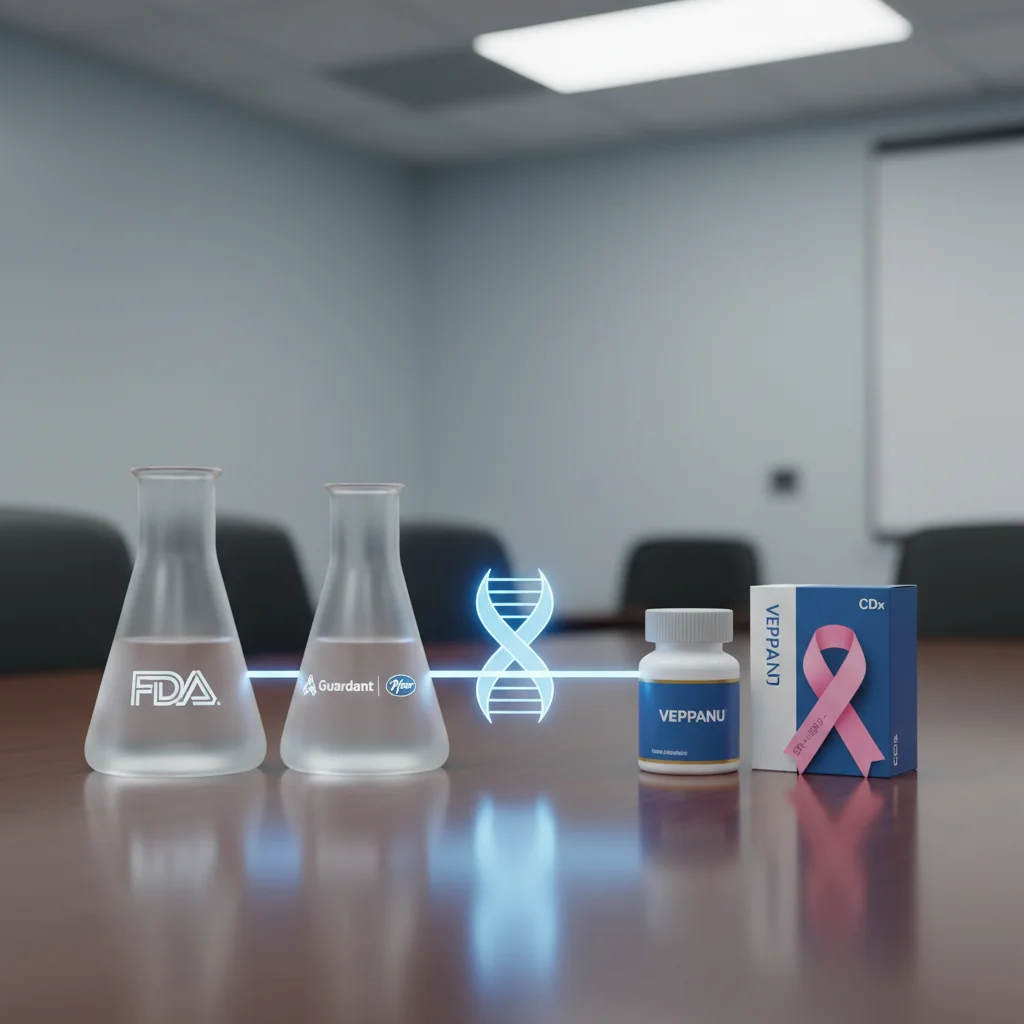
FDA Approves Guardant360 CDx Companion Diagnostic for Pfizer's VEPPANU in ER+/HER2- Breast Cancer
Guardant Health receives FDA approval for blood-based companion diagnostic to identify patients eligible for VEPPANU treatment in advanced breast cancer with ESR1 mutations.
Intelligence Snapshot
Executive Summary
FDA approves Guardant360 CDx as companion diagnostic for VEPPANU (vepdegestrant) in ER+/HER2- advanced breast cancer patients with ESR1 mutations
Key Insights
-
Blood-based test enables faster identification of patients eligible for targeted…
Blood-based test enables faster identification of patients eligible for targeted treatment without need for tissue biopsy
-
Marks Guardant Health’s third ESR1 companion diagnostic FDA approval, strengthening…
Marks Guardant Health’s third ESR1 companion diagnostic FDA approval, strengthening their position in breast cancer diagnostics
Market Impact
| Regulatory | medium |
|---|---|
| Commercial | medium |
| Competitive | low |
| Investment | low |
Executive Scorecard
Heuristic scores · directional, not investment adviceContents6 sections
Key Takeaways
- FDA approves Guardant360 CDx as companion diagnostic for VEPPANU (vepdegestrant) in ER+/HER2- advanced breast cancer patients with ESR1 mutations
- Blood-based test enables faster identification of patients eligible for targeted treatment without need for tissue biopsy
- Marks Guardant Health’s third ESR1 companion diagnostic FDA approval, strengthening their position in breast cancer diagnostics
The U.S. Food and Drug Administration has approved Guardant Health’s Guardant360 CDx as a companion diagnostic for Arvinas and Pfizer’s VEPPANU (vepdegestrant) in patients with estrogen receptor-positive, HER2-negative (ER+/HER2-) advanced breast cancer harboring ESR1 mutations.
Revolutionary Blood-Based Testing Approach
The approval enables oncologists to use a simple blood test to identify patients who may benefit from VEPPANU treatment, eliminating the need for invasive tissue biopsies in many cases. This liquid biopsy technology represents a significant advancement in precision oncology, allowing for faster treatment decisions and improved patient outcomes.
VEPPANU is an oral selective estrogen receptor degrader (SERD) designed to treat hormone receptor-positive breast cancer that has developed resistance to standard endocrine therapies. ESR1 mutations, which occur in approximately 30-40% of patients with advanced ER+ breast cancer, are associated with resistance to aromatase inhibitors and poor prognosis.
IntelligenceRegulatory Impact
FDA are the agencies to watch. Regulatory relevance reads medium for pharmaceutical intelligence. Teams should track submission types, designations, and guidance shifts that could move approval timelines.
Market Impact and Clinical Significance
This approval strengthens Guardant Health’s leadership position in the companion diagnostics market, particularly for breast cancer applications. The company now holds three FDA-approved ESR1 companion diagnostics, demonstrating the growing importance of mutation testing in guiding breast cancer treatment decisions.
For patients, this development means access to more personalized treatment options based on their tumor’s specific genetic profile. The blood-based testing approach also reduces the time between diagnosis and treatment initiation, which is critical for patients with advanced cancer.
IntelligenceCompetitive Intelligence
Competitive pressure is low. Watch which sponsors move first. Benchmark pipeline positioning, differentiation, and partnership scouting against the signals in this story.
Looking Forward
The approval comes as the oncology community increasingly embraces liquid biopsy technologies for their convenience, speed, and ability to detect circulating tumor DNA. This trend is expected to accelerate adoption of precision medicine approaches across various cancer types, with breast cancer leading the way in companion diagnostic development.
Frequently Asked Questions
What does this approval mean for breast cancer patients?
Patients with ER+/HER2- advanced breast cancer can now receive a simple blood test to determine if they have ESR1 mutations that make them eligible for VEPPANU treatment, potentially leading to better outcomes with targeted therapy.
When will the Guardant360 CDx test be available for VEPPANU?
The test is now FDA-approved and should be available immediately for oncologists to order for patients being considered for VEPPANU treatment.
How does this compare to traditional tissue biopsy testing?
The blood-based Guardant360 CDx test is less invasive than tissue biopsy, provides results faster, and can detect mutations in circulating tumor DNA that may not be present in the original tumor tissue.
Related coverage
Ask AI About This Topic
Grounded in NovaPharmaNews intelligence. Pick a prompt to start.
Stay Updated on Pharma News
Get the latest drug approvals, clinical trials, and regulatory updates delivered to your inbox.
- Evidence strength
- 79/100
- Last verified
- Jun 17, 2026
- AI-assisted review
- Yes
- Editorial review
- Dr. Sarah Chen
High source quality · grounded in cited primary and secondary sources.
This article follows our editorial standards. Report a correction via editorial contact.