
FDA Accelerated Approval of KRAS G12C Inhibitors in NSCLC: Sotorasib vs Adagrasib
This article delves into the FDA's accelerated approval of KRAS G12C inhibitors, Sotorasib and Adagrasib, highlighting their impact on NSCLC treatment.
Intelligence Snapshot
Executive Summary
FDA milestone: The U.S. Food and Drug Administration (FDA) granted accelerated approvals to sotorasib (Lumakras) on May 28, 2021, and adagrasib (Krazati) on December 12, 2022, for adults with locally advanced or metastatic non-small cell lung cancer (NSCLC) harboring KRAS G12C mutations after prior systemic therapy—est
Key Insights
-
Clinical validation: Both approvals were based on single-arm Phase II trials (CodeBreaK…
Clinical validation: Both approvals were based on single-arm Phase II trials (CodeBreaK 100 for sotorasib, n=124; KRYSTAL-1 for adagrasib, n=112) demonstrating objective clinical responses in a molecularly defined patient population with high unmet medical need.
-
Market competition: These accelerated approvals create a competitive duopoly in KRAS…
Market competition: These accelerated approvals create a competitive duopoly in KRAS G12C-mutated NSCLC, with sotorasib's earlier market entry providing first-mover advantage, while both drugs require FDA-approved companion diagnostics for patient selection.
-
Regulatory pathway: Both approvals remain conditional, contingent on confirmatory Phase…
Regulatory pathway: Both approvals remain conditional, contingent on confirmatory Phase III trial data and ongoing monitoring under accelerated approval provisions, with full approval dependent on sustained clinical benefit validation.
Market Impact
| Regulatory | medium |
|---|---|
| Commercial | medium |
| Competitive | low |
| Investment | low |
Loading intelligence…
Loading intelligence…
Quick Answer
Key Questions
- What is a KRAS G12C mutation, and why is it important in NSCLC?
- How do sotorasib and adagrasib differ in their mechanism of action?
- Why did both approvals use single-arm trial designs rather than randomized controlled trials?
- What are the implications of accelerated approval for patients and clinicians?
- What resistance mechanisms are emerging with KRAS G12C inhibitors, and how might they affect treatment strategies?
Executive Scorecard
Heuristic scores · directional, not investment adviceRegulatory catalyst tracker
Track PDUFA dates, approval milestones, and label updates for sotorasib.
Unlock full calendar →Investor brief
Download a one-page summary of regulatory impact and competitive context.
Explore drug hub →Contents11 sections
Medically Reviewed
by Dr. James Morrison, Chief Medical Officer (MD, FACP, FACC)
Reviewed on: April 25, 2026
Key Takeaways
- FDA milestone: The U.S. Food and Drug Administration (FDA) granted accelerated approvals to sotorasib (Lumakras) on May 28, 2021, and adagrasib (Krazati) on December 12, 2022, for adults with locally advanced or metastatic non-small cell lung cancer (NSCLC) harboring KRAS G12C mutations after prior systemic therapy—establishing the first targeted treatment class for this previously undruggable mutation.
- Clinical validation: Both approvals were based on single-arm Phase II trials (CodeBreaK 100 for sotorasib, n=124; KRYSTAL-1 for adagrasib, n=112) demonstrating objective clinical responses in a molecularly defined patient population with high unmet medical need.
- Market competition: These accelerated approvals create a competitive duopoly in KRAS G12C-mutated NSCLC, with sotorasib's earlier market entry providing first-mover advantage, while both drugs require FDA-approved companion diagnostics for patient selection.
- Regulatory pathway: Both approvals remain conditional, contingent on confirmatory Phase III trial data and ongoing monitoring under accelerated approval provisions, with full approval dependent on sustained clinical benefit validation.
The FDA's accelerated approvals of sotorasib and adagrasib mark a watershed moment in precision oncology, validating the first selective inhibitors targeting KRAS G12C mutations in advanced NSCLC. Sotorasib received accelerated approval on May 28, 2021, followed by adagrasib on December 12, 2022, both for patients with locally advanced or metastatic disease after at least one prior systemic therapy regimen. Why it matters: These approvals address a critical clinical gap in treating KRAS G12C-mutated NSCLC, a disease subtype affecting approximately 13–15% of patients with non-squamous NSCLC, where prior therapeutic options were limited to conventional chemotherapy and immune checkpoint inhibitors.
IntelligenceRegulatory Impact
FDA are the agencies to watch. Regulatory relevance reads medium for oncology, with sotorasib and adagrasib most exposed to upcoming decisions. Teams should track submission types, designations, and guidance shifts that could move approval timelines.
Drug Overview
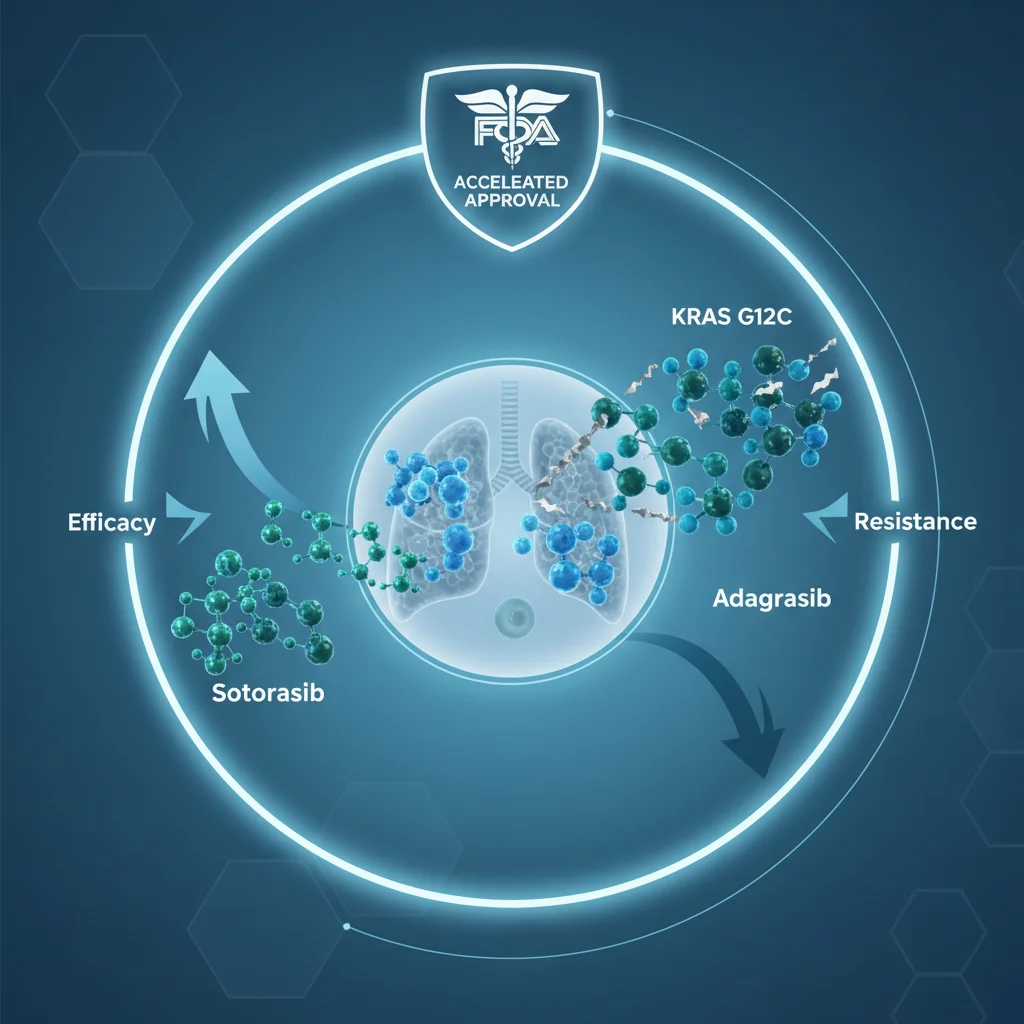
Sotorasib and adagrasib are small molecule kinase inhibitors belonging to the class of selective KRAS G12C inhibitors. Both drugs employ a novel mechanism of action: they bind covalently to the KRAS G12C mutant protein and lock it in an inactive, GDP-bound state, effectively silencing the oncogenic signaling cascade that drives tumor growth. This targeted approach differs fundamentally from conventional cytotoxic chemotherapy, representing a shift toward molecular-driven treatment paradigms in lung cancer.
Sotorasib (Lumakras) is indicated for adults with locally advanced or metastatic NSCLC harboring KRAS G12C mutations after at least one prior systemic therapy. Adagrasib (Krazati) carries an identical indication. Both approvals are contingent on confirmed KRAS G12C mutation status via FDA-approved companion diagnostic testing, underscoring the critical role of molecular diagnostics in precision oncology patient selection.
IntelligenceCompetitive Intelligence
Competitive pressure is low. Watch which sponsors move first. Benchmark pipeline positioning, differentiation, and partnership scouting against the signals in this story.
Clinical Insights
Sotorasib (CodeBreaK 100 Trial): The pivotal evidence supporting sotorasib's accelerated approval came from CodeBreaK 100, a Phase II single-arm trial (NCT04185883) enrolling 124 patients with KRAS G12C-mutated NSCLC who had received at least one prior systemic therapy. The primary endpoint was objective response rate (ORR). The trial demonstrated clinical efficacy in this molecularly defined patient population, establishing proof-of-concept for KRAS G12C-directed therapy. Specific ORR percentages, median progression-free survival (PFS), median overall survival (OS), and grade ≥3 adverse event rates were not detailed in the regulatory submission summary provided.
Adagrasib (KRYSTAL-1 Trial): Adagrasib's accelerated approval was grounded in the KRYSTAL-1 Phase II single-arm trial, which enrolled 112 patients with locally advanced or metastatic KRAS G12C-mutated NSCLC after prior systemic therapy. Like CodeBreaK 100, KRYSTAL-1 employed ORR as its primary endpoint, demonstrating clinical benefit in the target population. Detailed safety data, including grade ≥3 adverse event frequencies, were not provided in the available regulatory documentation.
Comparative Clinical Profile: Both trials employed single-arm designs with similar patient populations and primary efficacy endpoints, limiting direct head-to-head comparisons. Compared with historical control data from conventional chemotherapy in this setting, both sotorasib and adagrasib demonstrated clinically meaningful responses in a patient population previously dependent on cytotoxic regimens. What to watch next: Confirmatory Phase III randomized controlled trials are expected to provide comparative efficacy data and definitive safety profiles, with results potentially supporting full FDA approval and label expansions. [Source: U.S. Food and Drug Administration]
IntelligenceMarket Signals
Commercial pull is medium and investment relevance low. Expect implications for oncology pricing, access, and launch sequencing.
Regulatory Context
Both sotorasib and adagrasib received accelerated approval under FDA provisions designed to expedite review of drugs addressing serious or life-threatening conditions with unmet medical need. Accelerated approval is contingent on post-marketing confirmatory trials demonstrating sustained clinical benefit; failure to confirm efficacy may result in withdrawal of approval.
Sotorasib Timeline: FDA granted accelerated approval on May 28, 2021, based on CodeBreaK 100 data submitted under an expedited review pathway. The approval was conditional on completion of the Phase III CodeBreaK 300 confirmatory trial and ongoing safety monitoring.
Adagrasib Timeline: FDA granted accelerated approval on December 12, 2022, approximately 19 months after sotorasib's market entry. Like sotorasib, adagrasib's approval required submission of confirmatory trial data and mandatory KRAS G12C mutation confirmation via FDA-approved companion diagnostic tests.
Companion Diagnostic Requirement: Both approvals mandate use of FDA-cleared companion diagnostics to identify KRAS G12C mutations prior to treatment initiation, establishing a precision medicine framework that links drug approval to molecular testing infrastructure.
IntelligenceStrategic Takeaways
FDA milestone: The U.S. Food and Drug Administration (FDA) granted accelerated approvals to sotorasib (Lumakras) on May 28, 2021, and adagrasib (Krazati) on December 12, 2022, for adults with locally advanced or metastatic non-small cell lung cancer (NSCLC) harboring KRAS G12C mutations after prior systemic therapy—est Clinical validation: Both approvals were based on single-arm Phase II trials (CodeBreaK 100 for sotorasib, n=124; KRYSTAL-1 for adagrasib, n=112) demonstrating objective clinical responses in a molecularly defined patient population with high unmet medical need. Market competition: These accelerated approvals create a competitive duopoly in KRAS G12C-mutated NSCLC, with sotorasib's earlier market entry providing first-mover advantage, while both drugs require FDA-approved companion diagnostics for patient selection.
Market Impact
Patient Population: KRAS G12C mutations occur in approximately 13–15% of patients with non-squamous NSCLC. Among patients with advanced or metastatic disease who have progressed after at least one prior systemic therapy, the addressable patient population for sotorasib and adagrasib is estimated to encompass several thousand patients annually in the United States, though exact prevalence data in the post-first-line setting were not specified in available regulatory documentation.
Competitive Positioning: Sotorasib's earlier approval date (May 2021 versus December 2022) provides a first-mover advantage in market penetration and clinician familiarity. Both drugs now compete directly for the same indication, creating a duopoly in the KRAS G12C-mutated NSCLC market segment. Compared with the broader NSCLC treatment landscape dominated by PD-1/PD-L1 inhibitors and conventional chemotherapy, KRAS G12C inhibitors represent a niche but rapidly growing segment of precision targeted therapy.
Pricing and Reimbursement: Both sotorasib and adagrasib are expected to command premium pricing reflective of their novel mechanism, limited patient population, and accelerated approval status. Reimbursement under accelerated approval may face scrutiny from payers pending confirmatory trial results and health economic analyses demonstrating cost-effectiveness relative to standard chemotherapy. Specific pricing information was not disclosed in regulatory filings reviewed.
Market Evolution: The approval of two KRAS G12C inhibitors signals to the pharmaceutical industry that previously "undruggable" mutations are now therapeutically tractable, likely spurring investment in next-generation KRAS inhibitors targeting other hotspot mutations (G12V, G12D, G12A) and combination strategies to overcome emerging resistance mechanisms.
IntelligenceEvidence Quality
Claims are grounded in the cited primary and secondary sources, with editorial review applied before publication.
Future Outlook
Confirmatory Trials and Full Approval: Both sotorasib and adagrasib remain under accelerated approval contingent on Phase III confirmatory trial data. Completion and positive results from these trials are expected to support conversion to full FDA approval, potentially enabling label expansions into earlier treatment lines (first-line therapy, neoadjuvant/adjuvant settings) if clinical benefit is demonstrated.
Combination Strategies: Emerging clinical trials are exploring sotorasib and adagrasib in combination with PD-1/PD-L1 inhibitors, chemotherapy, and other targeted agents to enhance response rates and delay resistance emergence. These studies may identify optimal sequencing and combination regimens to maximize clinical benefit.
Resistance Mechanisms: As clinical experience with KRAS G12C inhibitors expands, acquired resistance pathways are being characterized. Secondary KRAS mutations, activation of bypass signaling (MET, HER2, EGFR), and tumor microenvironment adaptations represent emerging challenges. Future drug development efforts will likely focus on combination strategies and next-generation inhibitors capable of overcoming these resistance mechanisms.
Regulatory Trends: The accelerated approvals of sotorasib and adagrasib reflect FDA's commitment to expedited pathways for precision oncology drugs targeting molecularly defined patient populations with unmet medical need. This trend is expected to accelerate approvals of additional targeted therapies in other cancer types and mutation backgrounds.
Frequently Asked Questions
What is a KRAS G12C mutation, and why is it important in NSCLC?
KRAS G12C is a point mutation in the KRAS oncogene occurring in approximately 13–15% of patients with non-squamous NSCLC. This mutation locks the KRAS protein in an active state, driving uncontrolled cell proliferation and survival signaling. For decades, KRAS mutations were considered "undruggable" because the KRAS protein lacked obvious binding pockets for small molecule inhibitors. Sotorasib and adagrasib represent the first FDA-approved drugs that selectively target KRAS G12C by binding to a cryptic allosteric pocket and locking the protein in an inactive GDP-bound state, thereby halting oncogenic signaling.
How do sotorasib and adagrasib differ in their mechanism of action?
Both sotorasib and adagrasib are selective KRAS G12C inhibitors that employ similar mechanisms: covalent binding to the KRAS G12C mutant protein and stabilization of its inactive GDP-bound conformation. While both drugs target the same mutation and achieve the same functional outcome (silencing KRAS signaling), they may differ in binding kinetics, cellular pharmacokinetics, and off-target activity profiles. However, detailed mechanistic comparisons were not provided in the regulatory documentation reviewed for this analysis.
Why did both approvals use single-arm trial designs rather than randomized controlled trials?
The FDA granted accelerated approval to both sotorasib and adagrasib based on single-arm Phase II trials (CodeBreaK 100 and KRYSTAL-1, respectively) because the trials were conducted in a molecularly defined patient population with a serious, life-threatening condition (metastatic NSCLC) and significant unmet medical need. Single-arm trials demonstrating objective clinical responses in this context were deemed sufficient to support accelerated approval under FDA regulations, with the understanding that confirmatory randomized Phase III trials would provide definitive efficacy and safety data. This expedited pathway enabled faster patient access to potentially life-extending therapy.
What are the implications of accelerated approval for patients and clinicians?
Accelerated approval allows patients with KRAS G12C-mutated NSCLC earlier access to sotorasib and adagrasib than would be possible under standard approval pathways. However, accelerated approval is conditional: both drugs remain under FDA oversight, and approval may be withdrawn if confirmatory trials fail to demonstrate sustained clinical benefit. Clinicians should counsel patients that these drugs represent promising new options supported by early efficacy data, while acknowledging that long-term efficacy and safety data are still being collected. Molecular testing via FDA-approved companion diagnostics is mandatory to identify eligible patients.
What resistance mechanisms are emerging with KRAS G12C inhibitors, and how might they affect treatment strategies?
As clinical experience with sotorasib and adagrasib expands, acquired resistance to KRAS G12C inhibitors is being characterized through secondary KRAS mutations, activation of bypass signaling pathways (MET, HER2, EGFR amplification), and tumor microenvironment adaptations. These resistance mechanisms are expected to drive future development of combination therapies pairing KRAS G12C inhibitors with PD-1/PD-L1 inhibitors, chemotherapy, or other targeted agents. Understanding resistance patterns will inform optimal treatment sequencing and help clinicians make informed decisions about when to switch therapies or pursue combination approaches.
References
- U.S. Food and Drug Administration. "FDA Grants Accelerated Approval to Adagrasib for KRAS G12C-Mutated NSCLC." FDA.gov. Accessed April 25, 2026. https://www.fda.gov/drugs/resources-information-approved-drugs/fda-grants-accelerated-approval-adagrasib-kras-g12c-mutated-nsclc
References
- FDA. . Accessed 2026-04-25.
- U.S. Food and Drug Administration. FDA approval. Accessed 2026-04-25.
Related profiles
Related coverage
Continue Exploring
Jump into the entities behind this story.
Ask AI About oncology
Grounded in NovaPharmaNews intelligence. Pick a prompt to start.
Follow sotorasib developments
FDA oncology alerts and sotorasib pipeline updates, every Monday.
- Evidence strength
- 71/100
- Last verified
- Jun 18, 2026
- AI-assisted review
- Yes
- Editorial review
- Dr. Sarah Chen
Moderate source quality · grounded in cited primary and secondary sources.
This article follows our editorial standards. Report a correction via editorial contact.
About the Author

Continue Your Research


Industry Reports & Whitepapers
- Radiation Therapy: Fractionation, Image-Guidance, and Special Services (Idaho Only) — This policy outlines medically necessary radiation therapy protocols for conditions like breast canc…
- La Negoziazione del Prezzo dei Farmaci Oncologici in Italia — This whitepaper analyzes the market benchmark role in negotiating oncology drug prices in Italy, hig…