
ISCT 2026: EU Manufacturing Innovations Day 1 Roundup
ISCT 2026's opening day highlighted critical manufacturing innovations and regulatory challenges facing European cell and gene therapy producers. Key themes included scalability, automation, supply chain resilience, and the need for harmonized EU regulatory standards.
Contents9 sections
Key Takeaways
- Manufacturing scalability remains central: Day 1 sessions at ISCT 2026 emphasized the critical need for standardized, scalable manufacturing platforms to meet growing demand for cell and gene therapies across Europe.
- Regulatory harmonization in focus: EU regulatory discussions highlighted ongoing efforts to streamline approval pathways and manufacturing guidelines, though significant variability persists across member states.
- Cost and quality trade-offs: Key challenges identified include balancing manufacturing efficiency with product quality and safety standards, with automation and process analytics emerging as potential solutions.
- Supply chain resilience: Manufacturers are prioritizing supply chain diversification and localized production capacity to reduce dependency on single-source suppliers and improve access across European markets.
Event Overview
The International Society for Cell & Gene Therapy (ISCT) 2026 Annual Meeting convened in Europe with a dedicated focus on manufacturing innovations during its opening day. The conference brought together cell and gene therapy manufacturers, regulatory officials, and industry stakeholders to address the evolving landscape of therapeutic production in the European Union. With cell and gene therapy pipelines expanding rapidly, the manufacturing sector faces unprecedented pressure to scale production while maintaining regulatory compliance and product quality.
Manufacturing Technology Highlights
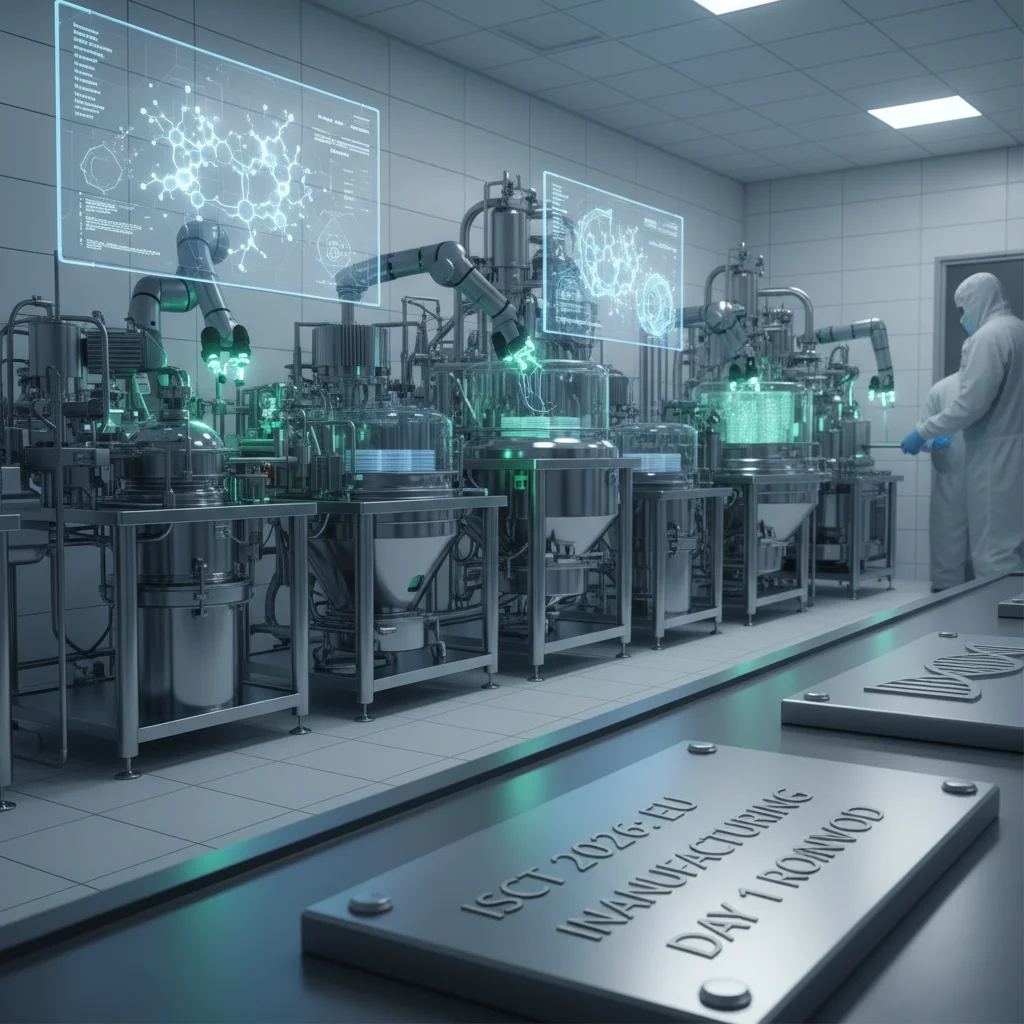
Day 1 presentations underscored the importance of advanced manufacturing technologies in addressing current production bottlenecks. Sessions focused on automation, real-time process monitoring, and closed-system manufacturing platforms designed to reduce contamination risk and improve reproducibility.
Automation and Process Control
Multiple presentations highlighted the role of automated bioreactor systems and continuous manufacturing approaches in improving throughput and consistency. Speakers emphasized that real-time analytics and process parameter monitoring enable manufacturers to detect deviations early, reducing batch failures and associated costs. The adoption of single-use bioreactor systems was noted as particularly valuable for smaller manufacturers seeking to enter the market without substantial capital investment in fixed infrastructure.
Closed-System Manufacturing Platforms
Closed-system technologies that minimize manual handling and environmental exposure were presented as critical for reducing contamination rates and improving operator safety. These systems are particularly relevant for allogeneic cell therapies, where batch consistency directly impacts clinical outcomes and regulatory approval timelines.
Data Integration and Traceability
Sessions emphasized the growing importance of integrated data systems that track manufacturing parameters, raw materials, and product specifications throughout the production cycle. Digital traceability systems were highlighted as essential for post-market surveillance and rapid response to quality issues.
Regulatory Landscape and EU Policy Updates
Regulatory discussions on Day 1 reflected the European Medicines Agency's (EMA) ongoing efforts to establish clearer guidance for cell and gene therapy manufacturing. While specific policy announcements were not disclosed during the opening sessions, panelists noted that manufacturers continue to navigate variable requirements across EU member states.
Key Regulatory Themes
Speakers identified several recurring regulatory concerns: (1) the need for harmonized quality standards across European jurisdictions; (2) clarification on comparability protocols when manufacturing processes are modified; (3) expectations for environmental monitoring and contamination control; and (4) requirements for long-term stability data in support of shelf-life claims.
Manufacturers were advised to engage early with national competent authorities during process development to identify potential compliance gaps before formal regulatory submissions. The importance of maintaining detailed batch records and deviation management systems was emphasized as critical for demonstrating manufacturing control to regulators.
Advanced Therapy Medicinal Products (ATMP) Framework
Panelists discussed the EMA's Advanced Therapy Medicinal Products (ATMP) classification framework and its implications for manufacturing oversight. The ATMP designation, which applies to most cell and gene therapies, carries heightened regulatory scrutiny and requires robust manufacturing controls. Speakers noted that the EMA's Committee for Advanced Therapies (CAT) continues to refine expectations for manufacturing quality overall strategies (QOS) and chemistry, manufacturing, and controls (CMC) documentation.
Challenges and Opportunities in Cell and Gene Therapy Manufacturing
Primary Manufacturing Challenges
Scale-up complexity: Transitioning from clinical-scale to commercial-scale production remains technically challenging, particularly for autologous therapies requiring individualized manufacturing runs. Speakers highlighted that process parameters optimized at small scale do not always translate predictably to larger volumes, necessitating comprehensive bridging studies.
Raw material sourcing: Access to qualified starting materials—including growth factors, cytokines, and specialized media—remains constrained in Europe. Supply chain disruptions and limited vendor capacity were identified as ongoing risks that could delay therapy launches.
Cost containment: Manufacturing costs for cell and gene therapies remain substantially higher than conventional pharmaceuticals. Panelists discussed the tension between maintaining product quality and achieving cost targets necessary for market viability and reimbursement approval.
Skilled workforce: The rapid expansion of the cell and gene therapy sector has created acute shortages of qualified manufacturing personnel with specialized training in advanced therapy production. Recruitment and retention of experienced staff was cited as a significant operational challenge.
Emerging Opportunities
Regional manufacturing hubs: Several speakers highlighted the potential for establishing regional manufacturing centers across Europe to serve multiple member states, reducing transportation times and improving product availability. Such hubs could leverage shared infrastructure and expertise while maintaining compliance with local regulations.
Contract manufacturing organizations (CMOs): The growth of specialized CMOs focused on cell and gene therapy manufacturing was presented as an opportunity for smaller biotech companies to access manufacturing capacity without building proprietary facilities. CMO partnerships enable companies to focus on clinical development and commercialization while outsourcing production.
Process innovation and continuous manufacturing: Adoption of continuous manufacturing approaches—as opposed to traditional batch processing—was identified as a significant opportunity to improve efficiency, reduce costs, and enhance product consistency. Several companies are investing in continuous bioreactor systems and downstream processing technologies.
Artificial intelligence and machine learning: Speakers noted emerging applications of AI and machine learning in optimizing manufacturing parameters, predicting process failures, and accelerating process development timelines. These tools could substantially reduce time-to-market for new therapies.
Market and Industry Implications
The manufacturing innovations and regulatory discussions presented on Day 1 carry significant implications for the European cell and gene therapy market. Manufacturers that successfully implement advanced technologies and achieve regulatory compliance are positioned to capture market share as clinical pipelines mature and therapies move toward commercialization. Conversely, companies unable to scale manufacturing efficiently or navigate regulatory requirements face delays and competitive disadvantages.
The emphasis on supply chain resilience and regional manufacturing capacity reflects growing recognition that Europe must develop indigenous manufacturing capabilities to reduce dependence on non-EU suppliers and ensure reliable access to therapies for European patients. Investment in manufacturing infrastructure and workforce development is likely to accelerate across the region.
What to Watch Next
Subsequent days of the ISCT 2026 conference are expected to feature detailed case studies on manufacturing scale-up, regulatory submissions, and post-approval manufacturing changes. Attendees should monitor announcements regarding new EMA guidance documents on manufacturing comparability and quality standards. Additionally, watch for industry partnerships and CMO announcements that signal confidence in the commercial viability of cell and gene therapies in Europe.
Frequently Asked Questions
What are the main manufacturing challenges for cell and gene therapies in the EU?
Key challenges include scaling production from clinical to commercial volumes, sourcing qualified raw materials, managing manufacturing costs, and recruiting skilled personnel. Regulatory variability across EU member states and the need for individualized production runs (particularly for autologous therapies) further complicate manufacturing operations. Day 1 discussions emphasized that addressing these challenges requires investment in automation, process analytics, and workforce development.
How are EU regulators addressing manufacturing oversight for cell and gene therapies?
The EMA continues to refine guidance through its Committee for Advanced Therapies (CAT) and the ATMP framework. Regulatory expectations focus on robust quality overall strategies, comprehensive chemistry, manufacturing, and controls documentation, and detailed batch records. Manufacturers are encouraged to engage early with national competent authorities to identify compliance requirements during process development, rather than during formal regulatory submissions.
What manufacturing technologies are most promising for improving efficiency?
Automation, closed-system bioreactors, real-time process monitoring, and continuous manufacturing approaches were highlighted as particularly valuable. Single-use bioreactor systems offer advantages for smaller manufacturers, while integrated data systems and digital traceability platforms support regulatory compliance and post-market surveillance. Artificial intelligence and machine learning applications are emerging as tools to optimize manufacturing parameters and accelerate process development.
How can smaller biotech companies access manufacturing capacity?
Contract manufacturing organizations (CMOs) specializing in cell and gene therapy production offer an alternative to building proprietary manufacturing facilities. CMO partnerships enable smaller companies to focus on clinical development and commercialization while outsourcing production to experienced partners. Regional manufacturing hubs across Europe may also provide shared infrastructure and expertise for multiple companies.
What role will regional manufacturing play in European cell and gene therapy supply?
Establishing regional manufacturing centers across Europe is viewed as a strategic opportunity to improve product availability, reduce transportation times, and ensure reliable access to therapies for European patients. Regional hubs could leverage shared infrastructure and specialized expertise while maintaining compliance with local regulations, reducing dependence on non-EU suppliers and strengthening European manufacturing capacity.
References
- International Society for Cell & Gene Therapy (ISCT). ISCT 2026 Annual Meeting. Official conference program and session materials. www.isct.org
- European Medicines Agency (EMA). Advanced Therapy Medicinal Products (ATMP) Framework. Available at: https://www.ema.europa.eu/en/human-regulatory/advanced-therapies
- European Medicines Agency (EMA). Committee for Advanced Therapies (CAT) Guidelines. Quality Overall Summary and Chemistry, Manufacturing, and Controls Documentation. https://www.ema.europa.eu/en/committees/committee-advanced-therapies-cat
- European Commission. Regulation (EC) No 1394/2007 on Advanced Therapy Medicinal Products. Official Journal of the European Union. Available at: https://eur-lex.europa.eu/legal-content/EN/TXT/?uri=CELEX:32007R1394
- NovaPharmaNews. Cell Therapy Manufacturing: Scaling Challenges and Solutions. Related coverage on manufacturing innovations in cell therapies. View article
- NovaPharmaNews. EU Regulatory Pathways for Gene Therapies: A Manufacturer's Guide. Related coverage on regulatory compliance for gene therapy manufacturers. View article
Track manufacturing news weekly
EMA manufacturing news and regulatory updates, every Monday.
This article follows our editorial standards. Report a correction via editorial contact.
Continue Your Research



Industry Reports & Whitepapers
- Optimizing Pharmaceutical Manufacturing: The Critical Role of Dew Point Monitoring — Discover how real-time dew point monitoring safeguards pharmaceutical production, prevents moisture-…
- EFPIA analysis: biopharmaceutical strategies in 10 countries and what Europe can learn — Europe faces growing biopharma competition as countries align R&D, regulation, and manufacturing to …