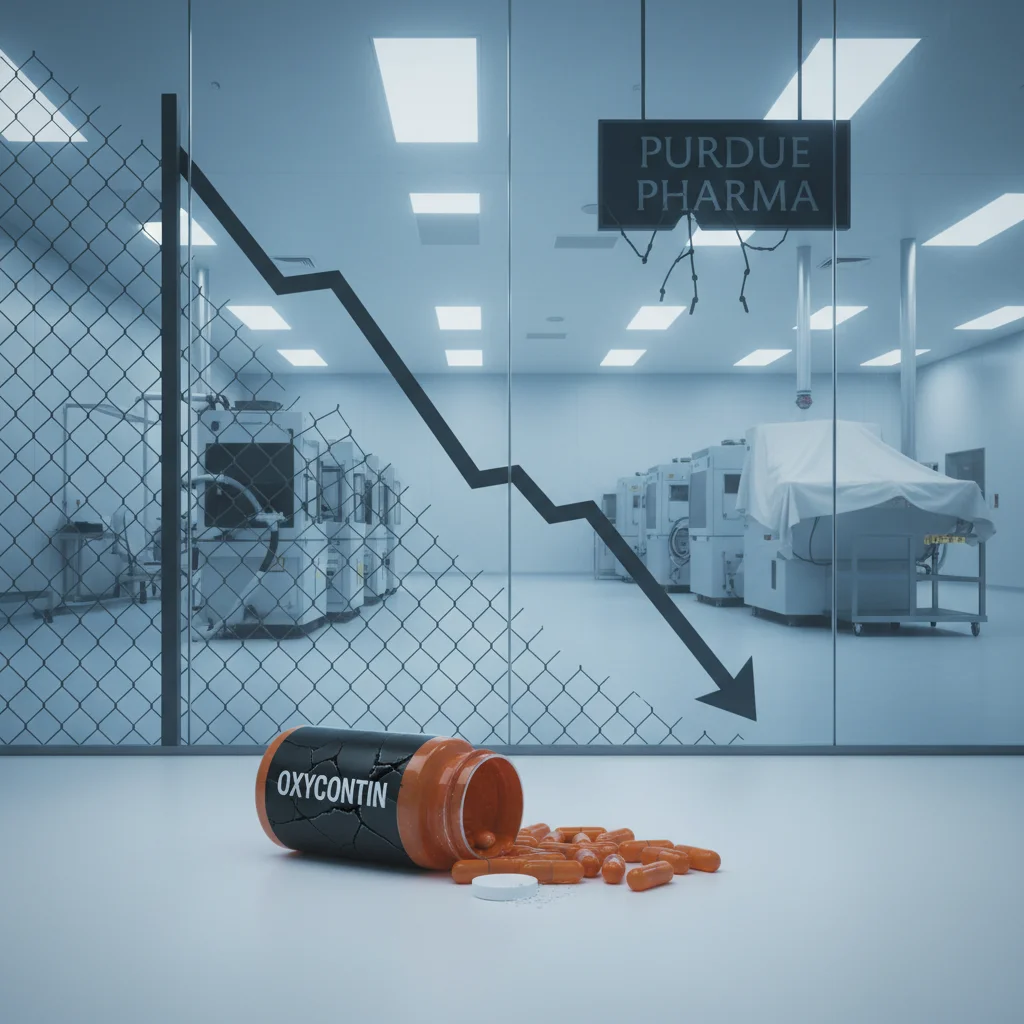
Purdue Pharma Shutdown: $7.4B Deal Ends OxyContin Maker's Era
Purdue Pharma, the manufacturer of OxyContin, is ceasing operations as part of a $7.4 billion settlement to address its role in the opioid crisis. This landmark agreement aims to resolve thousands of lawsuits and redirect company assets towards addiction treatment and prevention.


Key Takeaways
- Investment catalyst: The Purdue Pharma shutdown and $7.4 billion settlement closes one of the most consequential chapters in pharmaceutical litigation — reshaping liability frameworks for drug manufacturers and signaling heightened legal and reputational risk for opioid-adjacent portfolios.
- Competitive impact: Pulling oxycodone (OxyContin) from active commercial promotion accelerates market share redistribution toward non-opioid analgesics and abuse-deterrent formulations, while drawing sharper regulatory scrutiny onto the manufacturers still standing.
- Market opportunity: Settlement funds directed toward addiction treatment infrastructure — including medication-assisted treatment (MAT) and harm reduction services — represent a meaningful demand catalyst for companies commercializing buprenorphine, naltrexone, and naloxone.
- Next catalysts: Oversight body formation, state-level fund disbursement timelines, and potential follow-on litigation against remaining opioid manufacturers are the primary near-term developments to monitor.
What is the Purdue Pharma Shutdown and $7.4 Billion Settlement?
The Purdue Pharma shutdown, formalized through a $7.4 billion settlement, marks the definitive end of the Purdue Pharma L.P. enterprise and its decades-long commercial stewardship of oxycodone (OxyContin) — a resolution that redefines corporate accountability standards across the pharmaceutical industry. According to USA Today, the company is ceasing operations as a direct condition of the agreement.
The settlement resolves the sprawling body of civil litigation filed by state governments, municipalities, and other parties alleging that Purdue Pharma engaged in deceptive marketing practices that materially contributed to the opioid epidemic. Under the agreement's terms, the company's assets are being transferred and liquidated to fund addiction treatment programs, overdose reversal initiatives, and public health infrastructure — rather than continuing operations under any reconstituted corporate identity.
Executed through bankruptcy proceedings, this resolution is the culmination of litigation that spanned multiple federal and state jurisdictions and drew in thousands of plaintiffs. The settlement's architecture is notable in its own right: repurposing corporate assets for public health remediation at this scale has no direct precedent in U.S. pharmaceutical history.
Why it matters for BD teams and investors: The Purdue Pharma shutdown removes a legacy liability overhang from the opioid sector's legal landscape, but simultaneously signals that regulators and courts are willing to pursue total corporate dissolution as a remedy — a risk factor that must now be priced into due diligence for any company with active opioid or controlled-substance franchises.
Drug at a Glance
- Generic name (INN)
- Oxycodone
- Brand name
- OxyContin
- Mechanism of action
- Opioid agonist; binds to mu-opioid receptors in the central nervous system to produce analgesia
- Indication
- Management of moderate to severe pain where an opioid analgesic is appropriate
- Sponsor
- Purdue Pharma L.P.
- Approval status
- Approved
- Approval date
- December 1995
- Designation
- N/A
What Was Purdue Pharma's Role in the Opioid Crisis?
Purdue Pharma received U.S. Food and Drug Administration (FDA) approval for oxycodone (OxyContin) in December 1995. The extended-release formulation was initially marketed with claims suggesting a lower abuse potential relative to immediate-release opioids — a characterization that became the central allegation in subsequent federal and state litigation. Across thousands of lawsuits, plaintiffs contended that these marketing representations were scientifically unsupported and that the company's aggressive sales infrastructure drove inappropriate prescribing at scale.
According to the Centers for Disease Control and Prevention (CDC), opioid overdose deaths have represented one of the leading causes of injury-related mortality in the United States over the past two decades, with prescription opioids identified as a primary driver of the epidemic's first wave beginning in the late 1990s. The CDC has documented that the crisis evolved through distinct phases — from prescription opioid misuse to heroin and, subsequently, illicitly manufactured fentanyl — with the prescription phase laying the conditions for the downstream harm that followed.
Federal and state investigations surfaced internal communications at Purdue Pharma that prosecutors argued demonstrated the company's awareness of diversion and misuse patterns. The company entered a guilty plea in federal proceedings. The Sackler family — private owners of the company — faced direct civil liability claims from state attorneys general, a dimension of the litigation that shaped the ultimate settlement structure considerably. The U.S. Department of Justice (DOJ) characterized the conduct as a deliberate scheme to mislead prescribers and patients regarding addiction risk.
How Does the OxyContin Settlement Address Opioid Crisis Resolution?
The $7.4 billion settlement converts Purdue Pharma's corporate assets into a public health remediation fund, with disbursements targeted at addiction treatment, overdose reversal, and prevention infrastructure. According to USA Today, the company is shutting down as a direct condition of this agreement — no successor commercial entity will continue operating under the Purdue corporate structure.
The settlement framework was enabled by the company's Chapter 11 bankruptcy filing, which provided the legal mechanism to consolidate thousands of individual and governmental claims into a single resolution. Bankruptcy proceedings allowed for a structured asset valuation and distribution process overseen by the court, with state attorneys general and other creditor classes participating in negotiations over fund allocation priorities. The DOJ's involvement ensured federal prosecutorial claims were folded into the global resolution.
Funds from the settlement are designated to support evidence-based interventions including medication-assisted treatment (MAT) programs utilizing buprenorphine, methadone, and naltrexone, as well as harm reduction services such as naloxone distribution and syringe servi
About the Author
Related Articles
Purdue Pharma Shutdown: $7.4B Deal Ends OxyContin Maker's Operations

Purdue Pharma Dissolution Approved: What It Means for Opioid Crisis

CVRx Enrolls First Patient in BENEFIT-HF Heart Failure Trial Testing Barostim Device