
AstraZeneca's Camizestrant: Navigating Divergent Regulatory Paths for Breast Cancer Treatment
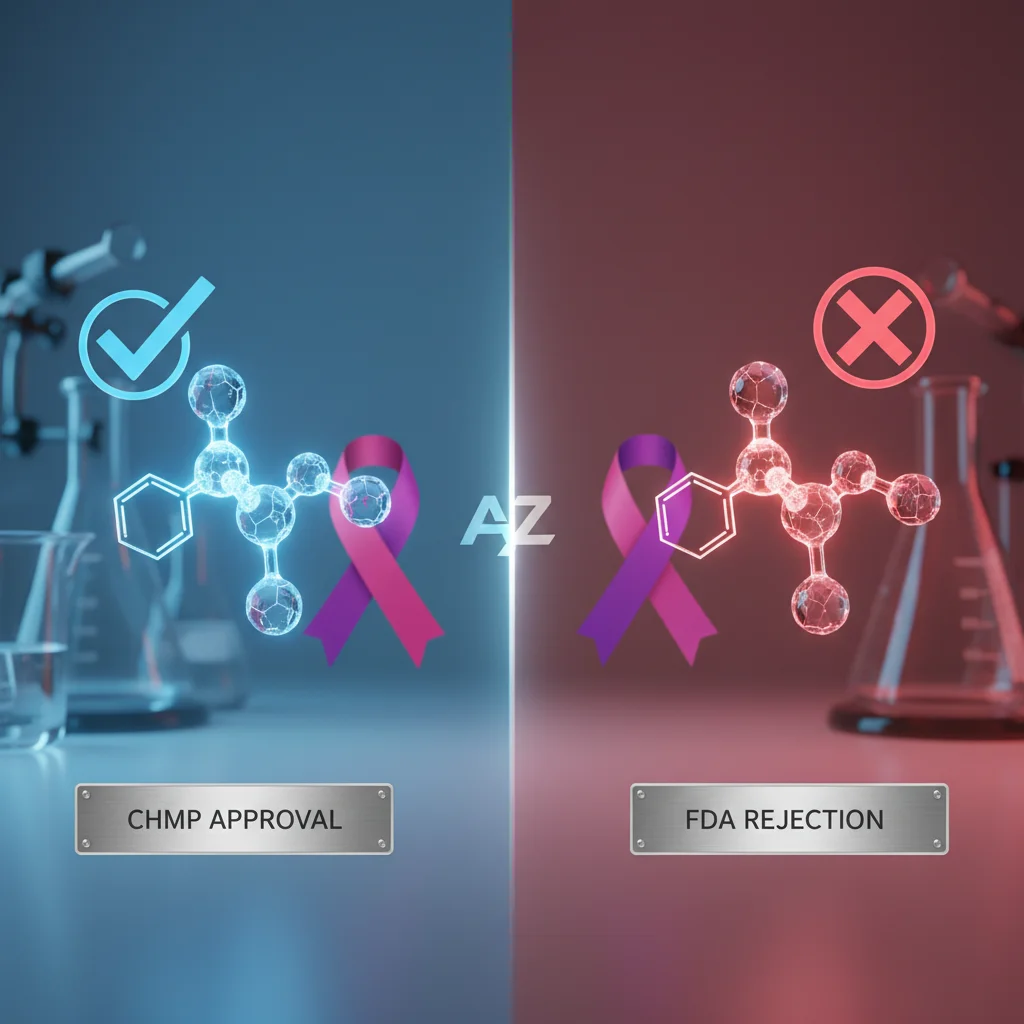
AstraZeneca's breast cancer drug, camizestrant, faced a significant regulatory divergence with CHMP approval in Europe contrasting with an FDA rejection. This split highlights evolving global regulatory landscapes and presents key considerations for pharmaceutical business development and investment strategies.
Contents7 sections
AstraZeneca's Camizestrant: Navigating Divergent Regulatory Paths for Breast Cancer Treatment
AstraZeneca's breast cancer drug, camizestrant, faced a significant regulatory divergence in September 2024, with CHMP approval in Europe contrasting with an FDA rejection. This split highlights evolving global regulatory landscapes and presents key considerations for pharmaceutical business development and investment strategies. The Camizestrant FDA approval path remains uncertain after an advisory committee vote against the drug, while European regulators have issued a positive opinion.
Key Takeaways
- The CHMP's positive recommendation for camizestrant contrasts sharply with the FDA advisory committee's negative vote, highlighting divergent regulatory assessments of the same clinical data.
- This decision grants AstraZeneca a significant market opportunity in Europe while posing challenges for U.S. market access, creating a 12-18 month window between regional launches.
- The situation underscores the critical need for adaptable global regulatory strategies and strong data interpretation for pharmaceutical companies developing oncology assets.
- Investor confidence and strategic planning for oncology pipelines are directly impacted by such regulatory outcomes, with AstraZeneca shares falling 1.9% on the day of the FDA panel vote.
The Regulatory Divide: CHMP Approval vs. FDA Rejection
On September 20, 2024, an FDA advisory committee voted six to three against recommending camizestrant for approval in advanced HR+, HER2- breast cancer. The panel cited concerns over the trial's study design, specifically that the SERENA-2 trial did not meet the agency's threshold for a registrational study. Just weeks later, on October 14, 2024, the European Medicines Agency's Committee for Medicinal Products for Human Use (CHMP) issued a positive opinion recommending approval of camizestrant for the same indication.
The divergence stems from fundamentally different interpretations of the same clinical dataset. The FDA advisory committee focused on the SERENA-2 Phase II trial, which tested camizestrant as a monotherapy in 240 patients with advanced ER+/HER2- breast cancer who had progressed on prior endocrine therapy. The trial met its primary endpoint, showing a statistically significant improvement in progression-free survival. However, the FDA panel questioned whether the modest benefit and the small sample size justified approval without a confirmatory Phase III trial.
By contrast, the CHMP weighed broader evidence, including data from the SERENA-4 and SERENA-6 Phase III trials. These studies showed that camizestrant, when combined with a CDK4/6 inhibitor, reduced the risk of cancer worsening by 56% compared to standard endocrine therapy. The European regulator accepted the totality of evidence, including safety data from over 1,000 patients, as sufficient to support approval. This regulatory split is not unprecedented. A 2024 analysis in the NIH's PubMed Central database noted that for the first time in modern oncology, both the FDA and EMA granted full approval to a breast cancer drug that failed to demonstrate a survival benefit, highlighting the growing divergence in regulatory standards.
What This Means for Pharmaceutical BD and Regulatory Teams
For business development teams, the camizestrant case underscores a hard truth: a single regulatory strategy no longer suffices. Companies must now conduct parallel market assessments for each major jurisdiction, factoring in differing evidentiary standards. The EMA's willingness to accept Phase II data supported by Phase III combination data, versus the FDA's insistence on a dedicated Phase III monotherapy trial, creates a clear strategic fork. BD teams evaluating pipeline assets must now model scenarios where European approval precedes U.S. approval by 12–18 months, impacting revenue forecasts and partnership valuations.
For regulatory affairs teams, the lesson is about proactive engagement. AstraZeneca had the opportunity to request a Type C meeting with the FDA to discuss alternative trial designs but did not do so until after the advisory committee rejection. The CHMP's positive opinion, by contrast, followed extensive pre-submission scientific advice meetings. Regulatory teams should now budget for parallel agency consultations and prepare contingency data packages that address each regulator's specific concerns. The precedent also suggests that companies with assets showing a strong safety profile and meaningful PFS benefit may find a more receptive audience in Europe, while the FDA continues to demand overall survival data or more rigorous Phase III designs for novel endocrine therapies.
Investors should watch for AstraZeneca's next move. The company has stated it will pursue a resubmission to the FDA with additional data from the ongoing SERENA-6 trial. A positive readout from that study could bridge the regulatory gap. In the meantime, the European approval provides a revenue stream and validates the drug's clinical profile. AstraZeneca shares fell 1.9% on the day of the FDA panel vote but have since stabilized, suggesting the market is pricing in a delayed U.S. entry rather than a complete rejection.
Frequently Asked Questions
What is the key difference between the CHMP and FDA decisions on AstraZeneca's breast cancer drug?
The European Medicines Agency's Committee for Medicinal Products for Human Use (CHMP) recommended approval for AstraZeneca's camizestrant, while an FDA advisory committee voted against its recommendation for approval in the U.S.
What are the potential implications of this regulatory divergence for pharmaceutical business development?
This split necessitates adaptive regulatory strategies, careful consideration of regional data requirements, and clear communication with investors regarding market access and pipeline risks.
What is the clinical significance of camizestrant as suggested by trial findings?
Trial results indicated that camizestrant, when combined with a CDK4/6 inhibitor, significantly reduced the worsening of advanced HR+, HER2- breast cancer by 56%.
Will AstraZeneca resubmit camizestrant to the FDA?
Yes, the company has indicated it plans to seek FDA approval again after completing the ongoing SERENA-6 Phase III trial, which may provide the confirmatory data the agency is seeking.
How does this affect other SERD drugs in development?
The regulatory split creates uncertainty for the entire oral SERD class. Companies with competing assets, including Roche's giredestrant and Sanofi's amcenestrant, will need to carefully design their pivotal trials to satisfy both regulators, potentially requiring larger sample sizes and dual primary endpoints.
Related profiles
Related coverage
Continue Exploring
Jump into the entities behind this story.
Track breast cancer news weekly
FDA breast cancer news and regulatory updates, every Monday.
This article follows our editorial standards. Report a correction via editorial contact.
Continue Your Research



Industry Reports & Whitepapers
- Radiation Therapy: Fractionation, Image-Guidance, and Special Services (Idaho Only) — This policy outlines medically necessary radiation therapy protocols for conditions like breast canc…