Purdue Pharma Shutdown: $7.4B Deal Ends OxyContin Maker's Era
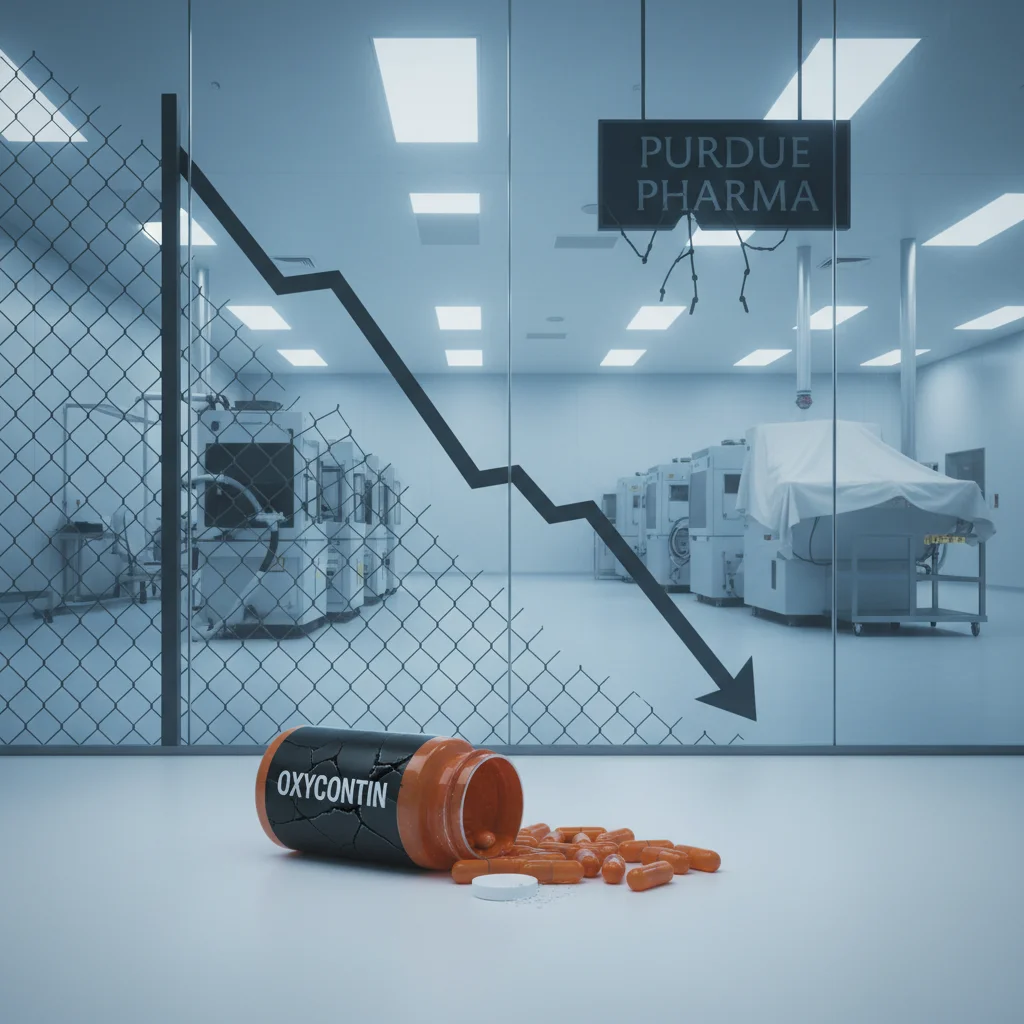
Purdue Pharma, the manufacturer of OxyContin, is ceasing operations as part of a $7.4 billion settlement to resolve claims related to the opioid crisis. This landmark deal signifies a major turning point in the legal and societal reckoning with the epidemic.

Key Takeaways
- Investment catalyst: The Purdue Pharma shutdown and $7.4 billion settlement closes the book on the most consequential pharmaceutical liability case in U.S. history, resetting litigation risk benchmarks for all manufacturers of Schedule II controlled substances.
- Competitive impact: oxycodone (OxyContin) exits the branded market under Purdue Pharma's stewardship; generic manufacturers and alternative analgesic developers face both market-share opportunity and heightened regulatory exposure.
- Market opportunity: The restructured successor entity is mandated to redirect resources toward opioid addiction treatment, creating addressable market expansion for addiction-medicine and abuse-deterrent formulation developers.
- Next catalysts: Bankruptcy court distribution approvals, Sackler family payment tranches, potential FDA rulemaking on opioid marketing, and legislative action on controlled-substance liability frameworks.
Purdue Pharma Shutdown: The End of an Era
The Purdue Pharma shutdown marks the definitive end of operations for the manufacturer of oxycodone (OxyContin), formalized through a $7.4 billion settlement agreement that resolves thousands of civil claims alleging the company's central role in precipitating the U.S. opioid crisis. For pharmaceutical BD teams, investors, and regulatory affairs professionals, this closure is not merely a legal denouement — it is a structural inflection point for controlled-substance risk, opioid litigation precedent, and the future architecture of pain-management markets.
Purdue Pharma, a privately held Connecticut-based company controlled by the Sackler family, filed for Chapter 11 bankruptcy protection in September 2019 beneath the weight of more than 2,600 lawsuits from states, municipalities, hospitals, and individuals. The $7.4 billion settlement — confirmed as part of a restructured bankruptcy resolution — ranks among the largest pharmaceutical liability payouts in American legal history, according to reporting by USA Today.
The opioid crisis Purdue helped catalyze has carried staggering public health and economic consequences. According to the Centers for Disease Control and Prevention (CDC), more than 500,000 people died from opioid overdoses between 1999 and 2019 — a period that maps directly onto OxyContin's peak commercial expansion. The Purdue Pharma bankruptcy and subsequent shutdown represent the most direct corporate accountability mechanism yet applied to that toll.
Drug at a Glance
- Generic name (INN)
- Oxycodone
- Brand name
- OxyContin
- Mechanism of action
- Opioid agonist; binds to mu-opioid receptors in the central nervous system, producing analgesia.
- Indication
- Moderate to severe pain requiring daily, long-term opioid treatment.
- Sponsor
- Purdue Pharma
- Approval status
- Approved
- Original approval date
- December 12, 1995
- Special designation
- None
What Led to the Purdue Pharma Bankruptcy and Shutdown?
Oxycodone (OxyContin) received FDA (U.S. Food and Drug Administration) approval on December 12, 1995. From launch, Purdue Pharma pursued an aggressive commercial strategy — deploying a large sales force to promote the drug's extended-release formulation directly to primary care physicians, a prescriber segment not historically targeted for Schedule II opioid promotion. Central to that effort were marketing claims emphasizing a lower abuse and addiction potential relative to immediate-release opioids, claims that regulators and courts subsequently found to be unsupported and misleading.
In 2007, Purdue Pharma and three of its executives pleaded guilty to federal charges of misbranding OxyContin, paying $634.5 million in fines — at the time one of the largest pharmaceutical criminal settlements on record, according to the U.S. Department of Justice. The guilty plea did not halt litigation. Over the following decade, states, counties, Native American tribes, hospitals, and individual plaintiffs filed thousands of additional lawsuits, alleging that Purdue's marketing practices directly contributed to a national opioid dependency crisis.
The CDC has documented that opioid overdose deaths — driven initially by prescription opioids — exceeded 14,000 annually at their prescription-opioid peak in the mid-2010s, before the crisis shifted toward illicit fentanyl. By 2019, the cumulative legal exposure had become untenable. Purdue Pharma filed for Chapter 11 bankruptcy protection that September, citing the need for a global resolution of opioid litigation claims that conventional litigation channels simply could not accommodate.
Why it matters for investors and BD teams: The Purdue Pharma bankruptcy established that aggressive, off-label-adjacent marketing of controlled substances can generate aggregate liability that exceeds a company's enterprise value — a risk-pricing framework now directly relevant to any company carrying a Schedule II or III portfolio.
What Are the Details of the $7.4 Billion Purdue Pharma Settlement?
The $7.4 billion settlement — confirmed through the federal bankruptcy court process — resolves thousands of civil claims brought by states, municipalities, hospitals, and individuals against Purdue Pharma and, critically, members of the Sackler family as controlling shareholders. The Sackler family's direct financial contribution forms a substantial component of the total figure. That alone marks a meaningful departure from earlier settlement structures, which had shielded family members from personal liability through a controversial bankruptcy injunction mechanism.
The settlement framework calls for the dissolution of Purdue Pharma as a commercial pharmaceutical entity and its restructuring into a public-benefit organization. Under this structure, the successor entity is directed to channel resources toward opioid addiction treatment and overdose reversal — a provision with direct market implications for companies operating in the medication-assisted treatment (MAT) space, including developers of buprenorphine- and naloxone-based products.
Distribution of settlement funds is administered through a court-supervised allocation plan, with proceeds directed to state and local governments, abatement programs, and individual claimants. The legal mechanism — using Chapter 11 reorganization to achieve a global settlement of mass tort claims — has been both praised for its efficiency and criticized for the degree of liability protection it extended to non-debtor third parties, a
About the Author
Related Articles

Sun Pharma Organon Partnership to Expand Access to Key Medicines

Cryoport Q1 2026 Results: Revenue Jumps 26% Supporting Record 766 Clinical Trials and 21 Commercial Cell Gene Therapies

Ascidian Therapeutics Completes ACDN-01 Dose Escalation in STELLAR Phase 1/2 Trial for Stargardt Disease